How to grow anthurium well? Essential home care tips
Anthurium is native to tropical rainforest regions such as Costa Rica and Colombia. It often grows as an epiphyte on trees, sometimes on rocks or directly on the ground. It likes warm, humid, semi-shaded environments and dislikes direct sunlight. So what should you pay attention to when growing anthurium at home?
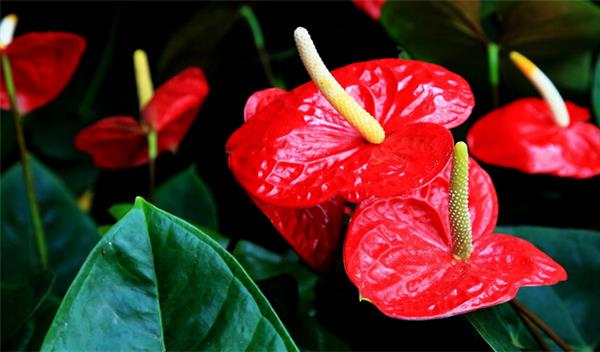
How to grow anthurium: growing medium:
Anthurium prefers moist, humid environments, so the growing medium must have strong water- and fertilizer-holding capacity and good permeability, with a pH between 5.5 and 6.5 being ideal. This is because information shows that if the pH is too high, it reduces the uptake of iron, manganese, zinc, etc., causing yellow leaves; while if the pH is too low, the supply of calcium and magnesium decreases, and the solubility of some trace elements increases, causing their concentrations to rise and triggering mold disease. We generally use perlite plus peat (at a ratio of 1:4).
How to grow anthurium: choosing a flower pot:
Anthurium has fleshy roots and is relatively sensitive to light, so generally choose a pot with low light transmittance and many drainage holes at the bottom. Therefore, peat pots and black plastic pots are better. However, it is best not to choose plastic pots in pale colors, and it is also best not to choose glass flower pots.
How to grow anthurium: temperature control:
The temperature most suitable for anthurium growth is 18°C to 30°C. If it enters the flower bud differentiation stage, lower the average temperature and reduce the day-night temperature difference. This can ensure normal flower bud differentiation and also effectively prevent leggy growth. In winter, the temperature should not be lower than 15°C. Humidity control mainly involves water management. Generally speaking, the moisture that affects anthurium growth and development is mainly substrate humidity and air humidity. Low substrate humidity will burn the leaves; too much water and long-term overly wet substrate will cause root rot and suffocation in anthurium. Therefore, reasonable regulation is very important. Note that in winter, reduce the frequency of watering, and apply fertilizer solution in the morning. Keep the leaves dry. Anthurium growth requires relatively high air humidity, and it grows faster under high humidity than under low humidity. When anthurium is growing most vigorously, the required relative air humidity is 50% to 80%.
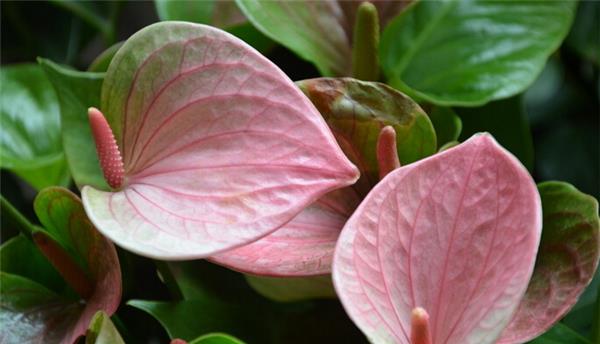
How to grow anthurium: light regulation:
Anthurium is a shade-loving plant, but it cannot do without light entirely, so when placing potted anthurium, be careful to place it where there is no direct light. If it enters the flowering stage, to prevent the spathe from changing color or being scorched, shade it; in the evening or on cloudy and rainy days, no shading is needed.
How to grow anthurium: fertilization management:
Normal anthurium growth requires many nutrient elements, as well as trace elements such as iron, copper, manganese, and zinc. However, anthurium leaves have a waxy surface and do not absorb nutrients, so fertilize at the roots and follow the principle of "light fertilizer, frequent application." When fertilizing, note that during the peak growth season, increase the amount of nitrogen fertilizer; in late autumn and early winter, increase the application of phosphorus and potassium fertilizer to help the plant resist cold; in winter, control fertilizer and water so it can overwinter safely. In addition, after applying liquid fertilizer, immediately spray water on the plant's leaves to rinse the leaves and prevent leaf burn.
How to grow anthurium: pest and disease management:
Diseases mainly include leaf spot, anthracnose, and root rot, while common pests of anthurium include red spider mites and aphids. This is mainly done by controlling temperature, regulating moisture, and using chemical prevention. Most importantly, observe promptly, prevent promptly, and promptly remove diseased and pest-infested branches and leaves.
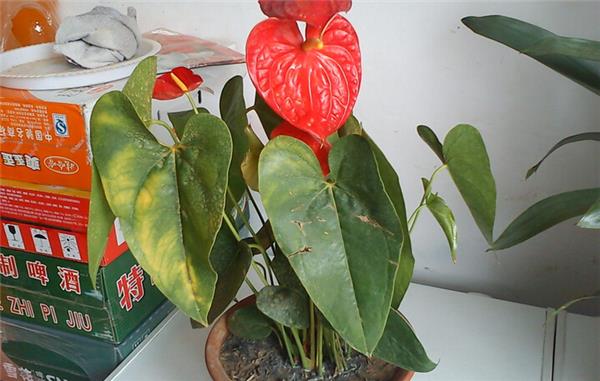
Anthurium is bright and eye-catching, and is often used to accent places such as home living rooms, making the room unusually magnificent and elegant. When growing anthurium, attention must be paid to avoid pests and diseases. Below, let us learn about the common diseases of anthurium and their solutions.
Anthurium diseases:
Anthurium diseases: 1. Red spider mite
Anthurium is prone to red spider mite infestation. Solution: spray with 50% malathion emulsifiable concentrate at 1500 times dilution.
Anthurium diseases: 2. Scale insects
Scale insects are characterized by often being active on the underside of leaves. When the infestation is severe, they easily induce a layer of black mold on the leaf surface, which feels sticky when touched and is not easy to wipe off lightly. Solution: dissolve a small amount of laundry detergent in water, gently wipe the leaf surface and underside with a soft cloth, then wipe again with clean water after wiping it off, to avoid laundry detergent residue on the leaves.
Anthurium diseases: 3. Thrips
Thrips are slender little yellow insects that crawl very quickly and often attack young peduncles, petioles, and spathes. After being damaged by them, the leaves that unfold are red, the petioles and peduncles are not smooth and are uneven, and the spathes that unfold are deformed flowers. Solution: apply 600-800 times diluted Confidor to the anthurium.
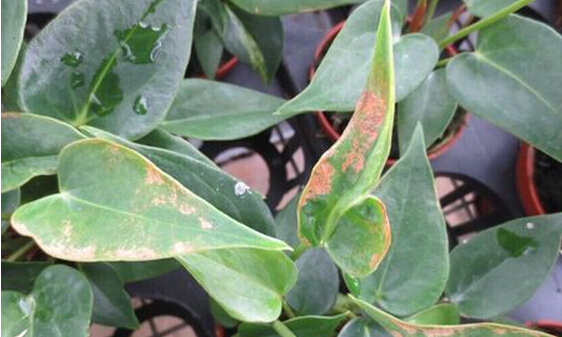
Anthurium diseases: 4. Anthracnose, leaf spot, and inflorescence rot
Anthurium commonly suffers from anthracnose, leaf spot, and inflorescence rot. Solution: spray with Bordeaux mixture or 65% zineb wettable powder at 500 times dilution. During care, it is best to apply 750 times diluted carbendazim or chlorothalonil solution once every 7-10 days.
There are about 200 or more species in the same genus as anthurium, of which about 20 or more have ornamental value. Common ones include: Anthurium andraeanum, Anthurium crystallinum, and Anthurium vittarifolium. So what are the common classifications of anthurium?
According to different ornamental purposes, they can be divided into 3 categories.
The first category is the cut flower type with upright spadix, represented by Anthurium scherzerianum;
The second category is the potted flower type with a curved spadix, represented by Anthurium andraeanum;
The third category is the foliage type with broad heart-shaped leaves, deep green and glossy, thick veins, silvery white, and beautiful patterns, represented by Anthurium crystallinum. The most widely cultivated type, with more lines and varieties, is the cut flower type.
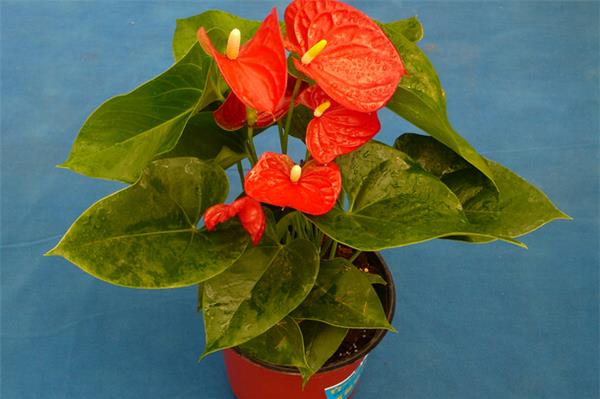
According to the color of the spathe and fleshy inflorescence, cut flower varieties include the following:
1. Gloria, Alexia: spathe bright red, spadix yellow;
2. Mauricia, Candia: spathe bright red, spadix tip green;
3. Rosetta, Nette: spathe crimson, spadix tip green;
4. Lydia: spathe crimson, spadix entirely pink;
5. Margaretha: spathe white, spadix flesh-red.
The above are some anthurium pictures and some anthurium growing methods shared with you. Hope they are useful to you!
Anthurium diseases: 4. Anthracnose, leaf spot, and inflorescence rot
Anthurium commonly suffers from anthracnose, leaf spot, and inflorescence rot. Solution: spray with Bordeaux mixture or 65% zineb wettable powder at 500 times dilution. During care, it is best to apply 750 times diluted carbendazim or chlorothalonil solution once every 7-10 days.
There are about 200 or more species in the same genus as anthurium, of which about 20 or more have ornamental value. Common ones include: Anthurium andraeanum, Anthurium crystallinum, and Anthurium vittarifolium. So what are the common classifications of anthurium?
According to different ornamental purposes, they can be divided into 3 categories.
The first category is the cut flower type with upright spadix, represented by Anthurium scherzerianum;
The second category is the potted flower type with a curved spadix, represented by Anthurium andraeanum;
The third category is the foliage type with broad heart-shaped leaves, deep green and glossy, thick veins, silvery white, and beautiful patterns, represented by Anthurium crystallinum. The most widely cultivated type, with more lines and varieties, is the cut flower type.
According to the color of the spathe and fleshy inflorescence, cut flower varieties include the following:
1. Gloria, Alexia: spathe bright red, spadix yellow;
2. Mauricia, Candia: spathe bright red, spadix tip green;
3. Rosetta, Nette: spathe crimson, spadix tip green;
4. Lydia: spathe crimson, spadix entirely pink;
5. Margaretha: spathe white, spadix flesh-red.
The above are some anthurium pictures and some anthurium growing methods shared with you. Hope they are useful to you!