New deep-veined truffle species discovered in Xitou; Taiwan Forestry Research Institute announces Taiwan's first white truffle
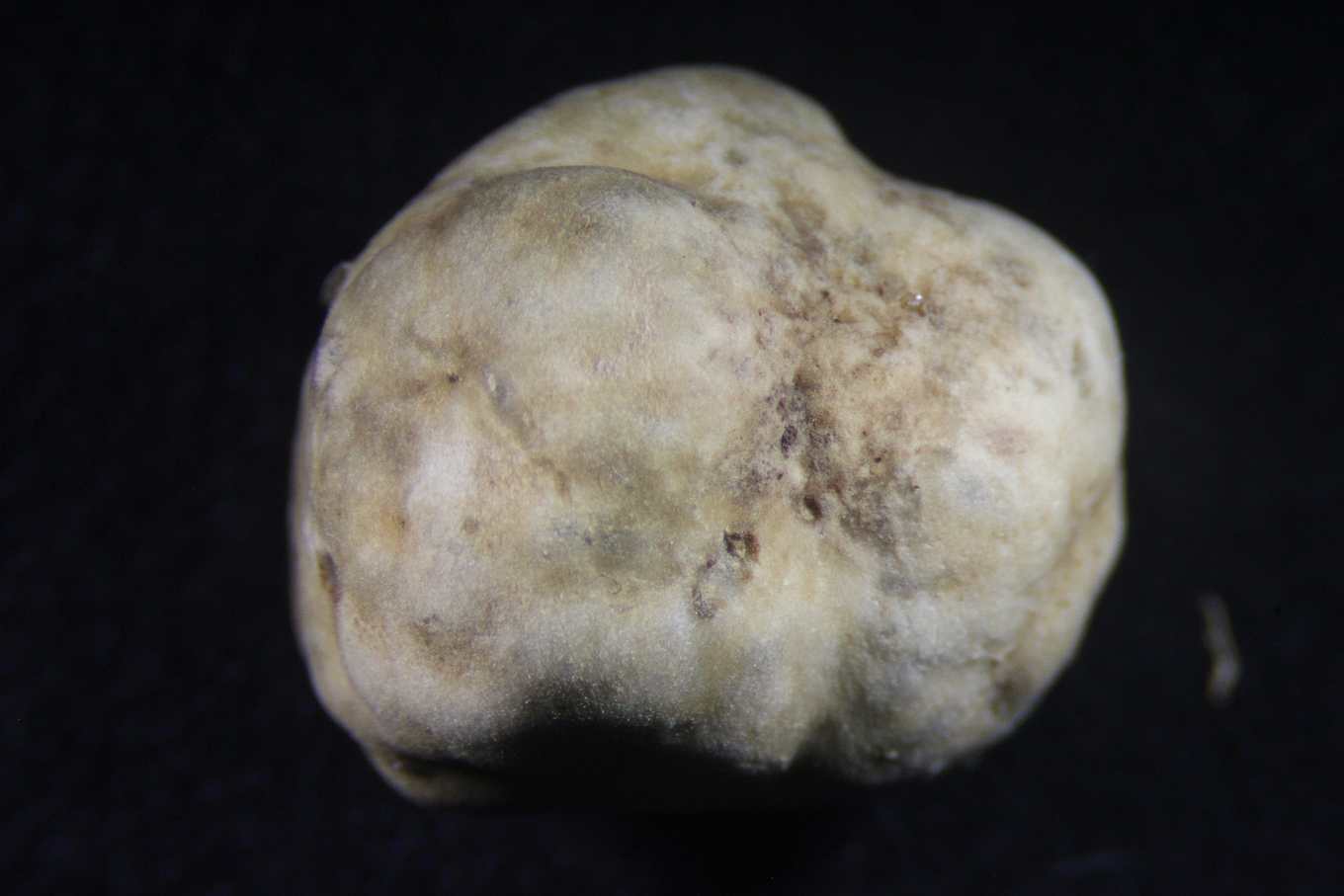
The truffle ingredient used in exotic haute cuisine can now be found natively in Taiwan, China! The Taiwan Forestry Research Institute (hereafter TFRI) under the Council of Agriculture held a press conference today (the 5th) to announce the discovery in Xitou, Nantou of a new truffle species to the world, the "deep-veined truffle," which is also the first white truffle officially announced in Taiwan, China. Its large diameter, white truffle nature and intense aroma are all characteristics of the "deep-veined truffle." TFRI Director Chang Pin stated that truffles have high added value and are an important part of forest-based economy; the international certification of the "deep-veined truffle" is a new milestone for forest-based economy, and he hopes domestic companies will seek technology transfer from TFRI to jointly develop the domestic truffle industry.
Exploring for truffles requires focus and endurance; the process is full of risks
Searching for truffles is like mountaineering and camping: not only is equipment needed, but focus, endurance and memory are all indispensable. Taking the search for the "spruce truffle" as an example, Fu Chun-hsu said the team members carried heavy equipment, walked through the mountains along the Batongguan Historic Trail, and once at hotspot areas they had to dig desperately into the soil with their bare hands; after six days and five nights, they still came up empty-handed.
When both physical and mental energy were exhausted, he suddenly recalled that in a previous field survey experience, he had dug up a "white thing" beneath a waterfall; at the time his supervising professor instructed that "that is a hypogeous gasteroid fungus, not the research target," so he cast this "white thing" aside. However, this memory from the field survey became the only important clue for discovering the "spruce truffle," and it also set in motion Fu Chun-hsu's mapping of "possible truffle locations." Through this same retrospective approach, the "deep-veined truffle" was discovered by the team in March of last year in Xitou, Nantou.
"Deep-veined truffle" is hosted on Taiwan yellow cypress, a world first
In addition to its large appearance, white truffle nature and intense aroma, the "deep-veined truffle" also has unique environmental conditions at its discovery site. Lin Chieh-lung stated that truffles in other countries are mostly hosted on trees such as Taiwan short-leaf pine, spruce and Fagaceae species, whereas the "deep-veined truffle" was found on Taiwan yellow cypress, a world first.
Another project researcher, Huang Chin-hui, added that generally speaking, truffles prefer to grow in alkaline soil, because other crops find it harder to grow there, so truffles have fewer "competitors." However, the "deep-veined truffle" can also grow in acidic soil, and since most soil in Taiwan, China is acidic, this also means the domestic truffle industry has development potential in terms of environmental conditions.
Fu Chun-hsu stated that because the "deep-veined truffle" is rare in number, they are currently cooperating with the Experimental Forest Management Office of National Taiwan University to carry out in-situ restoration at the discovery site in Xitou. In addition, inoculation experiments with other different tree species are also being conducted. According to data from the Ministry of Finance, Taiwan, China's average imports over the past five years have been about 210 tons, with the main importing regions being China, Poland and Italy.
Chang Pin stated that for the "deep-veined truffle," there are currently only a dozen or so specimens, and a market has not yet formed. In response, Fu further stated that truffles take eight years from growth to harvesting; the strain technology has now been completed, and he hopes technology transfer can be carried out as soon as possible next year (2020) to promote a domestic truffle industry.