What to Do When Spider Plant Leaves Turn Yellow? A Guide to Growing a Healthy Spider Plant
The spider plant (Chlorophytum comosum) is a shade-loving plant, and a humid environment is also the best environment for its growth. During cultivation, water it more in summer, and to prevent the leaves from withering, also water the leaves frequently. This can also wash away the dust on the leaves, which is good for growth and keeps the leaves clean and beautiful. However, why do spider plant leaves turn yellow? Below are some analytical ideas and solutions.
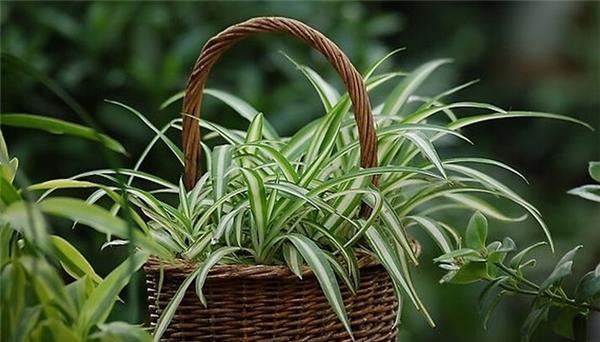
First possibility: over-fertilization, exceeding the plant's needs. After fertilizing, the leaves will appear glossy and uneven, and later, after part of the root system rots, the leaves turn yellow due to malnutrition. So at this point you should stop fertilizing and water more, or wash the root system once by repotting, and replacing the soil is also a good option. It is clear that the concentration of the soil solution matters a great deal.
Second possibility: the soil has not been turned over for a long time and has become compacted, after all the nutrient elements in the pot have been used up. The most important three elements, nitrogen, phosphorus and potassium, become deficient and the leaves gradually turn yellow. At this point you should replace the soil or promptly switch to fertile loam and water with alum fertilizer water.
Third possibility: the spider plant is a semi-shade flowering plant, but it still needs light, so you should ensure at least 4-5 hours of light every day. Otherwise chlorophyll decreases and the leaves also turn yellow. The best approach is to place it under an indoor incandescent lamp or keep it on a balcony.
Fourth possibility: the potting soil has poor air permeability and water permeability, causing the potting soil to stay waterlogged and not dry out for a long time, making root respiration difficult, so the leaves naturally turn yellow. At this point you should loosen the soil promptly and control the moisture. Fifth, watering with only a little water that does not penetrate for a long time. The roots of the spider plant lose water, and the lower old leaves turn yellow. You should water thoroughly and keep the potting soil warm and moist.
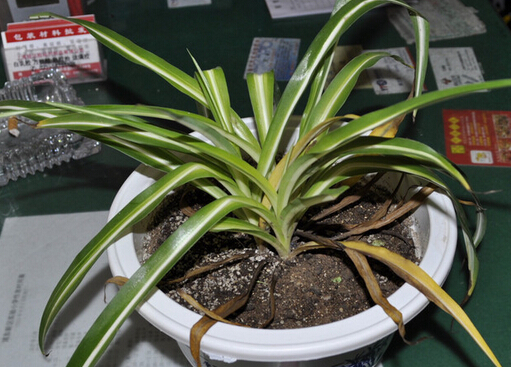
How to Prevent Spider Plant Leaves from Turning Yellow
Spider plants like moisture, but excessive watering or poor drainage will cause root rot, making the plant grow poorly and leading to scorched, dead foliage. Spider plants are fairly fond of fertilizer; when fertilizer and water are insufficient, the plant tends to develop yellow-green leaves and scorched tips. But fertilizing should not be excessive either; fertilize reasonably according to the growth situation. In winter, prevent frost damage, with room temperature no lower than 4°C. Although growing spider plants is not troublesome, if you do not pay attention to care, the leaf tips easily become dry, scorched and yellow. Spider plants like a semi-shade environment; if the placement spot has too much or too little light, the leaves easily turn pale green or yellow-green, lose their vitality, lose their ornamental value, and even dry up and die. In an environment with direct sunlight and dry air, leaf tip scorching is most likely. So it should be placed in a cooler, ventilated spot, and its leaf surfaces should be sprayed with water frequently to increase environmental humidity.
The spider plant is an evergreen ornamental plant. It is not only beautiful in appearance but also has a strong ability to purify the environment, making it one of the favorite flowering plants that many friends grow at home. However, during cultivation, spider plants sometimes develop yellow leaves. What should be done about this? How do you grow spider plants?
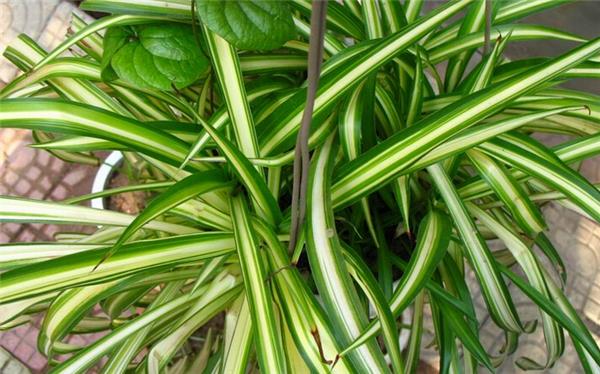
How to Grow Spider Plants
1. Temperature regulation. Spider plants like a warm, humid climate and are not cold-tolerant. They grow fastest at 20-24°C, stop growing above 30°C, and the leaves easily turn yellow with dry tips.
2. Light adjustment. When cultivated outdoors in summer, pay attention to shading so the light is not too strong, otherwise sunscald very easily occurs.
3. Water and fertilizer regulation. In the peak growth seasons of spring and autumn, watering should be sufficient, the potting soil should be kept moist regularly, and the branches and leaves should often be sprayed with clean water close to room temperature to prevent dry tips, but there should be no waterlogging.
4. Pruning and repotting. As the plant grows, to maintain a good plant shape, the old leaves at the base should be pruned frequently.
5. Pest control. Spider plants have dense clumps and poor ventilation, making them susceptible to scale insects, so prevention should be the priority.
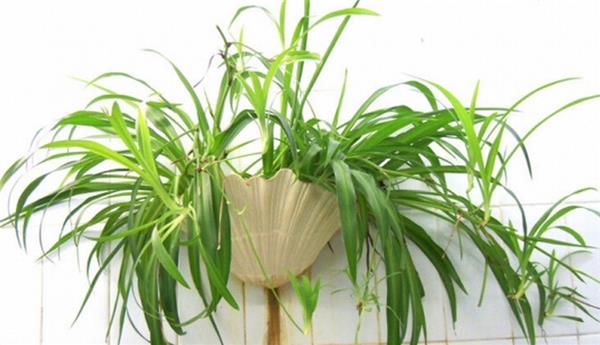
Spider plants are easy to grow and highly adaptable, and are one of the most traditional hanging plants for the home. Their leaves are slender and soft, and small plantlets emerge from the leaf axils, hanging down from the edge of the pot, spreading and trailing like flowers, evergreen all year round. So what uses do spider plants have?
Uses of the Spider Plant: Medicinal Value
Medicinal source: the whole herb or root of the spider plant, a plant of the Liliaceae family.
Medicinal properties: sweet taste; slightly bitter; cool in nature.
Effects: resolves phlegm and stops cough; disperses blood stasis and reduces swelling; clears heat and detoxifies.
Indications: phlegm-heat cough; traumatic injury; fractures; carbuncles and swellings; hemorrhoids; burns.
Usage and dosage: Internal use: decocted in water, 6-15g, or 15-30g of the fresh product. External use: an appropriate amount, pounded and applied; or decocted in water for washing.
Used for high fever in children, lung-heat cough, vomiting blood, traumatic swelling and pain, and other effects. The spider plant is a perennial herbaceous plant with slender, drooping branches and stems. It blooms small white flowers in summer with yellow stamens, and can be grown in pots for ornamental viewing.
Uses of the Spider Plant: Air Purification
The spider plant is the "king of formaldehyde removal" among plants. Combined with AQ air-purifying spray water, it can quickly break down formaldehyde in the air and reach the standard for quick move-in.
Spider plants can carry out photosynthesis under weak light and can absorb more than 80% of harmful gases indoors, with an extremely strong ability to absorb formaldehyde. Generally, keeping 1-2 spider plants in a room can absorb nearly all toxic gases in the air, and one spider plant in a room of 8-10 sq m is equivalent to an air purifier.
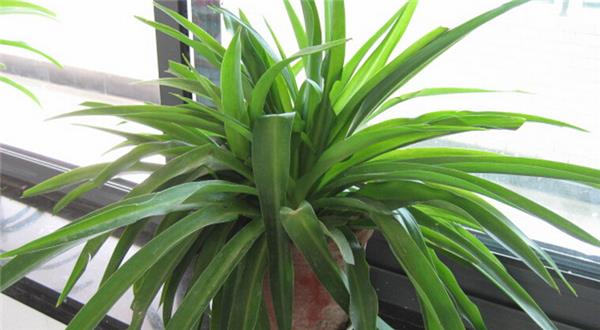
Because newly renovated houses continuously release harmful gases such as formaldehyde, environmental experts suggest keeping good ventilation after renovation, growing a few pots of green plants such as spider plants, and at the same time using some Maya Blue; after leaving the house vacant for three to six months, it can basically reach the move-in standard. It can absorb nearly all the carbon monoxide and nitrogen peroxide given off by stoves, electrical appliances and plastic products, and can also break down benzene and absorb relatively stable harmful substances such as nicotine in cigarette smoke, so the spider plant also has the laudatory name of "green purifier."
In short, when growing spider plants, we should grasp the four main care points: spider plants like cool shade, need frequent water spraying, need frequent fertilizing, and need frequent repotting. We believe that growing a beautiful spider plant is no problem at all. In this way, you can avoid yellowing spider plant leaves as much as possible, and I believe everyone will know what to do even if their beloved spider plant's leaves turn yellow!
Lung-heat cough, vomiting blood, traumatic swelling and pain, and other effects. The spider plant is a perennial herbaceous plant with slender, drooping branches and stems. It blooms small white flowers in summer with yellow stamens, and can be grown in pots for ornamental viewing.Uses of the Spider Plant: Air Purification
The spider plant is the "king of formaldehyde removal" among plants. Combined with AQ air-purifying spray water, it can quickly break down formaldehyde in the air and reach the standard for quick move-in.
Spider plants can carry out photosynthesis under weak light and can absorb more than 80% of harmful gases indoors, with an extremely strong ability to absorb formaldehyde. Generally, keeping 1-2 spider plants in a room can absorb nearly all toxic gases in the air, and one spider plant in a room of 8-10 sq m is equivalent to an air purifier.
Because newly renovated houses continuously release harmful gases such as formaldehyde, environmental experts suggest keeping good ventilation after renovation, growing a few pots of green plants such as spider plants, and at the same time using some Maya Blue; after leaving the house vacant for three to six months, it can basically reach the move-in standard. It can absorb nearly all the carbon monoxide and nitrogen peroxide given off by stoves, electrical appliances and plastic products, and can also break down benzene and absorb relatively stable harmful substances such as nicotine in cigarette smoke, so the spider plant also has the laudatory name of "green purifier."
In short, when growing spider plants, we should grasp the four main care points: spider plants like cool shade, need frequent water spraying, need frequent fertilizing, and need frequent repotting. We believe that growing a beautiful spider plant is no problem at all. In this way, you can avoid yellowing spider plant leaves as much as possible, and I believe everyone will know what to do even if their beloved spider plant's leaves turn yellow!