A Complete Summary of Detailed Steps on How to Solve Yellowing Leaves on Pothos
Pothos (Epipremnum aureum) is a foliage plant with emerald-green leaves and great decorative effect. It is very suitable for indoor placement, as it can soothe tense nerves and let the eyes relax from fatigue. There are three reasons why pothos leaves turn yellow. They are improper watering, improper fertilizing, and lighting problems. Below, the editor will introduce in detail the reasons for yellowing pothos leaves and the solutions.
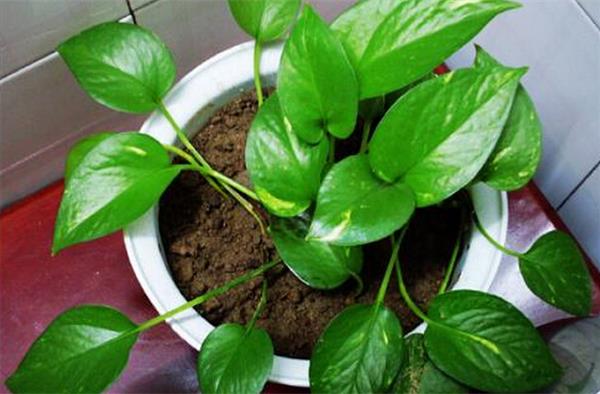
I. Why do pothos leaves turn yellow?
1. Improper watering as a cause of yellowing pothos leaves
Pothos should not be watered too much or too little, as both will cause its leaves to turn yellow. So how do you tell whether pothos is underwatered or overwatered? If the edges of the pothos leaves are withered and dry, while the newly grown young leaves are normal, then pothos may be underwatered; on the contrary, if the leaves are dull and lack luster, and the tips of the newly grown leaves are shriveled, it means it has been overwatered.
2. Sunlight as a cause of yellowing pothos leaves
Pothos likes shade and does not like too much light, so if you happen to place pothos in a spot with relatively sufficient light, such as a windowsill, and the pothos is exposed to the sun or strong light, then this is probably the reason your pothos leaves are turning yellow. However, you also cannot place pothos in a place with no light at all, and if it is not given sunlight for a long time, the chlorophyll in the pothos cannot be synthesized, which will also cause the pothos leaves to turn yellow.
3. Fertilizing as a cause of yellowing pothos leaves
Fertilizing is like watering: it also cannot be too much or too little. If too much fertilizer is applied and the concentration is too high, the leaf surface will become thick, shriveled, and lack luster, and the old leaves will turn yellow and then fall off; if too little fertilizer is applied, especially nitrogen fertilizer, then the color of the pothos leaf surface will become lighter, turning pale green or yellow, and the leaves at the base will turn yellow first.
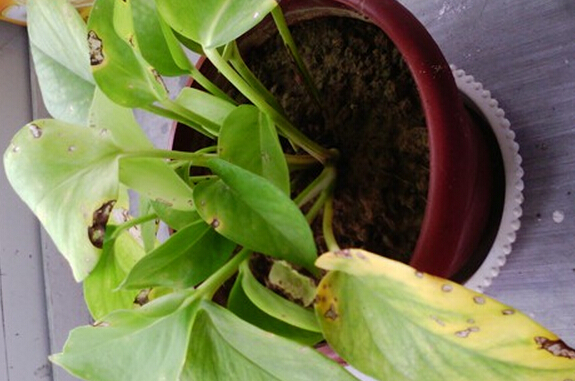
II. What to do when pothos leaves turn yellow
We discussed above the reasons why pothos leaves turn yellow. Now that we already know where the problem lies, it is very easy for us to solve it. We just need to treat the cause accordingly.
1. Pothos can be propagated by cuttings. When pothos leaves turn yellow, just remove the rotted roots, then pick off the yellow leaves, and finally plant the cuttings. If it is hydroponic pothos, it is even simpler: just change the water. Newly planted pothos cuttings should be placed in a place with weaker light to grow.
2. The most suitable temperature for pothos is 20°C-28°C during the day and 15°C-18°C at night; this is from a scientific standpoint. In fact, pothos can be placed fairly casually, as long as it is in a place where the light is not too abundant, and there is no need to deliberately control the temperature.
3. If the leaves are already very severely affected, be sure to control the amount of watering, and it is best to place the pothos in a well-ventilated place with a little light.
Pothos is a plant that is very easy to keep alive; as long as there is water, it will do, and it is called the "flower of life." It has strong twining ability and well-developed aerial roots. It can be allowed to climb on a cylinder tied with palm fiber and placed in an entrance hall or hotel, or it can be trained into a hanging form and placed in a study or on a windowsill. It is a flower that is relatively suitable for indoor placement. So, what are the growth habits of pothos?
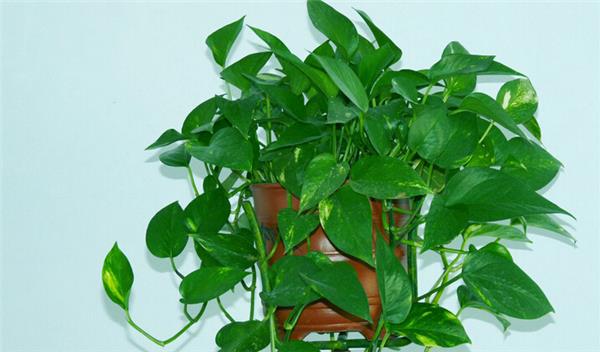
How much do you know about the growth habits of pothos?
Pothos likes warm, humid environments and requires loose, fertile, well-drained soil. For potted pothos, fertile, loose, well-drained leaf mold soil should be chosen, preferably slightly acidic. Pothos is extremely shade-tolerant and can be kept in a sunny indoor spot in all four seasons. In a dimly lit room, it should be moved every half month to a brighter environment for a period of recovery. Pothos likes hot and humid environments, and its overwintering temperature should not be lower than 15°C. The potting soil should be kept moist, and water should often be sprayed on the leaf surface to increase air humidity. Pothos is sensitive to temperature and should avoid direct sunlight in summer; when kept outdoors in summer, attention should be paid to shading. In winter, it can grow well under bright diffused light indoors, with sturdy stem nodes and brilliant leaf color. During the growth period, pothos has relatively high water requirements. In addition to normally replenishing water to the potting soil, water should also often be sprayed on the leaf surface.
Pothos is a typical foliage plant. Its leaves are emerald green, and it has a very good decorative effect when placed indoors. Pothos is also often placed in offices to soothe tense nerves and relax tired eyes. So, what are the specific functions of pothos?
Functions of pothos: 1. Decoration and ornamental value
It has strong twining ability and well-developed aerial roots. It can be allowed to climb on a cylinder tied with palm fiber and placed in an entrance hall or hotel, or it can be trained into a hanging form and placed in a study or on a windowsill. It is a flower that is relatively suitable for indoor placement. In this way, it not only makes full use of space and purifies the air, but also adds a lively, bright-colored green decoration to a rigid cabinet surface, full of vitality and adding a warm touch of charm to the room. Its flower language, "watching over happiness," also increases its ornamental appeal.
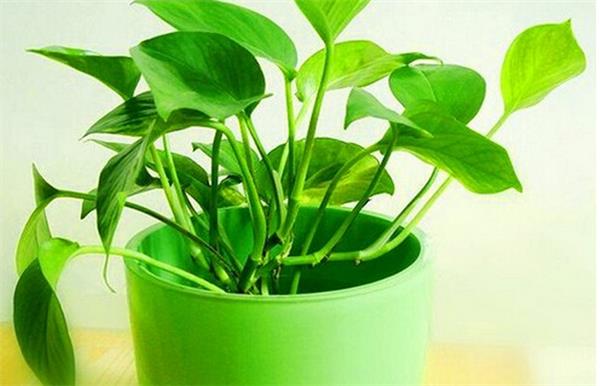
Functions of pothos: 2. Purifying the air
Pothos is a large evergreen vine plant. Like spider plants and ivy, it has a very strong ability to purify the air. Pothos can absorb benzene, trichloroethylene, formaldehyde, and so on from the air. For a newly decorated new home, placing pothos is simply the most suitable choice. According to research by environmental scientists, one potted pothos in a room of 8~10 square meters is equivalent to an air purifier. It can be seen that the air-purifying ability of pothos is quite strong.
Functions of pothos: 3. Absorbing odors
Pothos has the function of absorbing kitchen odors. Placing pothos in the kitchen can effectively absorb some of the cooking fumes produced by stir-frying and cooking, remove some other kitchen odors, and keep our kitchen air fresh.
Functions of pothos: 4. Medicinal value
Pothos can be used for traumatic injuries, promoting blood circulation, and dispersing blood stasis. Pothos flowers can lower blood sugar and blood lipids, and mainly have a good auxiliary therapeutic effect on diabetes, fatty liver, coronary heart disease, obesity, hyperlipidemia, and various vascular inflammations. In addition, it plays a good health-care role for the eyes and liver.
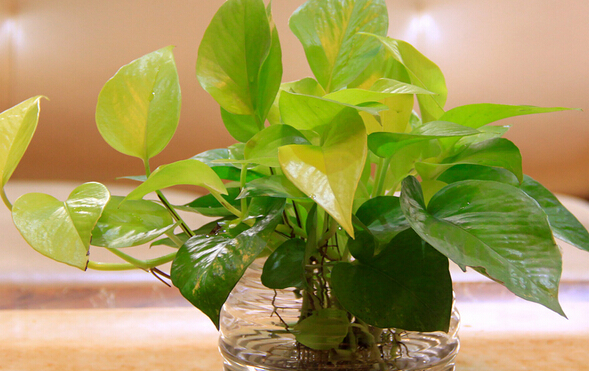
That is all for the sharing of questions related to yellowing pothos leaves. I hope growers who encounter yellowing pothos leaves will not panic. First find the cause of the yellowing pothos leaves, then treat the cause accordingly, and you will be able to grow emerald-green, beautiful pothos! At the same time, the cultivation of pothos should be combined with its growth habits, giving pothos careful and meticulous care. I hope the editor's introduction can help everyone.
Functions of pothos: 2. Purifying the air
Pothos is a large evergreen vine plant. Like spider plants and ivy, it has a very strong ability to purify the air. Pothos can absorb benzene, trichloroethylene, formaldehyde, and so on from the air. For a newly decorated new home, placing pothos is simply the most suitable choice. According to research by environmental scientists, one potted pothos in a room of 8~10 square meters is equivalent to an air purifier. It can be seen that the air-purifying ability of pothos is quite strong.
Functions of pothos: 3. Absorbing odors
Pothos has the function of absorbing kitchen odors. Placing pothos in the kitchen can effectively absorb some of the cooking fumes produced by stir-frying and cooking, remove some other kitchen odors, and keep our kitchen air fresh.
Functions of pothos: 4. Medicinal value
Pothos can be used for traumatic injuries, promoting blood circulation, and dispersing blood stasis. Pothos flowers can lower blood sugar and blood lipids, and mainly have a good auxiliary therapeutic effect on diabetes, fatty liver, coronary heart disease, obesity, hyperlipidemia, and various vascular inflammations. In addition, it plays a good health-care role for the eyes and liver.
That is all for the sharing of questions related to yellowing pothos leaves. I hope growers who encounter yellowing pothos leaves will not panic. First find the cause of the yellowing pothos leaves, then treat the cause accordingly, and you will be able to grow emerald-green, beautiful pothos! At the same time, the cultivation of pothos should be combined with its growth habits, giving pothos careful and meticulous care. I hope the editor's introduction can help everyone.