What are the care methods and precautions for geraniums?
Geraniums originally grew in South Africa and are an upright herbaceous flowering plant. Let's take a look at how to care for geraniums!
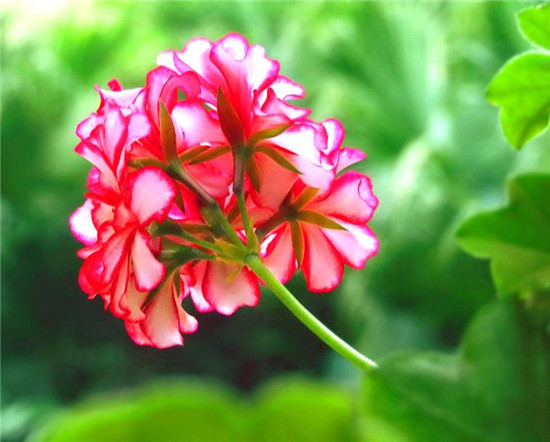
Geraniums have now been bred into many varieties. They generally grow to 30-60cm tall, with fleshy stems and woody bases, either unbranched or much branched, with visible nodes on the plant, and the whole plant covered in soft hairs. The round to kidney-shaped alternate leaves have distinct markings and serrated edges. The umbel-like inflorescence grows at the top of the stalk, and the corolla generally has 5 petals. There are quite a few flower colors, mainly red, with others including pink, purple, white, and mixed colors. Because the flower shape is like a ball, it is also called "foreign hydrangea."
The benefits and effects of geraniums
Ornamental value: The plant is upright with palm-shaped leaves, and the leaf surface has a distinctive horseshoe-shaped pattern. Multiple corollas form ball-shaped flowers, and the flower colors vary by variety. It is an excellent plant for decorating both indoors and outdoors. Whether in a room or in an outdoor courtyard flowerbed, it can bring vitality to the space.
Medicinal value: In medicine, it can boost immunity, resist pathogens, stop bleeding and relieve pain, accelerate cell metabolism and circulation, purify and repair the skin, and has a positive effect on treating skin problems such as burns and herpes. Through facial application or aromatherapy, it can stimulate the lymphatic system, speed up circulation, and help treat colitis and gastritis. It can also have a certain regulating effect on women's menstruation and breast development, reducing the problem of breast hyperplasia. Note that pregnant women must not use it.
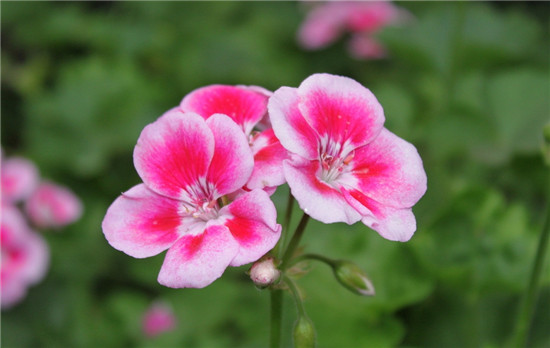
In addition, the essential oil extracted from it also affects the human nervous system. It can balance the mind, relieve unhealthy moods such as irritability, anxiety, depression, and low spirits, and ease stress. Placing it in the bedroom not only calms the mind and settles the spirit, but can also help drive away mosquitoes.
Beauty value: Its essential oil is added to skincare products, and then applied to the face to effectively improve the skin, control skin oiliness, unclog pores and revitalize the skin, reduce stretch marks and acne scars, and regulate hormones.
The growth of geraniums
Geraniums are naturally robust and rarely troubled by pests or diseases; they also have strong adaptability and can grow in various soil types, but grow best in sandy loam rich in humus; they like sunlight, prefer warmth, are somewhat drought-tolerant, fear waterlogging, and cannot tolerate the severe heat of midsummer or exposure to the scorching sun. When summer arrives, the plant stops growing, the leaves age, and it enters a semi-dormant state. At this time, it can be moved to a cool indoor spot, liquid fertilizer should be stopped, watering should be done on time, and on rainy days the pot should be laid on its side to prevent waterlogging and root rot.

By September, when the heat has passed and the weather is pleasant, you can repot and change the soil. First cut the branches short, leaving only about 10 cm at the base of each branch, so that new buds and new branches will grow again. Geraniums should be watered moderately; the potting soil must not be too wet, and it is best if half a day after watering the potting soil is semi-dry.
Geranium propagation is mainly by cuttings, mostly done in spring and autumn, but those with greenhouse facilities can also take cuttings in winter. Generally, spring cuttings can bloom between New Year's Day and the Spring Festival; autumn cuttings can bloom by the end of April. Use new or old branches for cuttings, but cuttings from tender shoot tips at the ends of branches grow best. Select cuttings about 10 cm long and keep two to three leaves at the upper end. If using old branches, they can also be without leaves. After letting the cut end dry slightly in the shade, insert it into clean sandy soil. The sandy soil should be kept slightly moist, and never with too much water. First place it in partial shade to keep the leaves from wilting, and after three to five days gradually expose it to sunlight. Generally, roots form in about two weeks, and when the roots are 3-4 cm long, it can be potted. Geraniums can also be grown hydroponically. Cut off an old branch, let it dry in the shade for 1 day, then insert it into clean water. In about 1 week new leaves will grow, and in about 20 days roots will form. The flower color of the ball flower can change with the pH value of the soil.
Soil requirements for geraniums
Geraniums are a drought-tolerant plant, and their soil requirement is that there should not be too much water, because too much water will cause the roots of geraniums to rot. Therefore, when growing geraniums, the soil should not have too much moisture. Geraniums like fertile, loose soil. When growing them, we should note that some sandy soil should be added to the soil bought from the store to ensure the soil is loose. Potted geraniums should be repotted once a year to help them bloom.
Living environment for geraniums
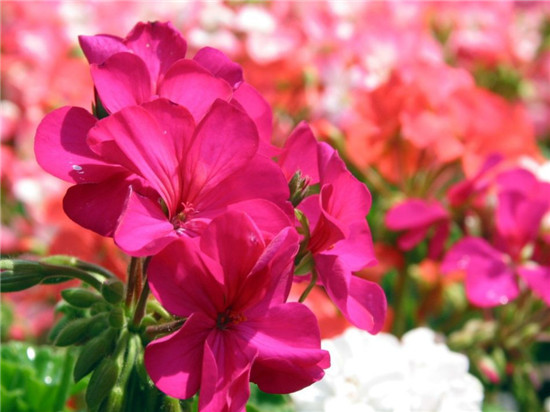
Geraniums have high requirements for light and temperature. Generally, the most suitable temperature for geranium growth is between 10-20°C, which means spring and autumn are very suitable for geranium growth. If summer is too hot or winter is too cold, geraniums will enter a dormant state. Therefore, be careful not to expose geraniums to the sun in summer and not to place them somewhere below 0°C in winter, otherwise it will harm them. In addition, prevent the impact of bad weather on geraniums. If heavy rain soaks the geraniums, it will make their roots unable to breathe and cause rot.
Pruning geraniums
The growing environment of geraniums requires fertile soil, which also makes courtyard-type geraniums grow very quickly. As ornamental plants, geraniums should be carefully maintained and pruned regularly, generally pruning them three times a year. The first time is mainly to thin out the branches, the second time is to cut off faded flowers and overly dense branches, and the third time is an overall trim, that is, shaping.
Pest and disease control for geraniums
For geraniums, the two common diseases are leaf spot and wilt. General control for these two usually involves placing the geraniums in a ventilated and well-lit place and preventing the branches from becoming too dense. After discovering diseased leaves, remove them promptly to avoid infecting other leaves. Also note that too much fertilizing can also cause geraniums to become diseased.
The above is all the content I have summarized for everyone on how to care for geraniums. I hope this article can help everyone. Please also continue to follow us.
If summer is too hot or winter is too cold, geraniums will enter a dormant state. Therefore, be careful not to expose geraniums to the sun in summer and not to place them somewhere below 0°C in winter, otherwise it will harm them. In addition, prevent the impact of bad weather on geraniums. If heavy rain soaks the geraniums, it will make their roots unable to breathe and cause rot.Pruning geraniums
The growing environment of geraniums requires fertile soil, which also makes courtyard-type geraniums grow very quickly. As ornamental plants, geraniums should be carefully maintained and pruned regularly, generally pruning them three times a year. The first time is mainly to thin out the branches, the second time is to cut off faded flowers and overly dense branches, and the third time is an overall trim, that is, shaping.
Pest and disease control for geraniums
For geraniums, the two common diseases are leaf spot and wilt. General control for these two usually involves placing the geraniums in a ventilated and well-lit place and preventing the branches from becoming too dense. After discovering diseased leaves, remove them promptly to avoid infecting other leaves. Also note that too much fertilizing can also cause geraniums to become diseased.
The above is all the content I have summarized for everyone on how to care for geraniums. I hope this article can help everyone. Please also continue to follow us.