Why does the sensitive plant (Mimosa pudica) shy away? A detailed explanation of the reasons behind leaf closing
Anyone who knows the sensitive plant knows that as soon as people lightly touch its leaves, the leaves close up. So what are the reasons the sensitive plant shies away and its leaves close? Let's take a look together!
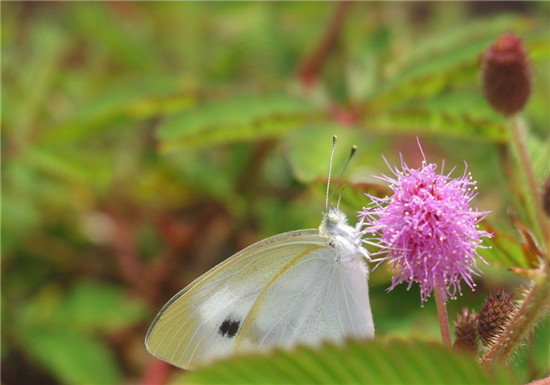
The sensitive plant is a perennial herb or subshrub in the Fabaceae family. Because its leaves respond to heat and light and close immediately when touched by an external force, it is named the sensitive plant. It is native to the tropical regions of South America, prefers warmth and humidity, and is not demanding about soil. The flowers are pink and shaped like pom-poms, delightful and charming. After flowering it produces pods, and the fruit is flat and round.
The leaves are feather-like compound leaves arranged alternately, in a palmate arrangement. The flowers, leaves and pods of the sensitive plant all have good ornamental value, and it is relatively easy to keep alive, making it suitable as a potted flower for balconies and indoors, and it can also be grown in courtyards and other places. Unlike ordinary plants, when the sensitive plant is touched by the outside world, its petioles droop and its leaflets close. This action is understood by people as "shyness", hence it is called the sensitive plant, the shy plant and the bashful plant.
It generally blooms after midsummer. The capitulum is oblong, with 2-3 borne in the leaf axils. The flowers are pale red, the calyx is bell-shaped with 8 tiny calyx teeth, the corolla has four lobes, there are four stamens, and the ovary is hairless. The pod is flat, 1.2-2 cm long and about 0.4 cm wide, with bristles on the edges, 3-4 pod segments, each pod segment containing 1 seed, and the segments fall off when mature. The flowering period is September.
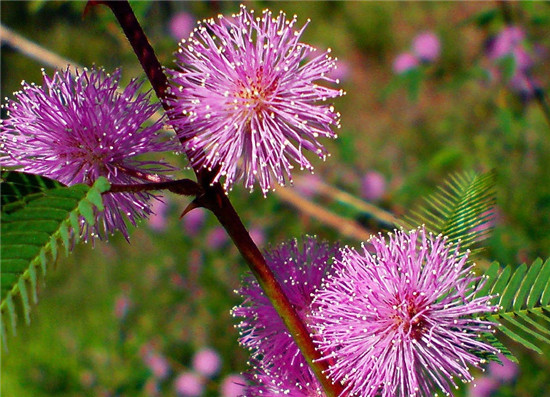
The sensitive plant has strong adaptability, prefers warmth and humidity, grows well in moist fertile soil, is not demanding about soil, is not cold-tolerant, likes light but can also tolerate semi-shade, and is now mostly grown as an ornamental plant in the home. It generally grows on mountain slopes in thickets and in moist places beside roads.
What are the reasons the sensitive plant shies away?
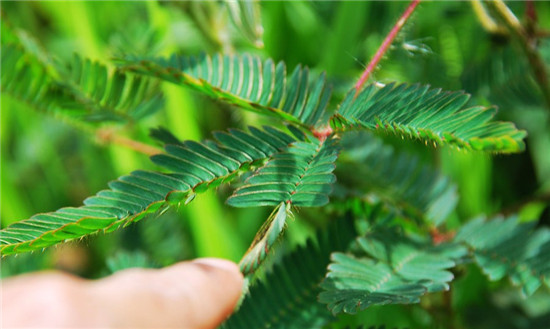
Plants are not the same as animals. Plants have no nervous system and no muscles and do not perceive external stimuli, but why the sensitive plant shies away is actually related to a nervous system. The sensitive plant is supported by tiny net-like actin. When it closes, the actin falls away, producing the closing movement. The actin contains muscle fibers, which is very rare in plants.
If the leaves of the sensitive plant are touched, they immediately fold up. The stronger the touch, the faster they fold, until finally the whole leaf droops as if it has no strength left. The leaves and petioles of the sensitive plant have a special structure, with a pulvinus in the middle that is most sensitive to stimuli. Once a stimulus is touched, the sensation is transmitted directly to the pulvinus at the base of the petiole, causing the leaf to close.
How to grow the sensitive plant
1. It needs frequent watering. The sensitive plant originally comes from the tropics and likes a humid environment, so the potting soil should often be kept moist. In summer, water according to the condition of the potting soil, about once a day. Do not let the soil dry out, and you can often spray water on the plant. In winter, to prevent cold damage, reduce the amount of watering.
2. Choose fertile, loose soil. The sensitive plant is not demanding about soil; ordinary garden soil will do. But if you want the sensitive plant to grow better, choose relatively loose and fertile soil. You can use a mix of leaf mold and sandy soil, or use only leaf mold; humus soil is also a good choice.
3. Ensure sufficient sunlight. The sensitive plant likes sunlight. It is best placed on a sunny balcony or by a window. Full exposure to sunlight is good for the growth of the sensitive plant. If there is too little sunlight, it may hinder its growth.
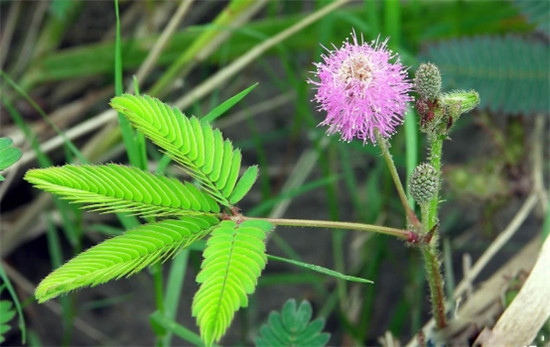
4. Prevent cold damage. The sensitive plant is suited to growing in a warm environment, preferably between 20°C and 28°C. If the temperature is too low, it stops growing. In winter, because the temperature is too low, water less to avoid cold damage to the roots and stems. Watering should be done when the temperature is higher during the day. If the temperature is below 10°C, it is best to provide certain protective measures.
5. Prevent pests and diseases. The sensitive plant generally has very few pests and diseases. The most common pest is the slug. If found, you can sprinkle some lime powder for control. If the plant is not growing well, check whether there is insufficient light or not enough water.
6. Fertilize according to your own situation. The sensitive plant only needs fertilizing once a month, but some people think that a potted sensitive plant that grows too large is not attractive; those who think this way should not fertilize it.
The above is all the content I have summarized for you on the reasons the sensitive plant shies away. I hope this article can help everyone. Please also continue to follow us.
I hope this article can help everyone. Please also continue to follow us.