What is the reason for the mimosa plant's contraction and closing
The mimosa plant, just hearing its name is very appealing. Can plants actually be shy? What kind of plant is it exactly? Why does the mimosa plant also contract? Follow me to learn about the mimosa plant!
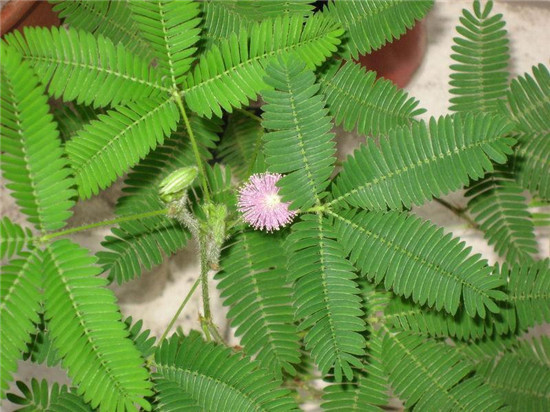
The biggest characteristic of the mimosa plant is that when it is stimulated (such as by touch), the leaf surface of the mimosa plant contracts and folds together. If the stimulus is stronger, this stimulus will quickly be transmitted in sequence to the adjacent leaflets, and even to the leaflets of the entire compound leaf, causing the petiole to droop. If the stimulus intensity is greater, it can even cause the leaflets of the entire plant to fold together and the compound leaves to droop. But after a period of time, it can return to its original state. The mimosa plant also responds very quickly to vibration; it begins to react 0.1s after being stimulated, and completes the response within a few seconds.
At night, the mimosa plant also folds its leaflets together and droops its petiole. During the day, when some leaflets are stimulated by vibration, they also fold together in pairs. It is more sensitive when the light is weaker. Normally, the water in the pulvinus supports the leaf blade; but when it is stimulated by external force, the water in the pulvinus immediately flows elsewhere, causing the mimosa plant's leaf blades to close. In addition, at night it automatically contracts (that is, sleep movement). This unique trait is also exactly the source of the mimosa plant's name and nickname.
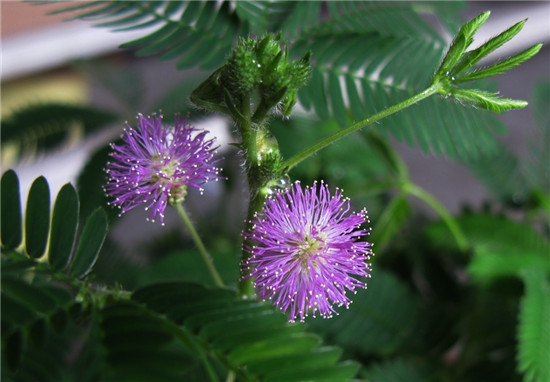
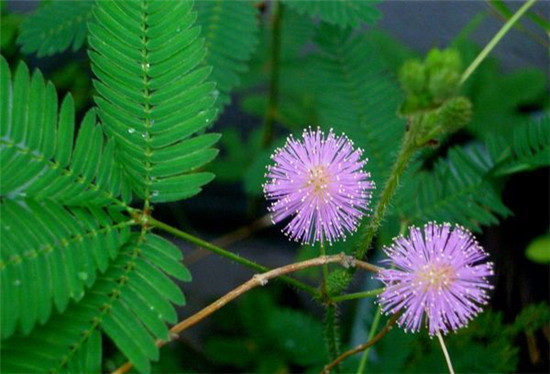
Because the mimosa plant has strong vitality and grows rather messily, many places classify it as a type of grass, but in fact it also blooms. The flowering period of the mimosa plant is from July to October each year, but its flowering period is very short; less than two days after blooming, the flowers fade. The flowers are pink, and the capitulum is spherical, shaped like a pom-pom. After flowering, it also produces pods, and the fruit is flat and round.
The flower language of the mimosa plant is sensitivity, shyness, and politeness. Gently touching this plant's leaves will make them immediately close and droop, and even a gust of wind will cause this to happen, just like a shy young girl. Therefore, its flower language is - shyness. People born under the blessing of this flower have very shy and timid personalities, and are also very afraid of strangers. They are especially keen in perception and also have strong self-esteem.
Why the mimosa plant is shy
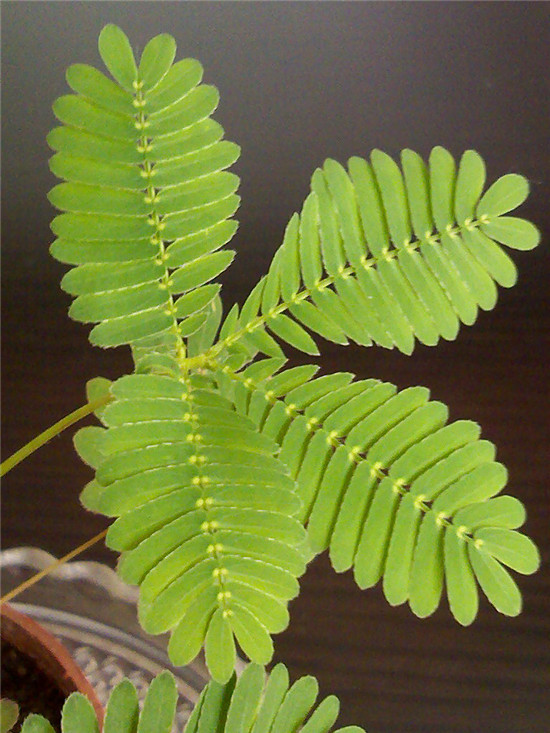
Why does the mimosa plant contract? It turns out that at the base of the mimosa plant's petiole there is a swollen organ called the "pulvinus." In the pulvinus there are many parenchyma cells, and these cells are highly sensitive to external stimuli. Once any part of the mimosa plant is touched, the stimulus is transmitted to the pulvinus. After the pulvinus receives the signal, the cell sap in the parenchyma cells begins to flow toward the intercellular spaces, reducing the cells' ability to expand. The pressure between the cells in the lower part of the pulvinus decreases, thereby causing the leaf blades to close and the petiole to droop. After 1-2 minutes, the cell sap gradually flows back into the pulvinus, and so the leaf blades return to their original appearance.
The contraction phenomenon of the mimosa plant is actually a physiological phenomenon of the mimosa plant, and it is also driven by the broader environment of "natural selection, survival of the fittest" in nature. Because the mimosa plant originated in tropical regions, where there are many violent storms, when a storm moves the leaflets, it immediately closes its leaf blades to protect them from being damaged by the storm, and thus gradually formed this physiological phenomenon. This is the reason why the mimosa plant is shy; its technical term is the reason for the mimosa plant's contraction.
According to data investigations, some people have studied the reason for the mimosa plant's contraction. Within 0.08 seconds after being stimulated, the mimosa plant's leaves will close. After stimulation, the transmission speed is also very fast, with the highest speed reaching 10 cm per second. After stimulation, after a short period of time, everything slowly returns to normal, the leaflets unfold again, and the petiole also stands upright again. The recovery time is generally 5-10 minutes. However, if we continue to tease it and stimulate its leaves continuously, it develops a feeling of "boredom" and no longer produces any reaction. This is because continuous stimulation causes the cell sap in the pulvinus cells to be lost and unable to be replenished in time.
The above is all the content I have summarized for everyone on why the mimosa plant contracts and closes. I hope this article can help everyone. Please also continue to follow us.