Why does the sensitive plant shy away? Uncovering the reason green plants shy away
The sensitive plant is a lovely plant whose leaves fold up as soon as they are touched, and it is deeply loved by the public. Today I will answer for everyone why the sensitive plant shies away, so let us go and take a look together!
How to grow the sensitive plant
1. Soil: The sensitive plant is highly adaptable and not demanding about soil; it grows well in moist, fertile soil. Sow it in a growing medium made by sieving and mixing 2 parts leaf mold, 3 parts garden soil, and 5 parts fine yellow sand.
2. Watering: The sensitive plant likes moisture; during the summer growing season, water once a day.
3. Sunlight: The sensitive plant likes ample light and tolerates partial shade slightly.
4. Temperature: As a potted ornamental flowering plant, the sensitive plant should be moved indoors to a sunny spot in winter; keeping the room temperature at 10-12°C is enough for it to overwinter safely.
5. Fertilizing: The sensitive plant does not need much fertilizer during the growing season; applying diluted liquid fertilizer 2-3 times is enough. Do not let it grow leggy, because the sensitive plant is mainly a fun foliage plant, and a small size is best.
Main uses of the sensitive plant
1. Ornamental. The sensitive plant has a loose, spreading form, and its feathery leaves are slender and elegant; its leaves close as soon as they are touched. The sensitive plant has many flowers and they are delicate and lovely, giving people an impression of dainty grace. It can be planted in the ground at a courtyard corner, or grown in a pot on a windowsill or desk.
2. Medicinal. The sensitive plant is also a medicine. Its nature is slightly cold, its taste sweet and astringent, and it is slightly toxic. It has effects such as calming the nerves, sedation, detoxification, dissipating blood stasis, relieving pain, clearing heat, promoting urination, stopping bleeding, and astringing, and is often used for neurasthenia, traumatic injuries, hemoptysis, and herpes zoster. Harvest in summer and autumn, remove weeds thoroughly, and dry in the sun or use fresh.
3. Predicting earthquakes. According to Turkish seismologist Erjiang, a few hours before a strong earthquake occurs, the leaves of the sensitive plant, which is sensitive to external touch, suddenly shrivel and then wither. In earthquake-prone Japan, scientists have found through research that under normal conditions, the leaves of the sensitive plant open during the day and close at night. If the leaves of the sensitive plant show the abnormal phenomenon of closing during the day and opening at night, it is a precursor of an earthquake. For example: at 7 a.m. on January 11, 1938, the sensitive plant began to open, but by 10 a.m. the leaves suddenly all closed, and indeed a strong earthquake occurred on the 13th. In 1976, members of the Japan Earthquake Club observed the abnormal closing phenomenon of sensitive plant leaves many times, and earthquakes occurred afterward each time.
Why does the sensitive plant shy away
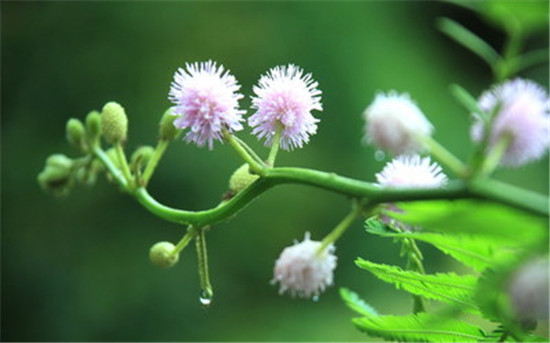
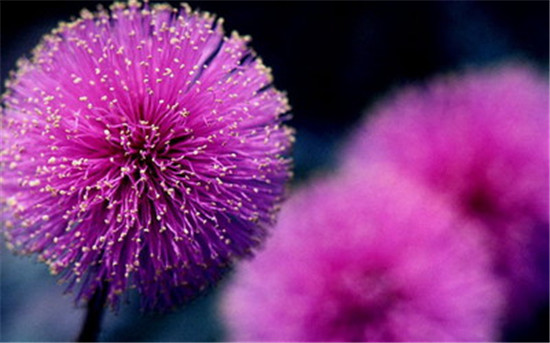
The sensitive plant is a perennial herbaceous plant, a low-growing plant native to the tropical regions of South America. Because its leaves close when subjected to external force, like a shy little girl, it is vividly called the sensitive plant. In fact, it is a plant commonly found in moist, warm places. Its flowers are mostly white or pink, and their shape is very much like a pom-pom, with the fine hairs spread out like a ball of yarn. The sensitive plant is very easy to keep alive, and its flowers, leaves, and fruit all have high ornamental value. So why does the sensitive plant shy away?
The sensitive plant grows on grassland that generally receives relatively much sunlight. As soon as it is touched by an external force, its pinnae close up, then the other leaves gradually close, and afterward they droop. Many people find this very surprising. In fact, this is a relatively common plant movement phenomenon in the plant kingdom.
This is because there is a very large vacuole inside its leaves, and at the position between the leaf and the petiole there is a structure whose scientific name is the pulvinus. When these parts are stimulated, some sensory cells inside with relatively low electrical potential immediately release water, and then the petiole droops, and because the leaves lose water they lose the turgor between internal cells, causing the leaf blades to close. In fact, it also closes at night, and this is all caused by the internal cell turgor pressure. In fact, its principle is the same as that of the Venus flytrap.
The shyness principle of the sensitive plant is closely related to its original environment. Because in tropical regions there is abundant water and rainy weather is frequent, the sensitive plant closes its pinnae in time to prevent wind and rain from damaging the leaves; in fact, this is also a manifestation of evolution in nature.
The above is all the content I have summarized for everyone on why the green plant sensitive plant shies away and the reason the sensitive plant shies away. I hope this article can help everyone. Please also continue to follow us.