An introduction to the characteristics of the peace lily potted plant, giving you a complete understanding
The peace lily, also known as the white sail plant, bract-leaf taro, and peace taro, is one of the best air-purifying plants. Let us now take a look at the characteristics of the peace lily!
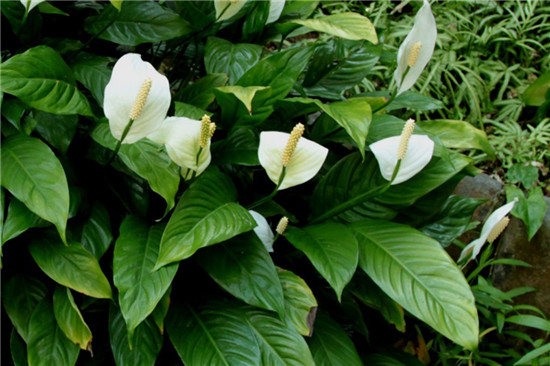
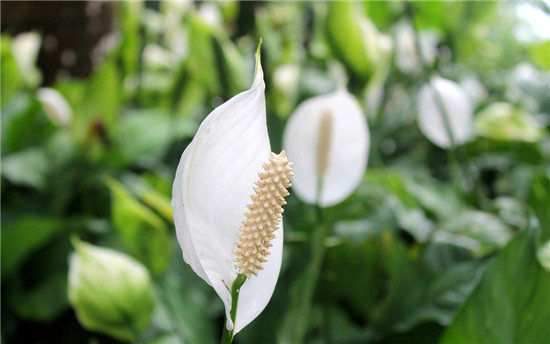
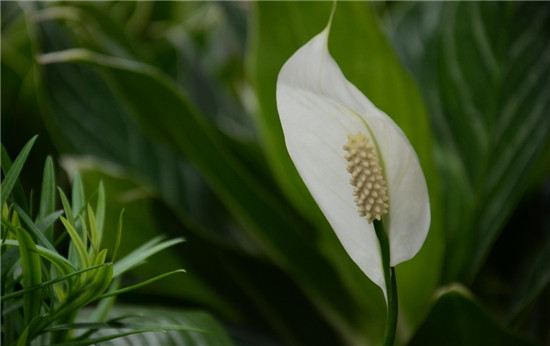
Because its leaves resemble those of the arrowroot and its flowers resemble a crane holding its head up, slender and graceful, pure white and spotless, the peace lily gives people a sense of "purity, calm, peace and well-being" and is regarded as the "flower of innocence." The peace lily is a perennial evergreen herbaceous foliage plant. The plant height is generally 40-60 cm, with a short rhizome, mostly growing in clumps. The leaves are oblong or nearly lanceolate, tapering at both ends, with a wedge-shaped base. The flower is a spathe, slightly fragrant, leaf-shaped; that is, its flower has no petals, but is composed of a white bract and a yellow-white spadix, closely resembling a palm, hence the name peace lily; its flower is large and conspicuous, and the flower stalk is long and rises above the leaves, white or green. The flowering period is from May to August.
Ornamental value
Because people traditionally feel that the peace lily carries an auspicious meaning, it has been given the elegant name "smooth sailing" based on the appearance of its flowers. As the peace lily has both beautiful flowers and leaves, is light and graceful in form, grows vigorously, and is also shade-tolerant, it is deeply favored by people and is often used for indoor greening and decorative display. It is an excellent foliage plant; in southern regions it can be planted in the ground, while in other regions it is mostly grown in pots for ornamental purposes. The peace lily is an "expert" at suppressing waste gases exhaled by the human body, such as ammonia and acetone. At the same time, it can also filter benzene, trichloroethylene, and formaldehyde from the air. Its high transpiration rate can prevent the nasal mucosa from drying out, greatly reducing the likelihood of illness. This beautiful indoor plant, native to the tropical rainforests of Venezuela, is undoubtedly a marvel of medicinal biology.
Types
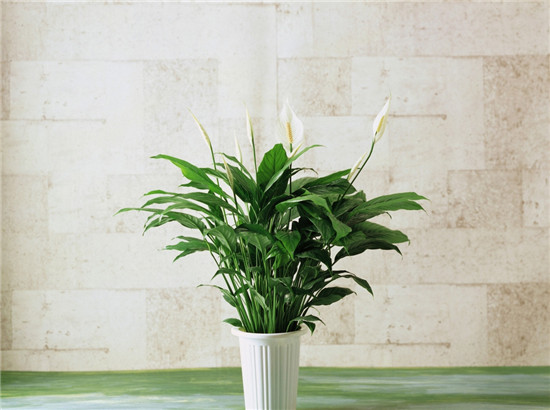
The peace lily is a perennial herb. It has a short rhizome. The leaves are long elliptic-lanceolate, tapering at both ends, with obvious veins, long petioles, and sheath-like bases. The scape is upright, rising above the leaf cluster; the spathe is upright and slightly curled, white; the spadix is cylindrical, white. The common varieties include the following.
The impact of the peace lily on the home environment and people
Because people traditionally feel that the peace lily carries an auspicious meaning, it has been given the elegant name "smooth sailing" based on the appearance of its flowers. As the peace lily has both beautiful flowers and leaves, is light and graceful in form, grows vigorously, and is also shade-tolerant, it is deeply favored by people and is often used for indoor greening and decorative display.
It is an excellent foliage plant; in southern regions it can be planted in the ground, while in other regions it is mostly grown in pots for ornamental purposes. The peace lily is an "expert" at suppressing waste gases exhaled by the human body, such as ammonia and acetone. At the same time, it can also filter benzene, trichloroethylene, and formaldehyde from the air. Its high transpiration rate can prevent the nasal mucosa from drying out, greatly reducing the likelihood of illness. This beautiful indoor plant, native to the tropical rainforests of Venezuela, is undoubtedly a marvel of medicinal biology.
Key points for caring for the peace lily
Substrate selection: The peace lily needs loose potting soil with good drainage and air permeability. Before obtaining high-quality seedlings, a cultivation substrate must be prepared. The substrate can be ordinary Northeast peat or imported German peat, but both must have 15%-20% perlite added and be stirred evenly. Choose large-particle perlite, and at the same time be careful not to crush the perlite as much as possible. The prepared substrate should have an EC value of about 0.7 mS/cm and a pH value maintained at about 5.5.
Temperature control: The peace lily is a high-temperature-loving species and should be cultivated in a high-temperature greenhouse. The most suitable daytime and nighttime temperatures for the peace lily are 20°C-21°C, and the maximum should not exceed 24°C. If the daytime temperature is relatively high, as compensation, the nighttime temperature can be appropriately lowered. For example, if the daytime temperature is 27°C for 6 hours, then at night the temperature should be kept at 9°C for 6 hours. Other situations can be handled by analogy. Pay special attention that if the peace lily is kept in a low-temperature state for a long time, it is prone to leaf drop or a scorched-yellow appearance.
Water management: The peace lily likes a moist environment. The substrate must always be kept moist, and you cannot wait until the substrate is completely dry before watering. The "water when dry, stop when wet" method of water management is not suitable for the peace lily, and it also increases the chance of root infection, which is not conducive to growth. The best watering method is overhead spraying, but the seedbed must have good drainage. The EC value of the sprayed water should not exceed 0.8 mS/cm at most, otherwise it is unfavorable for crop growth.
The above is the complete content of the characteristics of the peace lily potted plant and the introduction to the peace lily potted plant that I have summarized for everyone. I hope this article can help everyone. Please also continue to follow us.