What are the and effects of magnolia flowers?
Mimosa pudica is a perennial herbaceous plant in the genus Mimosa of the Fabaceae family, native to the tropical regions of the Americas. Next, let's take a look at some information about Mimosa pudica.
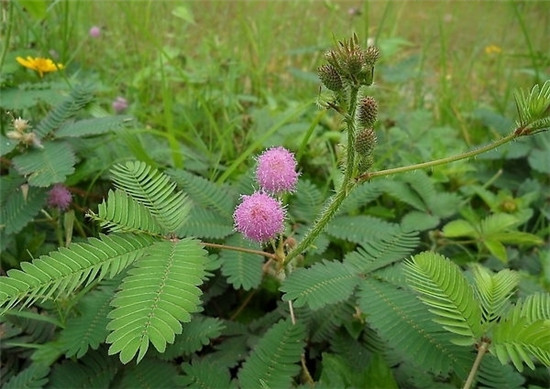
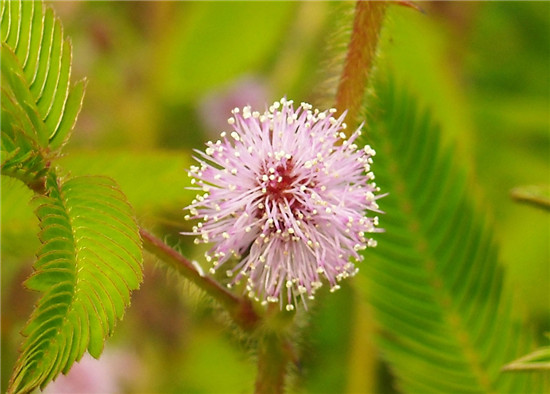
Mimosa pudica is a perennial herbaceous plant. Potted plants grow 20-40cm tall, with the whole plant covered in bristles and sharp thorns. The leaves are bipinnately compound, with 2-4 pinnae arranged palmately, and 14-48 leaflets that are oblong, 0.6-1.1 cm long and 1.5-2 mm wide, with bristles along the margins and veins. The flower heads are axillary, with pale pink flowers. The leaflets are extremely sensitive to external stimuli, closing and drooping when touched, then recovering shortly after. In winter in the north, it can overwinter indoors at temperatures above 10°C. It is an interesting ornamental plant.
Mimosa pudica is highly adaptable and prefers warm, humid conditions. It grows well in moist, fertile soil and is not demanding about soil. It is not cold-tolerant and prefers light but can also tolerate partial shade. It is now mostly grown as an ornamental houseplant. It generally grows on hillsides in thickets and in moist places beside roads.

Mimosa pudica is native to Central and South America and has now spread to many parts of the world. It is regarded as an invasive species in Tanzania, South Asia, Southeast Asia, the United States and many Pacific islands. In parts of Australia (such as the Northern Territory and Western Australia) it is regarded as a regulated species. In Queensland, Australia, it is regarded as a proposed regulated species. In Nigeria, Seychelles, Mauritius and East Asia and other places it is distributed but is not regarded as an invasive species.
Why does Mimosa pudica feel shy?
Reason 1 why Mimosa pudica "feels shy"
The cells of Mimosa pudica are supported by a fine, net-like protein called "actin". When Mimosa pudica performs its closing movement, the phosphate on the actin falls off. As long as Mimosa pudica absorbs a compound that prevents the phosphate from falling off, it will not change even when touched.
When the actin bundles disperse, the cells are destroyed, and as a result water escapes, causing the closing movement. Actin is generally found in the muscle fibers of animals and is related to muscle contraction and relaxation. It is unexpected that it also exists in Mimosa pudica, which can be said to be quite rare.
Reason 2 why Mimosa pudica "feels shy"
The leaves and petioles of Mimosa pudica have a special structure. At the base of the petiole and at the base of the leaflets of the compound leaf, there is a relatively swollen part called the pulvinus. The pulvinus is most sensitive to stimuli. Once the leaf is touched, the stimulus is immediately transmitted to the pulvinus at the base of the petiole, causing the two small leaflets to close. With a stronger touch, it is transmitted not only to the pulvinus of the leaflets but also quickly to the pulvinus at the base of the petiole of Mimosa pudica, and the entire petiole droops.
Although Mimosa pudica is a bit "shy", growing it is very simple. There are no special requirements for the techniques for planting it, and in terms of daily management there is also no need to pay particularly special attention.
It is also not strict about the climate and sunlight of nature, but it must have loose, fertile soil and a humid environment. As long as it is planted in the season suitable for its growth, weeded regularly, and fertilized not too many times, and the occurrence of pests and diseases is prevented, it will be fine.
The above is the entire content of the complete guide to Mimosa pudica that I have summarized for everyone. I hope this article can help everyone. Please also continue to follow us.