A comprehensive guide to the Mimosa pudica: get to know it inside and out
Mimosa pudica, native to the tropical regions of the Americas, is a perennial herbaceous plant in the genus Mimosa of the Fabaceae family. Because of its unique physiological habits, it has many alternative names, such as "shy grass, bashful grass, laughing grass, husband-and-wife grass" and so on.
The most obvious of Mimosa pudica's characteristics is that when it receives an external stimulus (such as being touched), its leaf surface immediately contracts and folds together. If the stimulus is stronger, it is quickly transmitted to the neighbouring leaflets and even to the leaflets of the entire compound leaf, causing the petiole to droop. Mimosa pudica also responds quickly to stimuli, usually beginning to react after 0.1s and completing the response within a few seconds.
The second characteristic of Mimosa pudica is that at night it also folds its leaflets together and its petiole droops, and during the day, when some leaflets receive a shock, they also fold together in pairs.
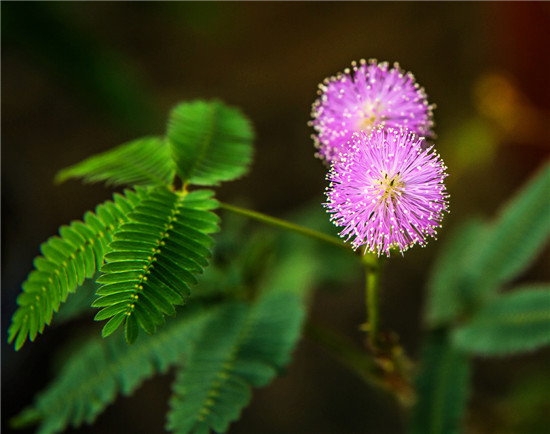
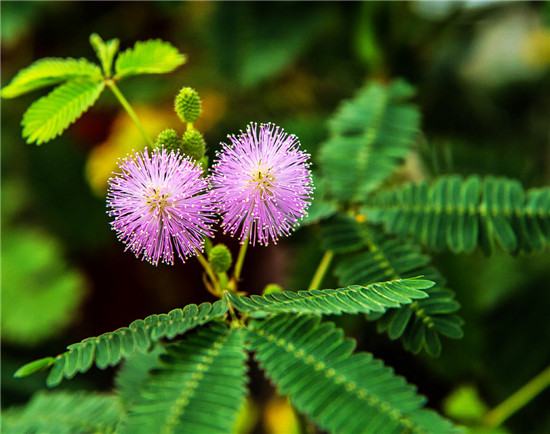
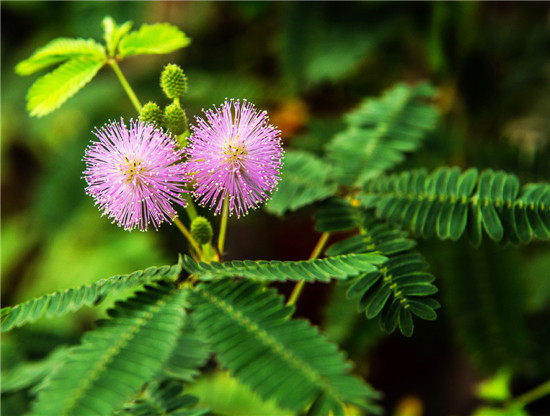
The third characteristic of Mimosa pudica is that, because it has strong vitality and grows in a rather messy way, many places classify it as a grass, but in fact it also blooms. Its flowers are pink, and the head-like inflorescence is spherical, shaped like a pom-pom. After flowering it also produces pods, and the fruit is flat and round.
How to grow Mimosa pudica
Best propagation time: sowing Mimosa pudica can be done at any time of year; it is generally sown from late March to early April, but sowing in pots indoors in February of early spring is best.
Best growing soil: Mimosa pudica thrives in well-drained sandy loam rich in organic matter.
Humidity requirements for growth: the suitable humidity for Mimosa pudica is around 70%.
Best growing temperature: Mimosa pudica is suited to growing in a warm environment, with 20°C to 28°C being suitable; if the temperature is too low it stops growing. In winter, because the temperature is too low, water less to avoid frost damage to the rhizome, and watering should be done when the temperature is higher during the day. If the temperature is below 10°C, it is best to provide some protective measures.
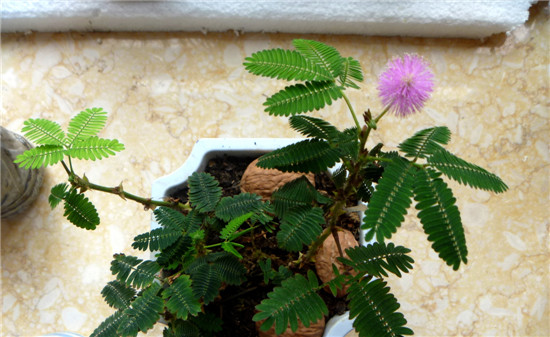
Best growing light: Mimosa pudica likes sunlight, so it is best placed on a sunny balcony or by a window; full exposure to sunlight is good for its growth, while too little sunlight may hinder its growth.
Why Mimosa pudica is shy
1. This special ability of Mimosa pudica has a certain historical origin. It is native to Brazil in tropical South America, where there are often strong winds and heavy rain. Whenever the first drop of rain hits a leaf, it immediately closes its leaves and droops its petiole, to avoid the damage that storms would do to it.
This is an adaptation to changes in external environmental conditions. In addition, the movement of Mimosa pudica can also be seen as a form of self-defence: as soon as an animal touches it, it folds its leaves, and the animal then does not dare to eat it.
2. The drooping of the compound leaf of Mimosa pudica is caused by changes in the turgor of the cells in the pulvinus at the base of the compound leaf's petiole. The structure of the cells in the upper and lower halves of the tissue in the pulvinus differs: the cells in the upper part have thicker cell walls while those in the lower part are thinner, and the intercellular spaces in the lower tissue are larger than those in the upper part.
Under the influence of an external stimulus, the permeability of the cells in the lower part of the pulvinus increases, and water and solutes seep out of the vacuoles and are discharged into the intercellular spaces; as a result, the turgor of the cells in the lower tissue decreases and the tissue becomes flaccid, while the upper tissue still maintains its turgid state at this time, and the compound leaf's petiole then droops.
The mechanism of leaflet movement is the same as this, except that the structure of the cells in the upper and lower halves of the tissue in the leaflet pulvinus is exactly the opposite of that in the pulvinus at the base of the compound leaf's petiole, so when the turgor changes and part of the tissue becomes flaccid, the leaflets fold together in pairs.
The above is the information about Mimosa pudica that I have summarized for you, the full contents of this comprehensive guide to Mimosa pudica. I hope this article can help you. Please also keep following us.