How do you grow cosmos? Sharing a few little planting tips
Cosmos is a small flower with fairly strong vitality; it tolerates drought and sun, is very easy to grow, and has a high germination rate and fast growth. So, what is the planting method for cosmos?

How to grow cosmos: steps/methods
1. First, choose soil; suitably choose soil from a place where flowers and plants grow lushly, which generally will not be too barren, and crumble it up.
2. First evenly sprinkle part of the soil into the flowerpot to about two-thirds full.
3. Evenly sprinkle the flower seeds onto the soil.
4. Then evenly sprinkle soil over the flowerpot, covering the seeds to about two cm.
5. Water an appropriate amount and place in a cool, ventilated spot; once sprouted, move to the balcony and water once every two to three days.
Points to note when planting cosmos:
It likes warmth, moisture and sun, slightly tolerates early frost, and is not strict about soil. It is not strict about fertilizer and water; during the growing period, apply decomposed urine diluted 5 times with water once every 10 days.
Before germination, it should not be exposed to strong sun or kept in high temperatures; when growing cosmos, do not water too frequently; after germination, it cannot continue to stay in a cool, ventilated spot and must get sun.
Tall and medium varieties need stakes before flowering to prevent wind damage and lodging. They grow quickly and can be pinched back several times to increase branching.
In hot weather, red spider mite damage easily occurs, and it should be prevented and controlled early. After the seeds mature, you can cut off flower heads with large, brightly colored blooms, dry them in the sun and keep them for seed.
Cosmos is a perennial herbaceous plant with persistent roots; sowing is simple. Recently, a flower friend asked how to sow cosmos seeds, so here is another summary of the process of sowing cosmos seeds.
1. Sowing time for cosmos
If you need it to bloom in summer, sow from February to March in early spring, and it is best to sow under conditions where both temperature and humidity can be controlled. If you plan to sow in the open air, sow in mid-April when the temperature is suitable; when the temperature is suitable, seedlings emerge in about a week.
The sowing medium should be loose, organic-rich soil, and a certain amount of decomposed organic fertilizer should be applied before sowing. When sowing, mix the seeds evenly with a certain amount of sand and evenly broadcast them onto the seedbed, then cover with about one cm of soil. After sowing, maintain soil moisture; germination can occur when the temperature is controlled at about 18°C.
2. Management of cosmos at the seedling stage
When the seedlings grow 4 to 5 true leaves, they can be transplanted into nutrient pots and pinched back. During the seedling growth period, no additional topdressing is needed, so as to avoid excessive growth of branches and leaves that affects flowering.
3. Management of cosmos during the growing period
Cosmos plants are relatively tall, with slender, weak stems and large, beautiful flowers; when encountering wind or other severe weather, they lodge, affecting ornamental value. Therefore, cosmos needs to be pinched back several times throughout its growth process, and watering should be reduced. Doing so not only promotes branching, but also dwarf the plant and avoids lodging during growth.

4. Pest and disease control
The main disease and pest of cosmos is powdery mildew; red spider mites easily appear in hot, dry conditions (whether you like it or not, cosmos has a high probability of getting red spider mites; even if you plant only two, red spider mites may still appear), and they should be detected and controlled early. Powdery mildew affects leaves, tender stems, flower buds and buds; the affected parts often grow a gray-white powdery mold layer, causing the growth and development of the affected plant to be blocked and the leaves to twist and deform. In severe cases, the leaves dry up and the whole plant dies.
The control method is: when planting, the density should not be too high, and good ventilation and light transmission should be maintained; after the disease occurs, diseased leaves and diseased plants should be cut off and destroyed in time, strictly preventing reinfection; in the early stage of the disease, spray 15% triadimefon wettable powder at 1500 times dilution, or 10% lewubing wettable powder at 1200 to 1500 times dilution, alternating the two chemicals and spraying 2 to 3 times in succession. In the early stage of red spider mite occurrence, spray 40% dicofol emulsifiable concentrate at 1000 to 1500 times dilution.
5. Cultivation of cosmos
Transplant when the seedlings have 4-5 true leaves, and pinch back; direct sowing followed by thinning can also be used. If base fertilizer is applied to the planting site, no further fertilization is needed during the growing period; if the soil is too fertile, branches and leaves tend to grow excessively and flowering decreases. Those that bloom during the high-temperature period from July to August are not easy to set seed. After the seeds mature, they fall off easily, so seeds should be collected in the early morning. Cosmos is a short-day plant; spring-sown seedlings often have lush leaves but few flowers, while summer-sown seedlings are short, neat and bloom continuously.
Before cosmos germinates, it should not be exposed to strong sun or kept in high temperatures; when growing cosmos, do not water too frequently; after germination, it cannot continue to stay in a cool, ventilated spot and must get sun. So, what is the basic information about cosmos?

[Morphological characteristics]
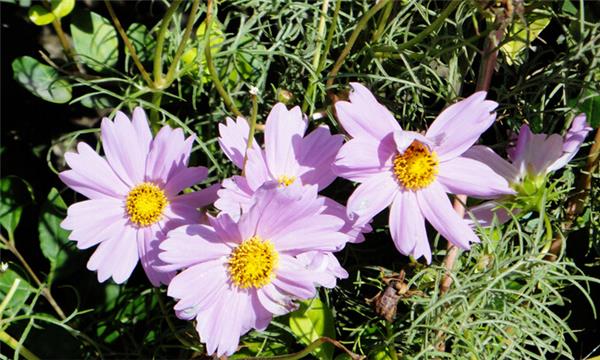
It is an annual herbaceous plant, with a plant height of 30-120 cm, slender upright stems, many branches, and smooth stems or slightly hairy ones. Simple leaves are opposite, about 10 cm long, bipinnately parted, with narrow linear lobes and entire margins without teeth. The capitulum grows on a slender pedicel, terminal or axillary, with a flower stem of 5-8 cm. There are 2 layers of involucral bracts, with the inner layer membranous at the margin. There is 1 whorl of ligulate flowers, with toothed petal tips and 8 petals, in white, pink and deep red. The tubular flowers occupy the central part of the flower disk and are all yellow. The achenes have ribs, the seed lifespan is 3-4 years, and the thousand-grain weight is 69. The flowering period is summer and autumn. Horticultural varieties include white cosmos, large-flowered cosmos and purple-red cosmos; horticultural cultivars are divided into two major systems, early-flowering and late-flowering, and are also divided into single and double forms.
[Growth habits] It likes light, tolerates poor soil, dislikes fertilizer; excessively fertile soil, dislikes heat, dislikes waterlogging, is not suited to high summer temperatures, and is not cold-tolerant. It needs loose, fertile and well-drained loam.

Summary: The above is an introduction to the planting methods of cosmos. Through the content above, everyone should have some understanding of how to grow cosmos. I hope the above content is helpful to everyone.
[Morphological characteristics]
It is an annual herbaceous plant, with a plant height of 30-120 cm, slender upright stems, many branches, and smooth stems or slightly hairy ones. Simple leaves are opposite, about 10 cm long, bipinnately parted, with narrow linear lobes and entire margins without teeth. The capitulum grows on a slender pedicel, terminal or axillary, with a flower stem of 5-8 cm. There are 2 layers of involucral bracts, with the inner layer membranous at the margin. There is 1 whorl of ligulate flowers, with toothed petal tips and 8 petals, in white, pink and deep red. The tubular flowers occupy the central part of the flower disk and are all yellow. The achenes have ribs, the seed lifespan is 3-4 years, and the thousand-grain weight is 69. The flowering period is summer and autumn. Horticultural varieties include white cosmos, large-flowered cosmos and purple-red cosmos; horticultural cultivars are divided into two major systems, early-flowering and late-flowering, and are also divided into single and double forms.
[Growth habits] It likes light, tolerates poor soil, dislikes fertilizer; excessively fertile soil, dislikes heat, dislikes waterlogging, is not suited to high summer temperatures, and is not cold-tolerant. It needs loose, fertile and well-drained loam.
Summary: The above is an introduction to the planting methods of cosmos. Through the content above, everyone should have some understanding of how to grow cosmos. I hope the above content is helpful to everyone.