What to Do When Pothos Leaves Turn Yellow? A Few Simple Tips to Solve It Easily
Pothos is a classic foliage plant with emerald-green leaves that looks wonderful as an indoor decoration. Pothos is also often placed in offices to soothe tense nerves and rest tired eyes. Yellowing pothos leaves indicate that something has gone wrong with the care method, and it needs to be corrected promptly. We will handle this in three situations.
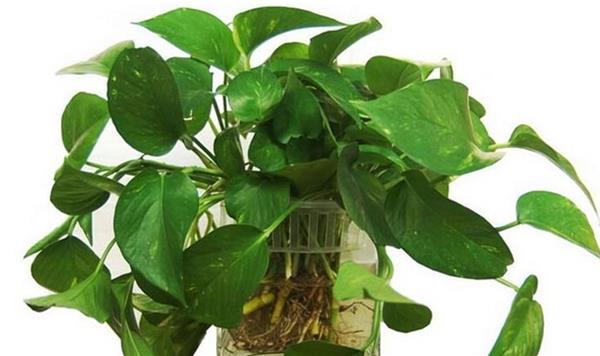
Cause of Yellowing Pothos Leaves: Improper Watering
Both overwatering and underwatering can cause pothos leaves to turn yellow. To tell the difference, observe how the yellowing appears: if the leaf tips or edges are scorched and dry, new young leaves are growing normally, and old leaves turn yellow and drop, it is underwatering; on the contrary, if the leaf surface is dull yellow and lusterless and the newly grown leaf tips shrink and stop growing, it may be overwatering. You can also judge based on your own watering habits.
Cause of Yellowing Pothos Leaves: Sunlight Problems
Pothos does not like too much sunlight and prefers a cool, shady growing environment, which is also why it grows well indoors. So if you happen to place your pothos somewhere it receives long hours of direct sunlight, you have probably found the cause of the yellowing leaves. But too much of anything is bad: if your home happens to get insufficient sunlight, the yellowing pothos leaves may also be caused by a lack of chlorophyll synthesis.
Cause of Yellowing Pothos Leaves: Fertilizer Application
The effect of fertilizing on yellowing pothos leaves must also be considered at two extremes. With too much fertilizer, the leaves become thick and fleshy and lose their luster, and old leaves turn yellow and drop; with too little fertilizer, especially a lack of nitrogen fertilizer, the leaf surface color fades, first transitioning to pale green and then gradually turning yellow, with the leaves at the base turning yellow first while the top leaves still retain their texture.
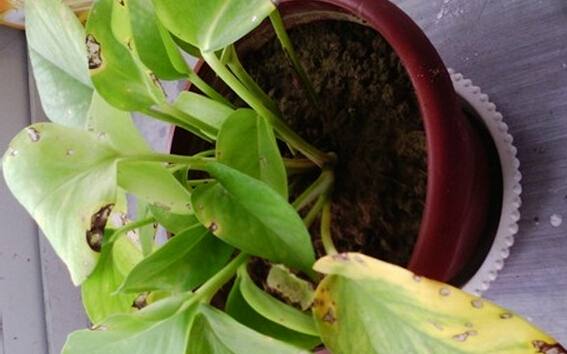
Solutions for Yellowing Pothos Leaves:
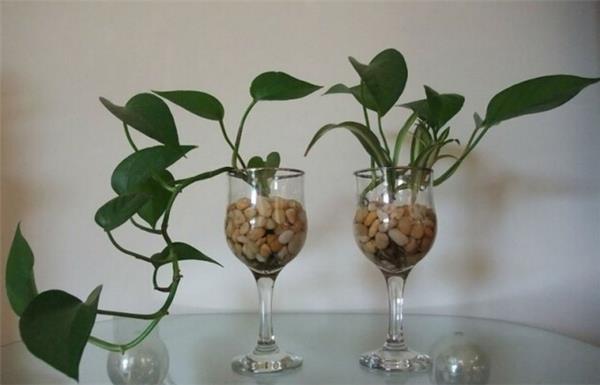
Treat the problem according to the specific cause, then remove the yellowed leaves, and the pothos will regain its luster. When the yellowing is severe, you can remove the rotted roots and pick off the yellow leaves before re-planting cuttings. During planting, bury two to three nodes; for water culture, also use two to three nodes, and change the water once every three to four days (boiled cold water is best). Right after planting, do not expose the cuttings to strong direct light; place them in a spot with weaker light, and in about 20 days the newly planted pothos will develop roots and grow.
Pothos is a large evergreen climbing plant. It grows in tropical regions, often climbing on rocks and tree trunks in rainforests, and can grow into a huge climbing plant. Its green leaves have yellow patches. It has strong twining ability and well-developed aerial roots, so it can be allowed to climb on a cylinder wrapped with palm fiber and placed in an entrance hall or hotel, or trained into a hanging form and placed in a study or on a windowsill; it is a flower plant quite suitable for indoor placement. So what specific benefits does pothos offer us? These will be discussed one by one below.
1. Decorative effect. Growing such a pot of pothos indoors or outdoors, seeing its vivid, dripping emerald green, can give people an aesthetic sense of pleasure and make body and mind feel refreshed, so its decorative effect is very prominent.
2. Air-purifying effect. Pothos is a large evergreen climbing plant, and like spider plant and ivy, it has a strong ability to purify the air. Pothos can absorb benzene, trichloroethylene, formaldehyde and others from the air, making it the perfect choice for a newly renovated home. According to environmental scientists' research, one pot of pothos in a room of 8-10 sq m is equivalent to an air purifier. It is clear that pothos has quite a strong air-purifying ability.
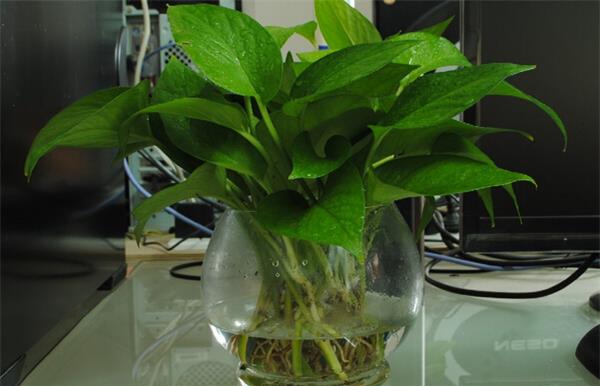
3. Wind-attracting effect. Pothos can attract wind and let indoor air circulate. Why say this? Plants themselves also breathe, absorbing carbon dioxide and releasing oxygen. Pothos is generally placed by the window, so when it is too windy outside it blocks some of it, and when there is no wind it also releases new oxygen by itself. The oxygen enters the space where we live, making us more energetic and the indoor air fresher.
4. Absorbing kitchen odors. This is actually also one aspect of purifying the air. Placing pothos in the kitchen can effectively absorb some of the cooking-oil fumes produced by stir-frying and cooking, and remove some other kitchen odors. It keeps our kitchen's air fresh.
Pothos likes warm, humid environments and requires loose, fertile soil with good drainage. Potted pothos should use fertile, loose, well-drained leaf mold, preferably slightly acidic. So what exactly is the care method for pothos?
1. Pothos develops best when cultivated in loose, organic-rich, slightly acidic and neutral sandy loam. Repot once every three years. Pothos is a shade-loving plant, averse to direct sunlight, fond of scattered light, and fairly shade-tolerant; generally, receiving four hours of scattered light gives the best growth and development.
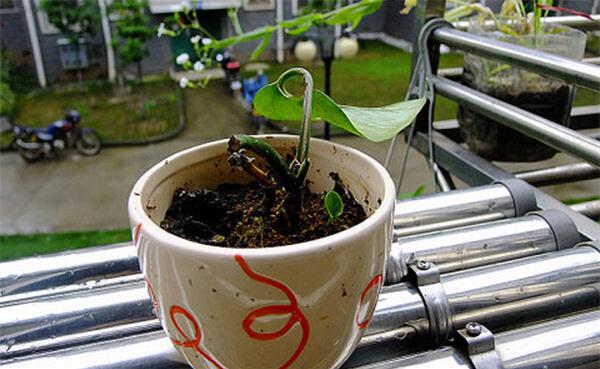
2. Propagation uses the cutting and stem-layering method. Select a robust pothos vine and cut it into sections of two nodes each, taking care not to damage the aerial roots, then insert them into plain sand or coal cinders to a depth of 1/3 of the cutting. Water thoroughly, place in a shaded spot, and spray with Xin Gao Zhi Mo to retain moisture; the survival rate can be raised to above 90%.
3. Pothos likes relatively high air humidity and a moist environment. Midsummer is the peak growth period for pothos. Every day you can spray the aerial roots and leaf surfaces several times, which can wash dust off the leaves, help pothos breathe, keep the leaf color emerald green, lower leaf surface temperature, increase the air humidity of the micro-environment, and help the leaves grow better. For fertilizing pothos, nitrogen fertilizer is primary and potassium fertilizer secondary. Spray with Xin Gao Zhi Mo to retain fertilizer and moisture. In winter, when indoor temperatures are lower, pothos enters a dormant state, so water less and just keep the potting soil from drying out.
4. The most suitable growing temperature for pothos is 20°C-28°C during the day and 15°C-18°C at night. In winter, as long as the indoor temperature is not below 10°C, pothos can safely overwinter; if the temperature is below 5, it easily causes leaf drop and affects growth. Spraying Zhuang Jing Ling at the right time during the growing period can make the plant's stems thick and strong, the leaves thick and fleshy, the leaf color fresh and tender, and the plant luxuriant.
5. Shaping and pruning. Plant 4-5 plants per pot or insert them directly as cuttings, and set up a palm pole in the middle of the pot so pothos can twine upward. Shaping and pruning are carried out in spring. When the stems have covered the palm pole and the tips extend about 20 cm beyond the palm pole, cut off the stem tips of 2-3 of the plants by 40 cm. After the cut-back sprouts new buds and new leaves, then cut off the stem tips of the remaining plants. For potted plants that have lost all their leaves or the lower half of their leaves due to winter cold or other reasons, you can cut back half of the plant's stems by 1/2 and the other half by 2/3 or 3/4, so that the cut points are staggered in height; in this way, the new leaves growing below the cuts can quickly cover the palm pole.
The above is the introduction to relevant information about yellowing pothos and the solutions, which we hope can help everyone.
2. Propagation uses the cutting and stem-layering method. Select a robust pothos vine and cut it into sections of two nodes each, taking care not to damage the aerial roots, then insert them into plain sand or coal cinders to a depth of 1/3 of the cutting. Water thoroughly, place in a shaded spot, and spray with Xin Gao Zhi Mo to retain moisture; the survival rate can be raised to above 90%.
3. Pothos likes relatively high air humidity and a moist environment. Midsummer is the peak growth period for pothos. Every day you can spray the aerial roots and leaf surfaces several times, which can wash dust off the leaves, help pothos breathe, keep the leaf color emerald green, lower leaf surface temperature, increase the air humidity of the micro-environment, and help the leaves grow better. For fertilizing pothos, nitrogen fertilizer is primary and potassium fertilizer secondary. Spray with Xin Gao Zhi Mo to retain fertilizer and moisture. In winter, when indoor temperatures are lower, pothos enters a dormant state, so water less and just keep the potting soil from drying out.
4. The most suitable growing temperature for pothos is 20°C-28°C during the day and 15°C-18°C at night. In winter, as long as the indoor temperature is not below 10°C, pothos can safely overwinter; if the temperature is below 5, it easily causes leaf drop and affects growth. Spraying Zhuang Jing Ling at the right time during the growing period can make the plant's stems thick and strong, the leaves thick and fleshy, the leaf color fresh and tender, and the plant luxuriant.
5. Shaping and pruning. Plant 4-5 plants per pot or insert them directly as cuttings, and set up a palm pole in the middle of the pot so pothos can twine upward. Shaping and pruning are carried out in spring. When the stems have covered the palm pole and the tips extend about 20 cm beyond the palm pole, cut off the stem tips of 2-3 of the plants by 40 cm. After the cut-back sprouts new buds and new leaves, then cut off the stem tips of the remaining plants. For potted plants that have lost all their leaves or the lower half of their leaves due to winter cold or other reasons, you can cut back half of the plant's stems by 1/2 and the other half by 2/3 or 3/4, so that the cut points are staggered in height; in this way, the new leaves growing below the cuts can quickly cover the palm pole.
The above is the introduction to relevant information about yellowing pothos and the solutions, which we hope can help everyone.