Detailed Guide to Making and Caring for Red Maple Bonsai
A red maple bonsai can be placed anywhere in the courtyard and is a striking scenic highlight. It can also be planted alone or in groups among rocks and green cypresses. When a red maple bonsai is placed in the home, the whole home feels full of energy and positive vibes. So what are the techniques for making a red maple bonsai?
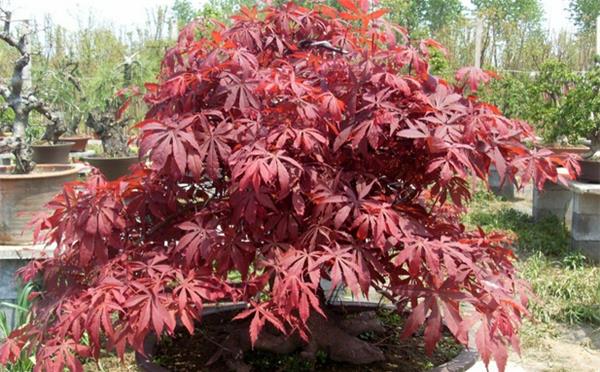
Full Steps for Making a Red Maple Bonsai
Step one: choosing the sapling. When making a red maple bonsai, what we most often make is the double-trunk style, but you must choose plants of different heights and sizes to grow as bonsai, so that the effect comes through. It is best to choose ones with a short stature and thin, drooping branches. When selecting seedlings, it is best if they come with a soil ball.
Step two: preparing the tools. Pot, soil, filter mesh, small stones, pruning shears, aluminum wire, a small saw, and wire pliers. The choice of pot is very important; it is best if the color is close to that of the trunk, and it does not need to be too deep. The bottom of the pot must have holes to allow water to drain. Only then is it beneficial to the growth of the red maple. For the soil, prepare mountain sand, burnt mud ash, and loess, mix them in a certain ratio, and make them into nutrient soil.
Step three: potting. Before potting, it is best to remove excess soil from the roots to leave enough space. Then trim off some excess fibrous roots. Next, bring the two trees close together. Lay filter mesh over the drainage holes at the bottom of the pot. Spread a layer of small stones on the filter mesh. Put the red maple into the pot, and at this point be sure to check the front side. Once it is positioned, add soil to the pot, but do not fill it to the brim, so that you can water it. While adding soil, press it firm so the tree does not shift position.
Step four: pruning. Prune away overly tall main trunk branches, dense branches inside the crown, overly weak branches, and branches growing too low on the trunk; wait until the shaping is complete before pruning.
Step five: shaping. When shaping, first wrap the small branches on the main trunk with aluminum wire, then bend them in the direction you want. If you feel the branches' extending angle does not achieve the ideal shaping effect, you can use aluminum wire to guide them appropriately. Note that every main trunk branch must be guided into the correct position with aluminum wire.
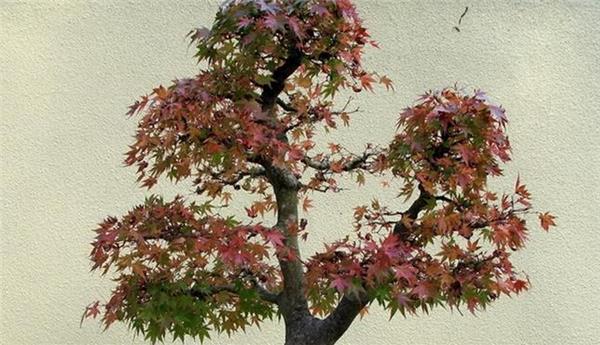
Step six: wiring and bending. This is the last step. Around the trunk and inside the crown, as well as some weaker branches on the main branches, all must have their direction determined, wrapped and guided with aluminum wire so they grow in the direction we want. Excess branches and leaves should be cut off with pruning shears.
Red maple is a valuable foliage tree species. It has a graceful shape, bright colors, neat branch order, distinct layers, and a well-arranged, scattered look, making it the best plant for ornamental viewing. In addition, red maple is widely used as an ornamental tree in garden green spaces and courtyards, mainly planted alone or scattered, and is suitable for placement in the center of a lawn, in front of and behind tall buildings, at corners, and other such places, where red leaves and green trees set each other off beautifully. It can also be grown in pots and shaped into forms such as exposed roots, leaning on stones, cliff style, and dead-wood style, elegant and distinctive. How should we care for a red maple bonsai?
Red Maple Bonsai Care Methods:
Of course, making a red maple bonsai requires meticulous care, because only meticulous care can make the red maple grow luxuriantly, and only then will the leaves turn red beautifully and the ornamental value be higher. Below, let us learn about red maple bonsai care methods:
1. For planting, ordinary potting soil can be used. After watering, place it in a semi-shaded spot. Frequently spray water on the branches and trunk. When the leaves begin to unfold, light can be increased. After all the leaves have unfolded, apply one dilute (nitrogen) fertilizer solution. Place it in a semi-shaded spot with even sunlight for normal care.
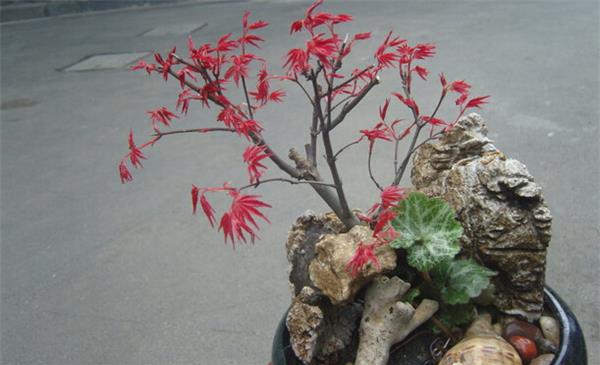
2. In summer and autumn, pay attention to ventilation. Potted plants should be moved to a semi-shaded spot around noon, and attention should be paid to ventilation. Under blazing sun, the leaves tend to scorch at the edges, curl, and drop. At the same time, pay attention to watering to prevent the soil from becoming too dry.
3. If you want to manually control foliage viewing, you can do it once each during the two periods between spring and summer and between summer and autumn. Doing it too often will harm the tree. You can completely strip the leaves once each in June and September, and after 10 days fresh red new leaves will grow. Note two points: first, after stripping the leaves, prune; second, fertilize one week before stripping the leaves. To manually control new leaves, fertilizer and water must be strengthened; this is the key to success.
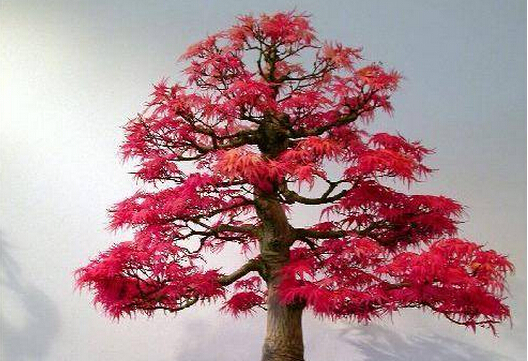
4. If the leaves scorch under blazing sun, in August you can remove all the scorched leaves, place the plant in a cool semi-shaded spot, and apply a nitrogen-phosphorus-potassium compound solution, applied diluted, about twice a week. In this way, by autumn, fresh red new leaves will grow.
5. After the leaves drop in winter, it enters dormancy. You can apply one thin basal fertilizer of nitrogen, phosphorus, and potassium, and carry out shaping and pruning, so that the branches and leaves in early spring of the following year will be even redder and more vivid. If extremely cold special weather occurs, the bonsai should be placed in a warm, wind-sheltered, sunny spot or in a sunny spot indoors to avoid frost damage.
6. The main pests of red maple are: red wax scale, cottony cushion scale, and heart-boring borers. Control method for scale insects: when there are few, scrub them off with a toothbrush; when severe, spray with a 1000-fold dilution of 25% iminophosphorus sulfur emulsion. Control method for heart-boring borers: use a syringe to inject a 2000-fold dilution of 40% omethoate into the pest-damaged part of the trunk.
Red Maple Bonsai - Value
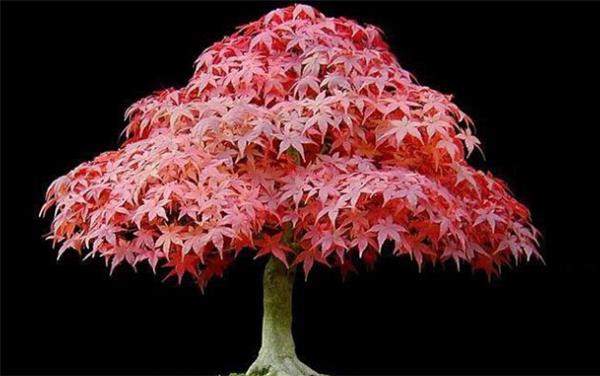
Red maple is a valuable foliage tree species. It has a graceful shape, bright colors, neat branch order, distinct layers, and a well-arranged, scattered look, making it the best plant for ornamental viewing. In addition, red maple is widely used as an ornamental tree in garden green spaces and courtyards, mainly planted alone or scattered, and is suitable for placement in the center of a lawn, in front of and behind tall buildings, at corners, and other such places, where red leaves and green trees set each other off beautifully. It can also be grown in pots and shaped into forms such as exposed roots, leaning on stones, cliff style, and dead-wood style, elegant and distinctive.
Conclusion: Plants are also living beings, so everyone must use the right methods to grow plants well. A red maple bonsai also needs everyone to raise and care for it with dedication, and only then will it show its most beautiful side. That is all for sharing with everyone about red maple bonsai making techniques and care methods and related content. We hope it can help everyone.
fresh red new leaves will grow.5. After the leaves drop in winter, it enters dormancy. You can apply one thin basal fertilizer of nitrogen, phosphorus, and potassium, and carry out shaping and pruning, so that the branches and leaves in early spring of the following year will be even redder and more vivid. If extremely cold special weather occurs, the bonsai should be placed in a warm, wind-sheltered, sunny spot or in a sunny spot indoors to avoid frost damage.
6. The main pests of red maple are: red wax scale, cottony cushion scale, and heart-boring borers. Control method for scale insects: when there are few, scrub them off with a toothbrush; when severe, spray with a 1000-fold dilution of 25% iminophosphorus sulfur emulsion. Control method for heart-boring borers: use a syringe to inject a 2000-fold dilution of 40% omethoate into the pest-damaged part of the trunk.
Red Maple Bonsai - Value
Red maple is a valuable foliage tree species. It has a graceful shape, bright colors, neat branch order, distinct layers, and a well-arranged, scattered look, making it the best plant for ornamental viewing. In addition, red maple is widely used as an ornamental tree in garden green spaces and courtyards, mainly planted alone or scattered, and is suitable for placement in the center of a lawn, in front of and behind tall buildings, at corners, and other such places, where red leaves and green trees set each other off beautifully. It can also be grown in pots and shaped into forms such as exposed roots, leaning on stones, cliff style, and dead-wood style, elegant and distinctive.
Conclusion: Plants are also living beings, so everyone must use the right methods to grow plants well. A red maple bonsai also needs everyone to raise and care for it with dedication, and only then will it show its most beautiful side. That is all for sharing with everyone about red maple bonsai making techniques and care methods and related content. We hope it can help everyone.