Step-by-step Guide to Making and Caring for an Asparagus Fern Bonsai
Asparagus fern, also known as cloud-pine and asparagus fern, gets its name because its leaves are soft, it stays green all year round, its stems have joints like bamboo, and its posture is elegant and unrestrained. Its leaf-like branches are slender and beautiful, densely growing like feathers, with layers of emerald clouds, an elegant plant shape, and unique charm, making it deeply loved by people; it is a well-known indoor ornamental flower. So how should an asparagus fern bonsai be cultivated?
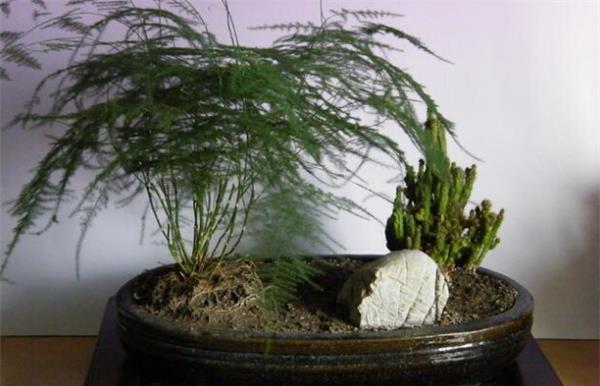
Bonsai shaping methods
1. Tower style: choose 2 to 3 tall, upright and elegant stems as the main peak, remove each growing point on the stems, and set the plant height at 30 to 35 cm. The remaining stems and new stems should not be taller than the main peak. For new buds, whether to remove the growing point can be decided according to the thickness of the stem. If the stem is thicker than that of the main peak, it should be removed; if it is thinner than the main peak, there is no need to remove it, and it can be allowed to grow. At the same time, it is also necessary to use the object-shading method and the plant's own phototropism to continuously adjust the plant shape.
2. Double-clump style: plant two asparagus ferns in the pot, one tall and one short, with the tall one about 30 cm and the short one about 18 cm; during the growing period, shape them in the same way as the tower-style asparagus fern.
3. Natural style: plant the asparagus fern in the pot freely and naturally, mainly following the plant shape of its natural growth, and still use basic methods such as removing growing points, object shading, and making use of its phototropism, so that the branches and leaves spread out and give people a natural sense of beauty.
Asparagus fern shaping methods
Because asparagus fern grows quickly, its small and beautiful appearance often cannot last, so it must be shaped. The methods are as follows.
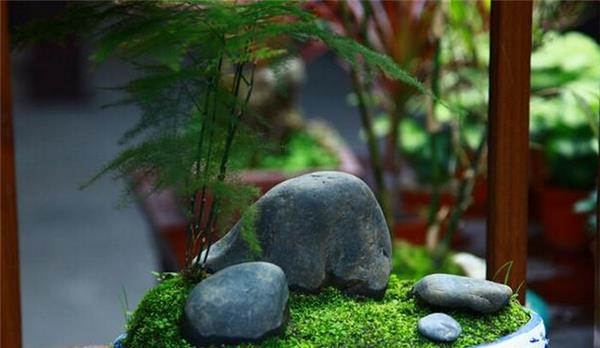
1. Pot control method: the ratio of flower pot size to plant height should be 1:3, which can limit root growth and keep the plant size unchanged.
2. Growing points: when new buds grow to 2 to 3 cm, removing the growing points can promote new branches and leaves on the stems, and can also control it from growing vines, so that the branches and leaves spread out horizontally and the plant shape keeps becoming fuller.
3. Phototropism: turning the flower pot in time can correct the growth shape of the branches and leaves and keep the plant shape unchanged.
4. Object-shading method: use hard cardboard to press down the branches and leaves or block sunlight, so that when the branches and leaves grow, they turn or bend upon encountering the obstacle, thereby achieving the purpose of shaping.
Bonsai making explanation
Material selection: choose one asparagus fern that is growing well and about 20 cm tall, and two asparagus ferns about 10 cm tall; an irregular white marble shallow pot and its matching stand, and several rocks about 10 cm tall; an appropriate amount of culture soil and moss.
Bonsai shaping: first spread a thin layer of culture soil in the white marble shallow pot, plant the tallest asparagus fern at the right end of the pot with its curved branches and leaves facing left, plant the second-tallest asparagus fern not far to the left of the first asparagus fern and appropriately near the back edge of the pot, then plant the shortest asparagus fern at the boundary between 1/2 and 2/3 of the pot length, with its curved branches and leaves also facing left, so as to achieve coordinated and unified orientation of the three asparagus ferns. Then look from afar and close up, and adjust the position of the asparagus ferns in the pot until it is natural and beautiful.
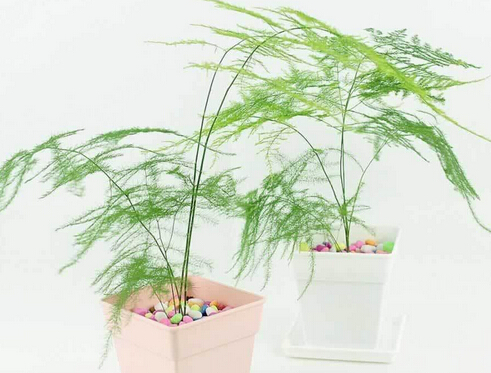
Adding stones and spreading moss: the stems of asparagus fern are thin and curved, which expresses softness, and the surroundings of the irregular white marble pot are also curved, so this scene has more than enough softness and not enough masculine strength. A superior scene needs a balance of hardness and softness. Place two upright rocks at an appropriate position toward the right rear on the pot surface; the rocks are hard in texture and their left and right side lines are straight, which expresses hardness. On the culture soil on the pot surface, spread a layer of moss to achieve a greening artistic effect. Spray clean water on the asparagus ferns and moss, and make the culture soil moist.
Asparagus fern is a perennial evergreen herbaceous plant that likes a warm, humid and semi-sunny environment, fears severe cold, and is afraid of exposure to the sun. To make an asparagus fern bonsai green in all four seasons and highly ornamental, what are the precautions for asparagus fern bonsai?
(1) Location: in North China, an asparagus fern bonsai can be cared for indoors or on an enclosed balcony all year round. Pay attention to air circulation.
(2) Light: asparagus fern likes a warm, humid and shaded environment, and is not tolerant of direct strong light. In early spring, late autumn and winter, it can receive sunlight. At other times, it should be shaded or receive scattered light.
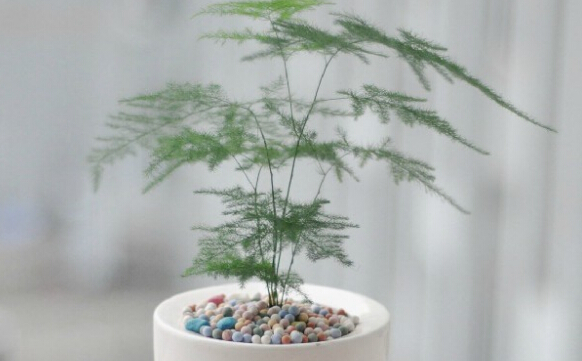
(3) Temperature: asparagus fern is a shade-loving plant that likes a warm and humid climate, and can neither tolerate cold nor endure summer heat. It has relatively strict requirements for light conditions, and can neither be shaded all year round nor withstand exposure to the sun; being exposed to the sun for half a day will also make it turn yellow. Therefore, it is advisable to move the asparagus fern indoors for cultivation and place it in scattered light to grow, avoiding direct sunlight. Keep the soil fertile and well-drained and breathable; in winter, the indoor temperature should be controlled above 5°C so that it can overwinter safely.
(4) Watering: during the growing period in late spring, summer and early autumn, the pot soil can be appropriately on the moist side; in winter, water evaporation is low, so watering should be appropriately reduced, and it is enough to keep the pot soil moist.
(5) Fertilizing: during the growing period, applying a thin organic liquid fertilizer once a month is enough. Too much fertilizer will cause the branches and leaves of asparagus fern to grow excessively, instead damaging the shape. Do not fertilize in winter.
(6) Pruning: asparagus fern grows quickly, and during the growing period new shoots often grow from the roots; over time, old stems and leaves turn yellow. To keep the asparagus fern's stems and leaves green and its posture graceful, frequently cut off old branches, excessive branches and leaves that affect the shape.
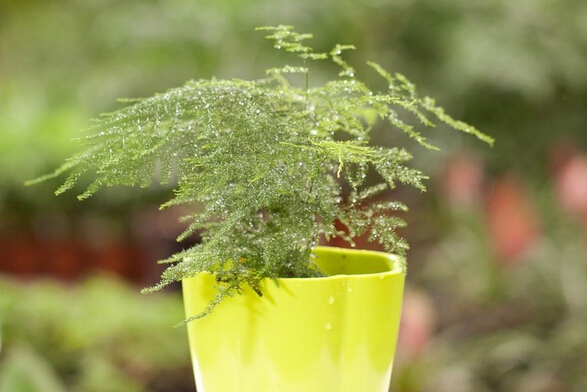
Asparagus fern is a perennial evergreen herbaceous plant that likes a warm, humid and semi-sunny environment, fears severe cold, and is afraid of exposure to the sun. To make an asparagus fern bonsai green in all four seasons and highly ornamental, it should be cared for according to its growth habits; for details, refer to the cultivation methods for asparagus fern. The above is the introduction to relevant information about asparagus fern bonsai compiled by the editor, hoping it can help everyone.
In winter, the indoor temperature should be controlled above 5°C so that it can overwinter safely.(4) Watering: during the growing period in late spring, summer and early autumn, the pot soil can be appropriately on the moist side; in winter, water evaporation is low, so watering should be appropriately reduced, and it is enough to keep the pot soil moist.
(5) Fertilizing: during the growing period, applying a thin organic liquid fertilizer once a month is enough. Too much fertilizer will cause the branches and leaves of asparagus fern to grow excessively, instead damaging the shape. Do not fertilize in winter.
(6) Pruning: asparagus fern grows quickly, and during the growing period new shoots often grow from the roots; over time, old stems and leaves turn yellow. To keep the asparagus fern's stems and leaves green and its posture graceful, frequently cut off old branches, excessive branches and leaves that affect the shape.
Asparagus fern is a perennial evergreen herbaceous plant that likes a warm, humid and semi-sunny environment, fears severe cold, and is afraid of exposure to the sun. To make an asparagus fern bonsai green in all four seasons and highly ornamental, it should be cared for according to its growth habits; for details, refer to the cultivation methods for asparagus fern. The above is the introduction to relevant information about asparagus fern bonsai compiled by the editor, hoping it can help everyone.