A Detailed Guide to Geranium Planting Methods and Care Tips
Geranium, also known as cranesbill and zonal geranium, is a perennial herbaceous flower. Because its clusters of flowers are dense like a ball, it is also called the "foreign hydrangea." Next, let us take a look at geranium planting and care!
Geranium's Growth Habits
Geraniums are naturally robust and rarely troubled by pests and diseases; they are also highly adaptable, able to grow in all kinds of soil, but grow best in sandy soil rich in humus; they like warmth, are somewhat drought-tolerant, fear waterlogging, and cannot tolerate the intense heat of midsummer or exposure to the scorching sun.
When summer arrives, the plant stops growing, the leaves age, and it enters a semi-dormant state. At this time it can be moved to a shady spot outdoors, liquid fertilizer should be stopped, watering should be done on time, and on rainy days the pot should be laid on its side to prevent waterlogging and root rot.
In winter, the temperature should not be lower than 10°C, and it can tolerate a short period of 5°C low temperature. Geraniums prefer warm winters and cool summers. Indoors in winter, maintaining 10-15°C during the day and above 8°C at night allows them to bloom normally. However, the optimal temperature is 15-20°C. Geraniums like dryness and dislike dampness, so watering in winter should not be excessive; water only when the soil is dry.
When the soil is wet, the stems are tender, which is unfavorable for the sprouting and opening of flower stems; long-term excessive moisture causes the plant to grow leggy, the flower stems to be positioned higher up, and the leaves to gradually yellow and fall off. Geraniums need ample sunlight during their growing period, so in winter they must be placed in a sunny spot. Insufficient light leads to leggy stems and leaves, thin and soft flower stalks, and poor inflorescence development; flower buds under weak light often fail to open smoothly and wither prematurely. Geraniums do not like heavy fertilizer; too much fertilizer makes geraniums grow excessively, which is unfavorable for flowering.
To make flowering abundant, water with a dilute fertilizer solution (decomposed soybean cake water) once every 1-2 weeks; watering with a 800-fold potassium dihydrogen phosphate solution every 7-15 days can promote normal flowering. After flowering, promptly cut off the withered flower stems, which can increase light between the plants, induce the sprouting of new leaves, and bring out new flower stems.
Geranium Variety Classification and Identification Tips
Horsehoe geranium: Named for the obvious dark brown horseshoe markings inside the leaf margins. The petals are the same color, from deep red to white; the upper two petals are extremely short, and the petals are narrowly wedge-shaped. This species has produced a great many variegated-leaf varieties.
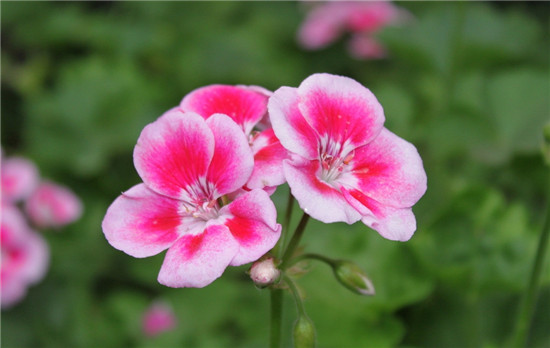
Pelargonium domesticum: Also known as butterfly geranium and foreign butterfly. The whole plant has soft hairs. The leaves have no horseshoe markings, and the leaf margins have sharp, irregular teeth. The flowers are large, with colors including white, pale red, and pale purple. It is named for the two red or purple blotches on the petals.
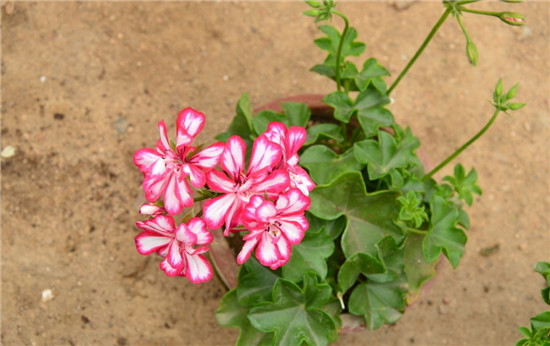
Ivy geranium: Also called trailing geranium and ivy-leaved geranium. The stems are semi-trailing, and the plant is prostrate or climbing. The leaves are shield-shaped and slightly glossy. The flowers are small, borne 4-8 together, with colors including white, pink, red, purple, and peach red. The flowering period is winter and spring.
Scented geranium: Also known as musk geranium and round-leaved geranium. The stems are slender and trailing, and new branches and new leaves are often clustered at the top of the stem. The umbel inflorescence has small white flowers, and the upper two petals have red-purple markings. When the leaves are touched by hand, they immediately give off an appealing fragrance.
Rose-scented geranium: Also called "touch-me-fragrance." A semi-shrub. The leaves are palm-shaped with 5-7 deep lobes, and the lobes are further pinnately shallowly lobed. The flowers are peach red or pale red, with purple-red markings in the center, and the upper two petals are larger. The flowering period is summer.
Chrysanthemum-leaved geranium: The stems have long hairs. The leaves are palmately deeply lobed, and the lobes are further divided into linear segments. The whole plant is covered with a white powdery bloom. The flowers are rose red with purple spots and stripes. The flowering period is summer.
Geranium Cultivation Methods
1. Soil: Geraniums are also highly adaptable and can grow in all kinds of soil, but grow best in sandy loam rich in humus.
2. Watering: Geraniums like dryness and dislike dampness, so watering in winter should not be excessive; water only when the soil is dry. When the soil is wet, the stems are tender, which is unfavorable for the sprouting and opening of flower stems; long-term excessive moisture causes the plant to grow leggy, the flower stems to be positioned higher up, and the leaves to gradually yellow and fall off.
3. Sunlight: Geraniums need ample sunlight during their growing period, so in winter they must be placed in a sunny spot. Insufficient light leads to leggy stems and leaves, thin and soft flower stalks, and poor inflorescence development; flower buds under weak light often fail to open smoothly and wither prematurely.
4. Temperature: Geraniums prefer warm winters and cool summers. Indoors in winter, maintaining 10-15°C during the day and above 8°C at night allows them to bloom normally. However, the optimal temperature is 15-20°C.
5. Fertilizing: Geraniums do not like heavy fertilizer; too much fertilizer makes geraniums grow excessively, which is unfavorable for flowering. To make flowering abundant, water with a dilute fertilizer solution (decomposed soybean cake water) once every 1-2 weeks; watering with a 800-fold potassium dihydrogen phosphate solution every 7-10 days can promote normal flowering.
6. Pests and diseases: When geraniums have poor ventilation and are too damp, they are prone to leaf spot disease and flower wilt disease. Once discovered, attention should be paid to ventilation, and the diseased flowers and leaves should be removed immediately to prevent infection, and an equal-amount Bordeaux mixture should be sprayed for control. The main pests are red spider mites and whiteflies, which damage the leaves and flower stems, and can be killed by spraying a 1000-fold solution of 40% omethoate emulsifiable concentrate.
7. Pruning: Pruning branches and pinching. To encourage geraniums with more branches to bloom more, the plant should be pinched multiple times to promote increased branching and bud formation. After the flowers fade, the spent flowers should be cut off in good time, and overly dense and thin, weak branches should be cut off to avoid excessive consumption of nutrients, but in winter when it is cold, heavy pruning is not advisable.
The above is the complete content I have summarized for everyone on geranium planting and care. I hope this article can help everyone. Please also continue to follow us.
To prevent infection, and spray an equal-amount Bordeaux mixture for control. The main pests are red spider mites and whiteflies, which damage the leaves and flower stems, and can be killed by spraying a 1000-fold solution of 40% omethoate emulsifiable concentrate.7. Pruning: Pruning branches and pinching. To encourage geraniums with more branches to bloom more, the plant should be pinched multiple times to promote increased branching and bud formation. After the flowers fade, the spent flowers should be cut off in good time, and overly dense and thin, weak branches should be cut off to avoid excessive consumption of nutrients, but in winter when it is cold, heavy pruning is not advisable.
The above is the complete content I have summarized for everyone on geranium planting and care. I hope this article can help everyone. Please also continue to follow us.