What are the cultivation methods and precautions for growing Mimosa pudica
Mimosa pudica, native to the tropical regions of the Americas, has many alternative names and nicknames because of its unique physiological habits, such as "laughter-triggering grass", "sensitive plant", "shameplant" and so on. Next, let us learn about Mimosa pudica and its cultivation methods.
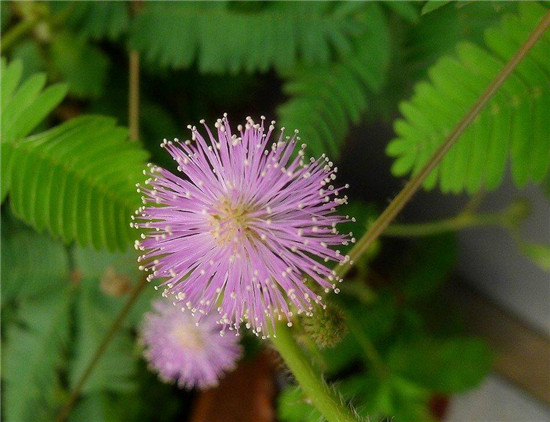
The most distinctive feature of Mimosa pudica is that when it is stimulated (such as by touch), its leaf surface contracts and folds together. If the stimulus is strong, this stimulus will quickly be transmitted in turn to the adjacent leaflets, and even to the leaflets of the entire compound leaf, causing the petiole to droop. If the stimulus is strong enough, it can even cause the leaflets of the entire plant to close up and the compound leaves to droop. But after a period of time, it can return to its original state. Mimosa pudica also responds very quickly to vibration; it begins to react 0.1s after being stimulated, and completes the reaction within a few seconds.
At night, Mimosa pudica also closes its leaflets and droops its petioles. During the day, when some leaflets are vibrated, they also close in pairs. It is more sensitive when the light is weak. Normally, the water in the pulvinus supports the leaf blade; but when it is stimulated by an external force, the water in the pulvinus immediately flows elsewhere, causing the leaves of Mimosa pudica to close. In addition, at night it automatically contracts (that is, sleep movement). This uniqueness is exactly the source of the name and nicknames of Mimosa pudica.
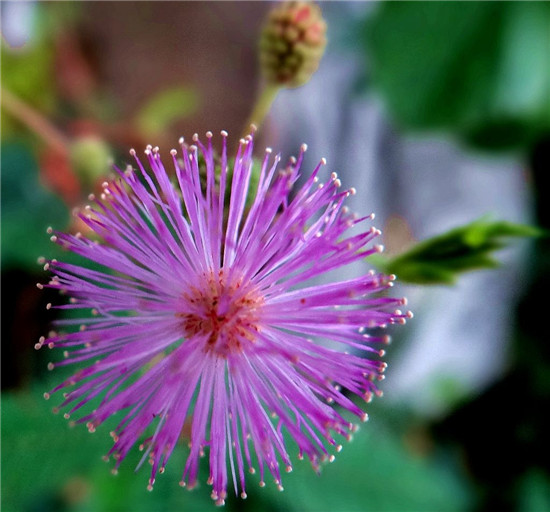
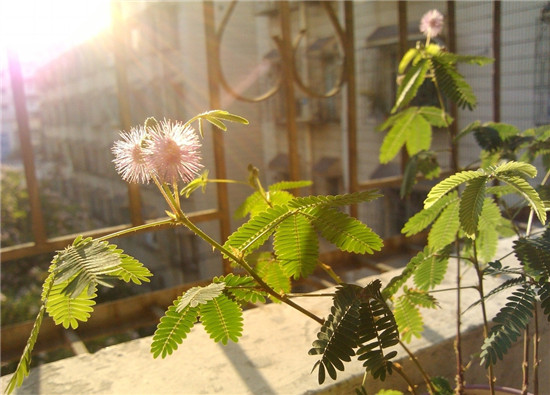
Because Mimosa pudica has strong vitality and grows rather, many places classify it as a type of grass, but in fact it also blooms. The flowering period of Mimosa pudica is from July to October each year, but its flowering period is very short; the flowers fade less than two days after blooming. The flowers are pink, and the capitulum is spherical, shaped like a pom-pom. After flowering, it also produces pods, and the fruit is flat and round.
How to grow Mimosa pudica
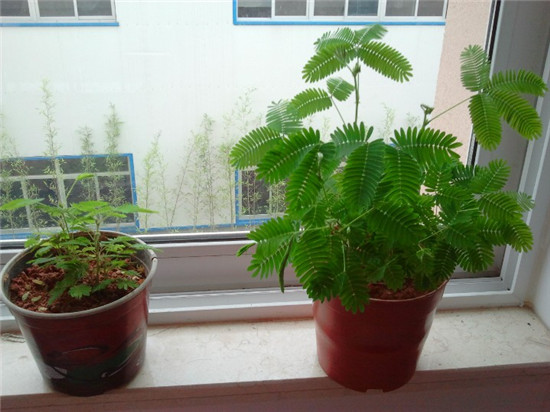
Mimosa pudica prefers a warm, humid environment with plenty of sunlight. It is suitable for growing in well-drained sandy loam rich in organic matter. The plant is robust, grows quickly, has strong adaptability, and its cultivation technique is simple with extensive management. It is not strict about climate, sunlight or soil, so when cultivating it, fertile, loose sandy loam is best. During the plant's growth period, loosen the soil, remove weeds and water in time. For indoor potted plants, water once a day in summer. Fertilize once a month; if you do not want the plant shape to become too large, reduce the amount of fertilizer, or even do not fertilize.
Is Mimosa pudica toxic
The whole plant of Mimosa pudica is slightly toxic, but it does not affect humans. The whole plant of Mimosa pudica is used as medicine, and has the effects of calming the nerves and sedating, stopping bleeding and astringing, and dispersing blood stasis and relieving pain. Mimosa pudica contains mimosine; excessive contact can cause sparse eyebrows and yellowing of hair, and in severe cases can also cause hair loss.
The flower language of Mimosa pudica
What is the flower language of Mimosa pudica? We all know that Mimosa pudica is very "shy", so is its flower language shyness? If the leaves of Mimosa pudica are touched by hand, watered, or encounter a typhoon, they will curl up. It is as if it is bowing to people. It is a very polite plant. Therefore, its flower language is "politeness". Anyone born under the blessing of this flower is a person who behaves properly and is loved by elders.
Cultivation methods for Mimosa pudica:
1. Soil: Mimosa pudica has strong adaptability and is not strict about soil. It grows well in moist, fertile soil. Sow it in a culture soil prepared by mixing 2 parts leaf mold, 3 parts garden soil, and 5 parts fine yellow sand after sieving.
2. Watering: Mimosa pudica prefers moisture. During the summer growing period, water once a day.
3. Sunlight: Mimosa pudica prefers sufficient light and is slightly tolerant of semi-shade.
4. Temperature: As a potted ornamental flower, Mimosa pudica should be moved indoors to a sunny place in winter, and maintaining a room temperature of 10-12°C is enough for it to overwinter safely.
5. Fertilization: Mimosa pudica does not need much fertilizer during its growth period. Applying diluted liquid fertilizer 2-3 times is enough. Do not let it grow leggy, because Mimosa pudica is mainly a fun foliage flower, and a small size is better.
The above is all the content I have summarized for you on what the cultivation methods for Mimosa pudica are. I hope this article can help everyone. Please also continue to follow us.