What Does a Mimosa Pudica Look Like? Master These Growing Tips
Mimosa pudica is a lovely plant whose leaves fold up at the slightest touch. It is well suited as a potted flower for balconies and indoors, and many people also plant it in their yards. Below, let us look at how to grow Mimosa pudica.
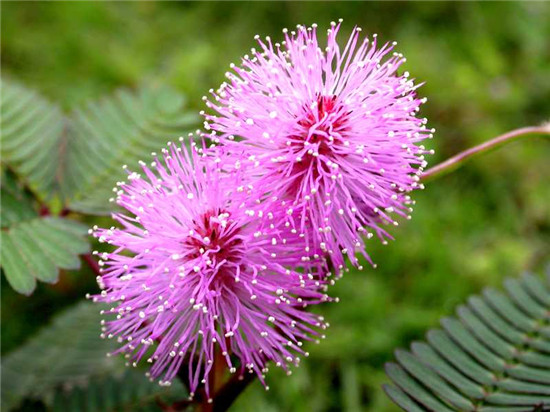
Basic information about Mimosa pudica:
Mimosa pudica is a perennial herb or subshrub of the Fabaceae family. Because its leaves react to heat and light and close immediately when touched by an external force, it is named Mimosa pudica (touch-me-not). It is native to the tropical regions of South America, prefers warmth and humidity, and is not demanding about soil. Its flowers are pink and shaped like fluffy balls, delightful and charming.
After flowering, it produces pods, and the fruit is flat and round. The leaves are feather-like compound leaves arranged alternately, in a palmate arrangement. The flowers, leaves and pods of Mimosa pudica all have good ornamental value, and it is relatively easy to keep alive, making it suitable as a potted flower for balconies and indoors; it can also be grown in yards and other places.
Unlike ordinary plants, when Mimosa pudica is touched by the outside world, its petioles droop and its leaflets close. People interpret this action as "shyness," which is why it is called Mimosa pudica, zhixiu cao (shy-knowing grass) and paichou cao (shy-of-ugliness grass).
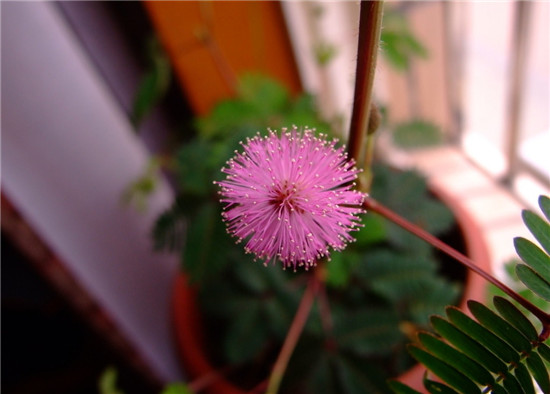
Growing method: pot cultivation. When you touch the leaves of Mimosa pudica, they slowly close, which is very peculiar. Its flowers are like fluffy little pink balls, especially cute. Because of its living habits, it is a small plant suitable for pot cultivation.
Watering: Since Mimosa pudica is originally a tropical plant and very fond of a humid environment, we should often keep the potting soil moist. In summer, water according to the condition of the potting soil, roughly once a day. Never let the soil dry out, and you can also frequently spray water on the plant. In winter, reduce the amount of watering to prevent frost damage.
Fertilizing: Mimosa pudica is not demanding about soil; ordinary soil will do. But if you want Mimosa pudica to grow better, you can choose a relatively loose and fertile soil. You can also use a mixed soil of leaf mold and sandy soil, or use only leaf mold, and humus soil is also a good choice.
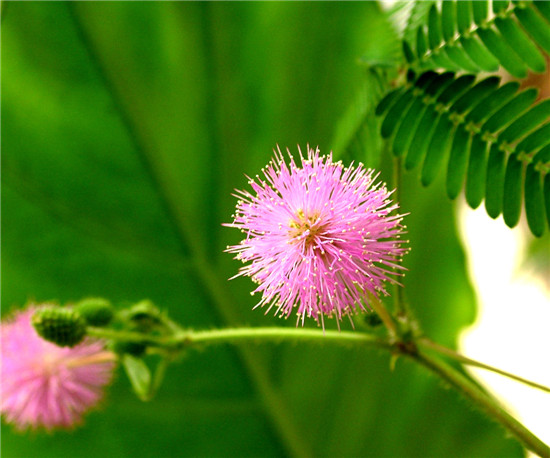
Sunlight: Mimosa pudica likes sunlight. Placing it in a sunny spot is very beneficial to its growth. If there is too little sunlight, it is instead unfavorable to its growth.
Plants and animals are not the same. Plants have no nervous system and no muscles, and cannot perceive external stimuli. But why Mimosa pudica is shy is indeed related to a nervous system. Mimosa pudica is supported by fine, net-like actin. When it closes, the actin falls away, producing the closing movement. The actin contains muscle fibers, which is very rare in plants.
If the leaves of Mimosa pudica are touched, they immediately fold up. The stronger the touch, the faster they close, until finally the entire leaf droops as if listless. The leaves and petioles of Mimosa pudica have a special structure, with a pulvinus in the middle that is most sensitive to stimuli. Once touched, the stimulus is transmitted directly to the pulvinus at the base of the petiole, causing the leaf to close.
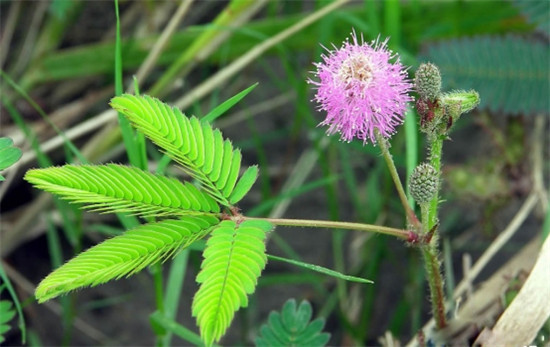
The above is the entire content of the appearance and growing tips of Mimosa pudica that I have summarized for everyone. I hope this article can help you. Please also continue to follow us.