Complete Guide and Detailed Introduction to the Sensitive Plant (Mimosa pudica)
I believe many people have seen this plant. It has tiny leaves and pink spherical flowers, and its leaves fold up as soon as they are touched. That is the common sensitive plant (Mimosa pudica).
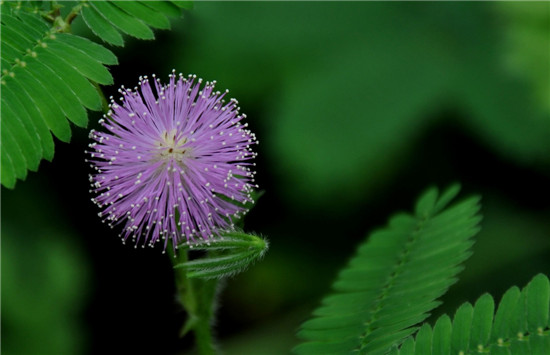
Facts About the Sensitive Plant
The sensitive plant is commonly known as "shy grass" or "touch-me-not." It belongs to the genus Mimosa in the Fabaceae family and is a perennial herbaceous plant. The plant grows 30-60 cm tall; its stems trail and branch heavily, scattered all over with backward-pointing bristles and sharp prickles; the petioles are 1.5-4 cm long; the stipules are lanceolate and bear bristles; the leaves are pinnate, with 2-4 leaflets arranged in a palmate pattern, the leaflets are oblong, and they close and droop when touched; the flowers are numerous, in heads, generally pink, blooming from July to October; the pods are flat with bristly margins, have 3-4 segments, with 2 seeds per segment, and fall off on their own once mature.
The sensitive plant is a perennial herb or subshrub in the Fabaceae family. Because its leaves respond to heat and light and close immediately when touched by an external force, it is named the sensitive plant. It is native to the tropical regions of South America, prefers warmth and humidity, and has only ordinary requirements for soil. The flowers are white or pink and shaped like fluffy balls, charming and lovely. After flowering it produces pods, and the fruit is flat and round. The leaves are bipinnate compound leaves arranged alternately and in a palmate pattern. The flowers, leaves and pods of the sensitive plant all have good ornamental value, and it is relatively easy to keep alive, making it suitable as a potted flower for balconies and indoors (people who eat it or come into excessive contact with it may also experience hair loss). It can also be grown in courtyards and other places. The sensitive plant differs from ordinary plants in that when touched by people, its petioles droop and its leaflets close, so people interpret this as "shyness," which is why it is called the sensitive plant, the shy plant, or the bashful plant.
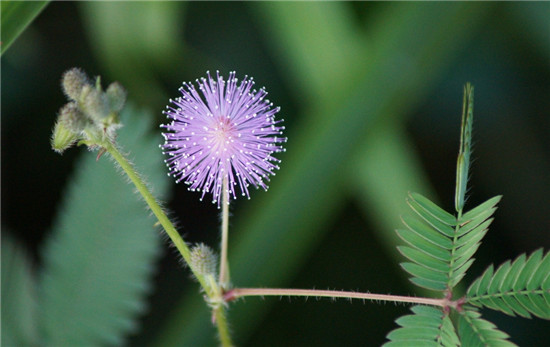
The sensitive plant is highly adaptable. It likes warmth and humidity and grows well in moist, fertile soil. It is not demanding about soil, is not cold-tolerant, likes light, but can also tolerate partial shade. It can be cultivated in ordinary soil, needs little fertilizer during the growing period, and can be given diluted liquid fertilizer just 2-3 times.
The sensitive plant is generally propagated by sowing, with sowing from late March to early April. Scatter the seeds evenly over fine soil and cover with about 1.5 cm of soil. At a temperature of around 18°C, seedlings can emerge in about 10 days (generally they grow once in the soil and need no special effort in management). Seedlings grow relatively slowly, and can be planted out when they reach 7-8 cm.
When planting in fields, the spacing between plants is 25-30 cm, with timely loosening of the soil, weeding and watering. For indoor potting, water once a day in summer. Apply fertilizer once a month; if you do not want the plant to grow too large, reduce the amount of fertilizer, or even do without it.
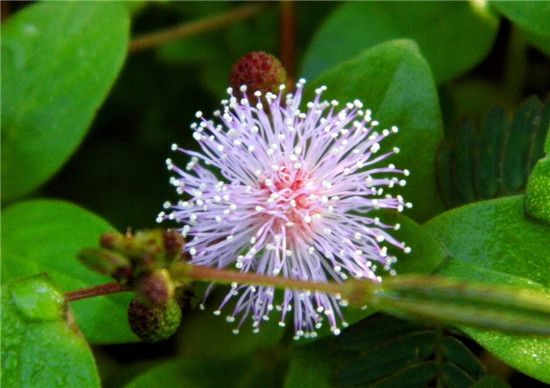
The Main Uses of the Sensitive Plant
1. Ornamental. The sensitive plant has a loose plant form and delicate, graceful feathery leaves, and its leaves close as soon as they are touched; the sensitive plant's flowers are numerous and elegant, delicate and charming, giving people an impression of frail refinement. It can be planted in the ground at the corner of a courtyard, or potted on a windowsill or desk.
2. Medicinal. The sensitive plant is also a medicine. Its nature is slightly cold, its taste sweet and astringent, and it is slightly toxic. It has effects such as calming the spirit, sedation, detoxification, dispersing blood stasis, relieving pain, clearing heat, promoting urination, stopping bleeding and astringing, and is often used for neurasthenia, traumatic injuries, coughing up blood, and shingles. Harvest in summer and autumn, remove weeds, and dry in the sun or use fresh.
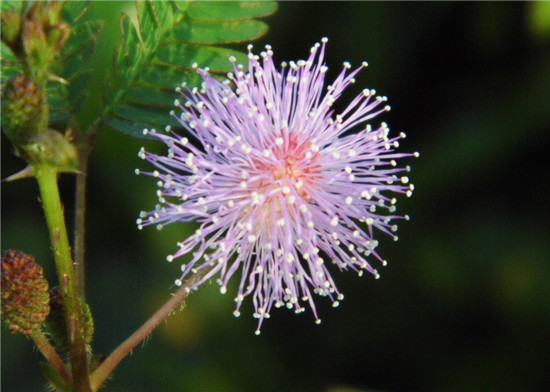
3. Predicting earthquakes. According to Turkish seismologist Eyidogan, several hours before a strong earthquake occurs, the leaves of the sensitive plant, which are sensitive to outside touch, suddenly shrink and then wither. In earthquake-prone Japan, scientists have found through research that under normal conditions, the leaves of the sensitive plant open during the day and close at night.
The above is the complete guide to the sensitive plant and all the content of the introduction to the sensitive plant that I have summarized for everyone. I hope this article can help everyone. Please also continue to follow us.