Revealing a Complete Summary of Methods for Successfully Growing Calathea makoyana
Calathea makoyana is a perennial plant of the Calathea genus. Because its leaf pattern consists of alternating dark green and light green feather-like markings, resembling a peacock's tail feathers, it is called the peacock plant. It is a common household potted plant, and many families place it indoors for ornamental display. So, what are the methods for growing Calathea makoyana?
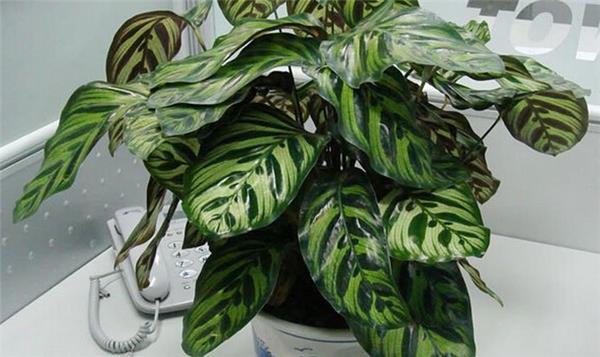
1. Growing environment. Calathea makoyana likes a high-temperature and humid environment and has strong shade tolerance, with an ideal light intensity of 30%-40%. It grows well under indoor diffused light and should be cultivated in loose, fertile soil with good drainage. In spring and autumn, it can be kept in a bright indoor spot for care; in summer, it should be kept in a semi-shaded spot, as overly strong light will make the leaves turn yellow and scorched, affecting its ornamental value. In winter, when light intensity decreases, the pot can be moved near a south-facing window for cultivation, and the growing environment at this time should not be too shady. If placed in a dim spot for a long time, the leaves of Calathea makoyana will lose their distinctive gloss.
2. Growing temperature and humidity.
① Temperature. The optimal growing temperature for Calathea makoyana is around 22°C. When the summer temperature is above 35°C, not only will the plant's growth stall, but the leaf color will also turn yellow and lose its ornamental value. When the winter temperature is below 15°C, the plant's growth slows; below 10°C, the leaves tend to curl; below 5°C, it is prone to cold damage, and in severe cases the entire plant may die. Therefore, in winter, attention must be paid to cold protection and insulation, and the room temperature should be kept above 13°C.
② Humidity. The suitable air humidity for Calathea makoyana is 70%-75%, and when new leaves are emerging, the humidity requirement is even higher. Therefore, during the growing season, it should be watered thoroughly to keep the soil moist, but not waterlogged. In summer, spray water on the leaf surface 2-3 times a day, and also sprinkle water on the surrounding ground to increase humidity and lower temperature, which helps its growth. In winter, watering should be controlled, and the potting soil only needs to be slightly moist. In northern winters, indoor air is dry, so besides using clean water close to room temperature to spray and wash the leaf surface around midday during the day, it is best to cover it with a plastic film cover at night to keep it warm and moist. To keep the leaf color fresh, neat, and radiant, the leaves can be gently wiped with clean water every half month.
3. Pot selection and fertilizing.
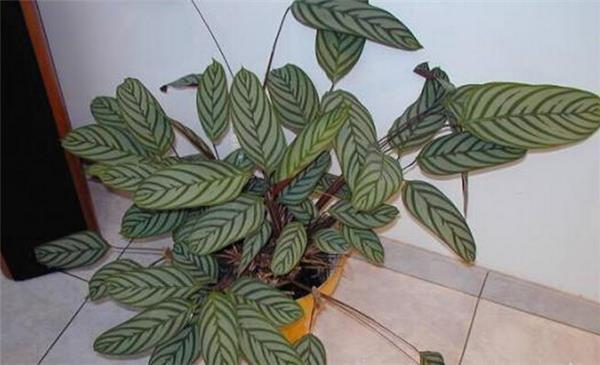
① Pot selection. Calathea makoyana is a shallow-rooted plant, so the growing container should preferably be a wide, shallow pot to help the root system extend and spread. The potting soil needs to be loose, fertile, and well-drained. A mix of 6 parts peat soil (or leaf mold), 2 parts garden soil, and 2 parts sandy soil can be used. A soilless medium can also be used, such as an even mix of perlite and vermiculite. Generally, repotting is done at the turn of spring and summer together with division propagation, once every 2 years.
② Fertilizing. During the peak growing season, Calathea makoyana should be given a dilute liquid fertilizer once every half month. When fertilizing, be careful not to apply too much nitrogen fertilizer, so as to avoid poor growth such as fading leaf markings, thickened leaves, and soft petioles. Generally, the application ratio of nitrogen, phosphorus, and potassium should be 1:1:1. For soilless cultivation, it is enough to apply a complete-element inorganic nutrient solution 1-2 times a month during the growing period.
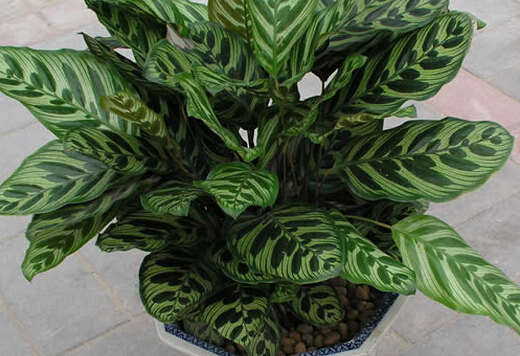
4. Propagation. Calathea makoyana is mostly propagated by division, carried out in spring from April to May together with repotting and soil replacement. Dividing too early when the temperature is too low slows wound healing, easily causes rot, and reduces the survival rate. When dividing, turn the mother plant out of the pot, remove the old soil, and use a sharp knife to cut every 3-4 buds into 1 plant. Coat the cut surface with charcoal powder to prevent rot, pot them immediately after cutting, water thoroughly, and place them in a semi-shaded spot to recover. After 5-7 days, they can be returned to normal care. When dividing, it is best to plant 3-5 plants per pot. If only one plant is planted per pot, it is necessary to retain more than 5 leaves and bring along more roots; otherwise, it will affect the plant's survival and its growth and development after survival.
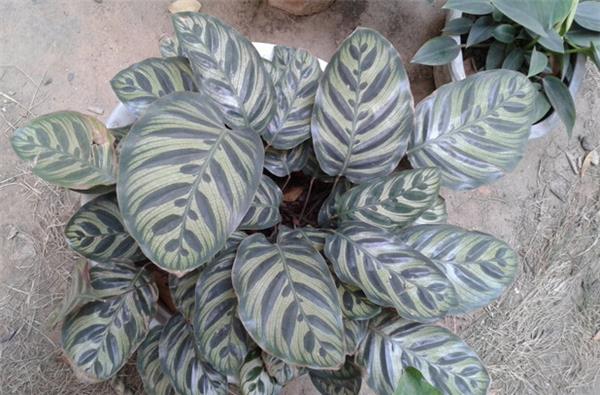
When growing Calathea makoyana at home, humidity must be controlled. Apart from summer and winter, it is recommended to spray and wash it once every 3-5 days. Those with a greenhouse can also raise the greenhouse temperature to increase humidity. To make the leaf color radiant and gorgeous, it is recommended to apply a dilute liquid fertilizer once every 3-4 weeks during the growing period, along with applying nutrient solution 1-2 times a month. The most important thing is to provide more sunlight, because if kept in a dim spot for a long time, the leaves will lose their distinctive gorgeous gloss. In daily care, pay attention to gently wiping the leaves with clean water often. Only by doing the above aspects well can the leaf color of Calathea makoyana remain beautiful.