Methods for Growing Crown of Thorns and an Analysis of Its Uses
Crown of Thorns, also known as Iron Begonia, Qilin Thorn, and Qilin Flower, originated on the island of Madagascar in Africa. Some plants can play a role in dispelling negative energy in feng shui. If, looking out from a balcony at home, the surrounding environment is harsh, with a sharp corner nearby pointing at the house, a street running straight at it, a street curving away like a bow, or if it faces a temple, hospital, or cemetery, then plants that can dispel negative energy should be placed there. So what are the uses of Crown of Thorns?

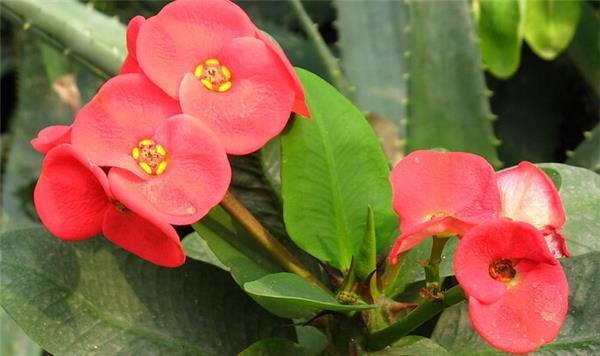
1. Ornamental value. Crown of Thorns can be used for potted ornamental display, thorn hedges, and so on. It is easy to cultivate and has a long flowering period, with bright red bracts that are dazzling to the eye, making it a highly popular potted plant. Because the young stems of Crown of Thorns are supple, they are often used to tie into shapes such as peacocks, becoming a fine display piece in public places such as hotels and shopping malls.
2. Medicinal value. The stems, flowers, branches, and leaves of Crown of Thorns can be used as medicine. It is cool in nature, bitter in taste, and slightly toxic. It has the effects of drawing out toxins and reducing fire, and cooling the blood to stop bleeding.
Common varieties:
Among plants of the same genus as Crown of Thorns, the white-flowered Crown of Thorns (var. alba) is also commonly cultivated. At present there are many horticultural varieties with different flower colors, as well as large-flowered varieties.
Origin and distribution:
Crown of Thorns originated on the island of Madagascar in Africa, and prefers a warm, humid, and sunny living environment.
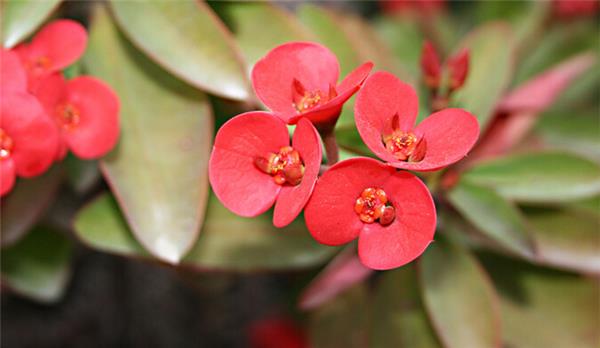
Crown of Thorns prefers a warm, humid, and sunny environment, tolerates high temperatures but not cold, and does best in loose, well-drained leaf mold soil, with winter temperatures not below 12°C. Crown of Thorns has a special nature: it grows slowly, adding only about 10 cm per year, but it is long-lived and can live for more than 30 years as a potted plant. Its flowering period is long; if light and temperature are suitable, it can bloom year-round. So what are the methods for growing Crown of Thorns?
There are many methods for growing Crown of Thorns. The most suitable growing temperature for Crown of Thorns is 15°C to 32°C. It fears high temperatures and stuffiness, and in winter, when the temperature drops below 4°C, it also enters a dormant state. If the ambient temperature approaches 0°C, it will die from frostbite. In the intense heat of summer, when the temperature is above 33°C, it enters a dormant state. It avoids cold and frost, and the overwintering temperature needs to be kept above 10°C. Its drought tolerance is very strong, and it can grow even under arid environmental conditions. If water accumulates in the flower pot, or if it is watered and fertilized too frequently, it is prone to root rot.
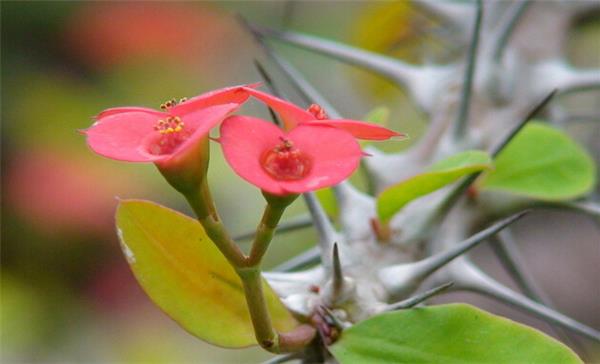
Crown of Thorns cutting propagation method: Crown of Thorns is mainly propagated by cuttings. Cuttings can be taken throughout the growing period, but May to June is best, with a high survival rate. Select mature branches from the previous year, cut them into sections of about 6 cm, with the tip branches being best. White milky sap flows from the cut; wash it with warm water and let it dry, then insert it into a sand bed. Crown of Thorns tissue culture method: Crown of Thorns generally uses the cutting propagation method, but Crown of Thorns has a low propagation coefficient and slow speed, making it difficult to achieve standardized production, so large-scale propagation generally uses the tissue culture method, which can achieve relatively good results.
The above is the relevant information about Crown of Thorns introduced for everyone, and I hope it can be of help to you.