An In-Depth Analysis of the Effects and Benefits of Gelsemium
After news spread that someone died of poisoning after putting Gelsemium into a hot pot, many people became curious about the brief introduction to the effects and benefits of Gelsemium and how to use it, and quite a few asked: what exactly are the effects and benefits of Gelsemium?
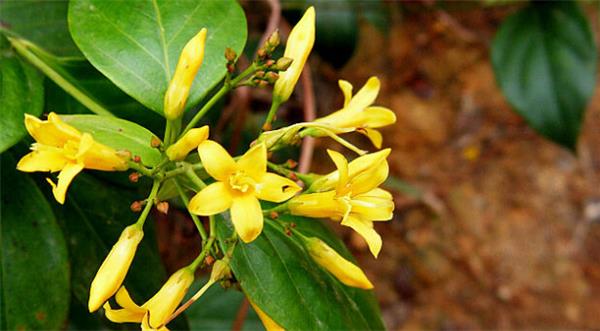
[Gelsemium pinyin name] DuànChánɡCǎo.
[Gelsemium alias] Gouteng, Da Cha Yao, Da Pao Ye, Huanghua Ku Man, Huang Meng Cai.
[Gelsemium source] It is the plant Gelsemium elegans (Gardn. et Champ.) Benth. of the genus Gelsemium in the family Loganiaceae, with the root, leaves and whole plant used as medicine. The root can be collected throughout the year, washed clean and sun-dried. The leaves and whole plant are collected in summer and autumn and sun-dried.
[Gelsemium toxicity] This product contains a variety of extremely toxic gelsemine alkaloids, and accidental ingestion can be fatal. After poisoning, it causes dizziness, severe pain in the throat and abdomen, foaming at the mouth, dilated pupils, dropping of the lower jaw, muscle weakness, and death from heart and respiratory failure.
[Gelsemium nature and flavor] Bitter, pungent, warm. Highly toxic.
[Gelsemium effects and functions] It counteracts toxins and draws out poison, disperses blood stasis and relieves pain, and kills insects and stops itching. For external use it treats skin eczema, tinea corporis, tinea pedis, bruises, fractures, hemorrhoids, boils, and leprosy. It can also kill maggots and mosquito larvae.
[Gelsemium main indications] (1) Digestive system tumors such as liver cancer, esophageal cancer and gastric cancer, as well as lymphosarcoma, osteosarcoma, skin cancer, etc. (2) Rheumatic arthralgia, furuncles and toxic swellings, scabies and tinea, skin eczema, etc.
[Gelsemium usage and dosage] For external use, an appropriate amount; pound the fresh product and apply it to the affected area, or decoct it in water and wash with it.
[Gelsemium caution] Oral administration is prohibited. Its roots, leaves and flowers can all be pounded and applied externally, but the time should be watched, otherwise blisters will form.
The scientific name of Gelsemium is Gouteng, and it also has other aliases such as Jin Gou Wen, Ku Wen, Lan Chang Cao, Ye Ge, Da Cha Yao, Da Cha Teng, Du Ji Da Cha Ye, Hu Man Teng, Hu Man Teng, Du Gen, Shan Pi Shuang, Huang Teng, Zhu Ren Shen, Ma Zui Teng, Huo Ba Cao, and Shui Mang Cao. It is the plant Hu Man Teng of the family Gelsemiaceae, an annual vine.
Gelsemium is bitter, pungent, warm. Highly toxic. It has the effects of counteracting toxins and drawing out poison, dispersing blood stasis and relieving pain, and killing insects and stopping itching. For external use it treats skin eczema, tinea corporis, tinea pedis, bruises, fractures, hemorrhoids, boils, and leprosy. It can also kill maggots and mosquito larvae. The rhizome and leaves contain the alkaloids gelsemine zi, yin, mao, jia, bing and chen, among which gelsemine zi has the highest content, and gelsemine yin is extremely toxic and is the most important active ingredient. So what is the detailed information about Gelsemium?
(1) Morphological characteristics
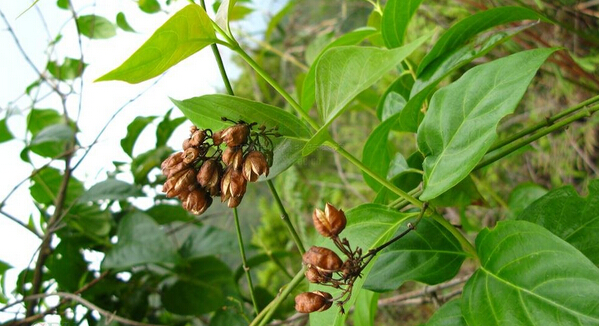
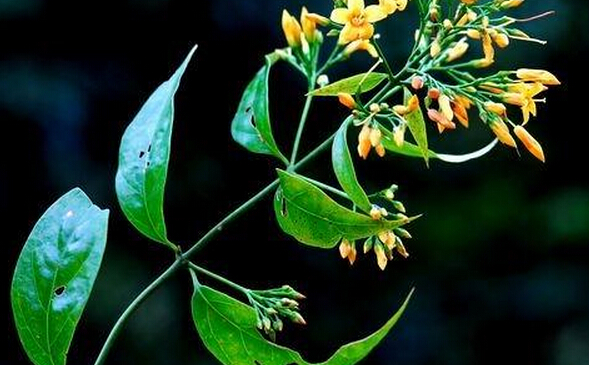
Evergreen vine, about 12 m long. Branches smooth, young branches with fine longitudinal ridges. Leaves simple, opposite; with short petioles; leaf blades ovate-oblong to ovate-lanceolate, 5-12 cm long, 2-6 cm wide, apex acuminate, base cuneate or nearly rounded, margin entire. Cymes mostly terminal, three-forked branching, bracts 2, short triangular; sepals 5, separate, about 3 mm long; flowers small, yellow, corolla funnel-shaped, apex 5-lobed, with pale red Da Cha Yao spots inside, lobes ovate, apex acute, shorter than the corolla tube; stamens 5; ovary superior, 2-locular, style filiform, stigma 4-lobed. Capsule ovate-elliptic, 10-14 mm long, 6-8 mm in diameter, pendulous, with persistent calyx at the base, pericarp thinly leathery. Seeds oblong, numerous, with spiny protrusions, winged at the margins. Flowering period May to November, fruiting period July to February of the following year.
(2) Ecological environment
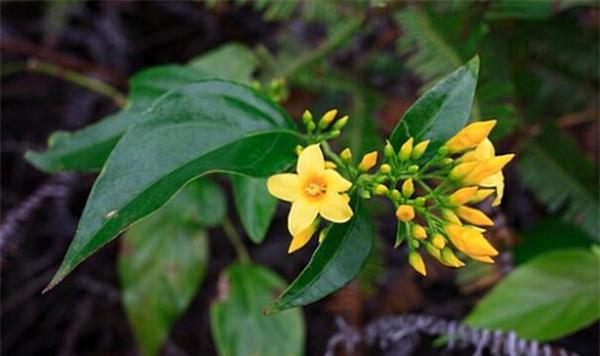
It mainly grows on hillsides, in ravines, on hills, and in open forests or thickets.
That is all for the introduction above. After reading it, don't you think this Gelsemium has quite a few effects? If you want to use Gelsemium, you must first ask a doctor before determining how much is appropriate for you; otherwise, accidental ingestion will cause great harm to the body, and I hope this will draw everyone's attention.