A Detailed Guide to Haworthia truncata Cultivation Methods and Classification
Haworthia truncata is a succulent plant in the Liliaceae family. Its leaf pads are arranged in two columns forming a fan shape, and because the fleshy leaves are slightly thick and jade-like, it is called "jade fan" (Yu Shan). Its plant form resembles a fan, the leaves are thick and fleshy, and the tips look like transparent window patterns. Its leaves have many patterns and look very small and exquisite, and it is praised as a living work of craft art. It is one of the favorite varieties of many plant lovers. So, what are the cultivation methods for Haworthia truncata?
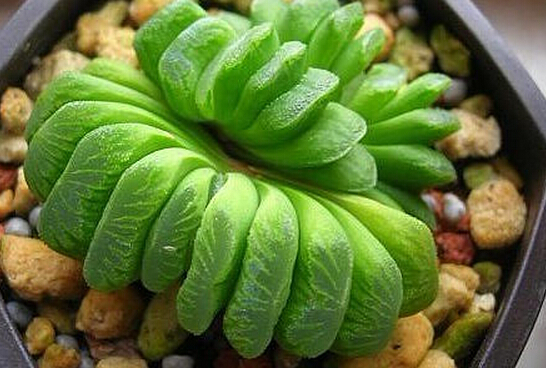
Cultivation Methods for Haworthia truncata
Haworthia truncata generally enters dormancy from the end of June to the beginning of October, and its growing period is roughly from November each year to July of the following year. In winter, the minimum temperature should generally be kept above 8°C, and the suitable temperature during the growing period is about 15-20°C.
Temperature: In winter it should be kept above 8°C, and the growing temperature is 15-20°C. The temperature should not be too low, but it also should not be too high, because Haworthia truncata is not tolerant of high temperatures. It can be kept in a dry and semi-shaded environment, and the air should not be too humid.
Watering: During the growing period of Haworthia truncata, its leaves grow relatively quickly, but its leaves do not evaporate much water, so it is not suitable to water too much. During the high temperatures of summer, Haworthia truncata is in a semi-dormant state; at this time it should not be placed in an environment with direct sunlight, and watering should be reduced. Only when it resumes growth can watering be increased, but the potting soil should be kept slightly moist and must not become waterlogged.
Sunlight: Haworthia truncata likes a semi-shaded environment and must not be exposed to direct sunlight or strong light.
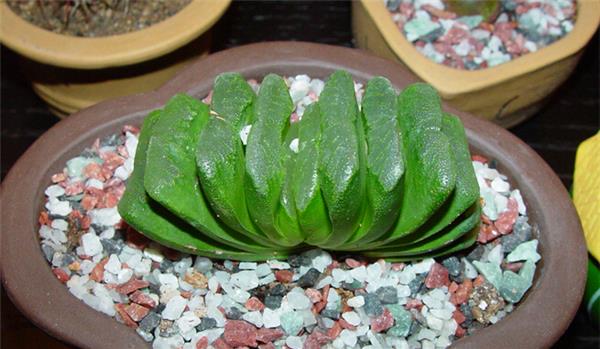
Fertilizing: During the growing period of Haworthia truncata, fertilize once every two weeks. A flower fertilizer with a nitrogen-phosphorus-potassium formula is generally used to conveniently provide the long-term nutrients it needs.
Repotting: It is generally recommended to repot Haworthia truncata every year. The repotting time can be chosen in spring, and the soil requirement is loose, fertile sandy soil. At the same time, the pots can be turned once at the end of September each year, which can remove old roots and also loosen the soil.
Prevention of common diseases: Haworthia truncata sometimes develops leaf rot and dry rot; at this time it can be sprayed with a 1500-fold dilution of 50% carbendazim wettable powder. As for insect pests, there is damage from whiteflies, which can be killed by spraying with a 3000-fold dilution of 10% deltamethrin emulsifiable concentrate.
Haworthia truncata (Haworthia truncata), also known as truncated twelve, is a succulent plant in the genus Haworthia of the Liliaceae family. The plant has no stem, and the fleshy leaves are arranged in two columns in a fan shape. The leaves are upright, slightly curved inward, and slightly concave at the top. The surface is rough, green to dark greenish-brown, with small wart-like protrusions, and the cross-section of new leaves is partly transparent and grayish-white. Some varieties also have grayish-white transparent patterns on the leaf cross-section. Its horticultural variety Haworthia truncata 'Nishiki' has yellow or pink markings on the leaves, making it even more beautiful. So, what types of Haworthia truncata are there?
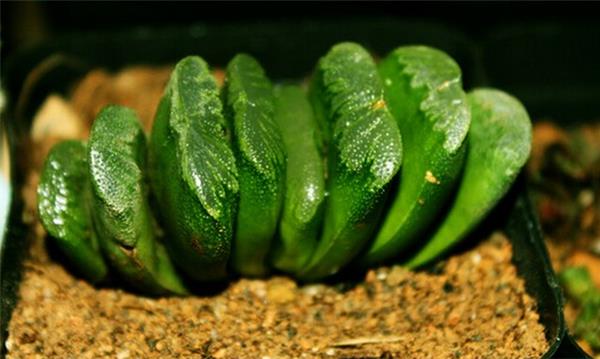
Types of Haworthia truncata
Haworthia truncata can be roughly divided by leaf shape into: peak type, umbrella type, flat type, and pot type.
By the patterns on the leaf surface:
1. Those with many white or green lines on the window surface are called dragon patterns.
2. Those with striped white lines on the window surface are called stripes.
3. Those whose window surface is covered with small dots are called granular.
4. Those with green and white dots on the window surface are called islands.
5. Those with a patch of white lines in the middle of the window surface are called white clouds.
6. Those without lines are called no-line fans.
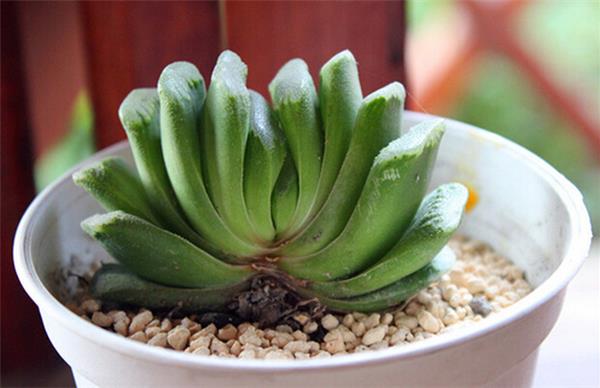
7. Those with a cross-shaped pattern on the window surface are called crosses.
8. Those with a single white line in the middle of the window surface are called single-line patterns.
By propagation method, they can be divided into: division, leaf cuttings, root cuttings, and seed sowing.
The above is the relevant introduction to the cultivation methods and classification of Haworthia truncata. I hope this introduction can help everyone.