A Detailed Guide to the Daily Care Methods and Techniques for Cyclamen
As the king of potted flowers, cyclamen naturally has its unique qualities, and it also carries the meaning of "immortals arriving gracefully." Let's take a look together at the daily care methods for cyclamen!
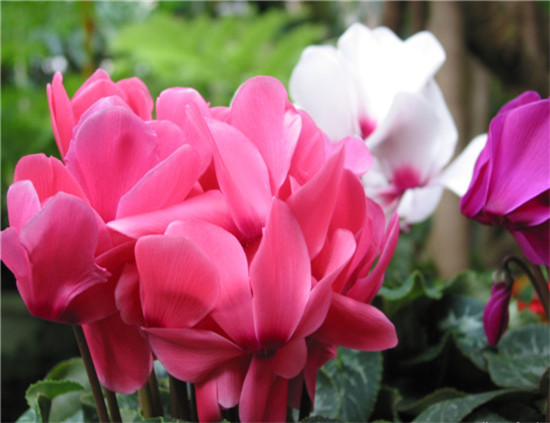
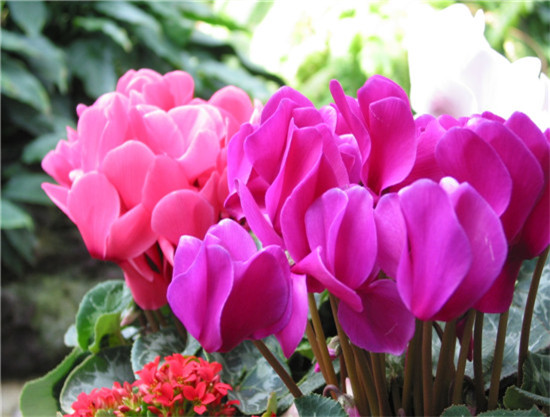
Cyclamen is also called rabbit ear flower, yipin crown, and radish begonia (cyclamen). It originated in the Mediterranean region. Because horticulturists have continuously improved its varieties, this beautiful begonia flower has become a worldwide ornamental flower and is highly praised by many flower lovers. Its tuber is flat-round spherical or spherical, fleshy; the leaf surface is green with white or gray mottling; the leaf underside is green or dark red; the leaf stalks are relatively long, reddish-brown, and fleshy. The leaves grow from the top of the tuber and are ovate, kidney-shaped, or heart-shaped, with fine serrations along the leaf edges. The flowers come in white, pink, rose red, bright red, purple red, snow blue, and other colors, usually with dark red spots at the base; the petal edges are diverse, including notched, entire, wavy, and wrinkled forms.
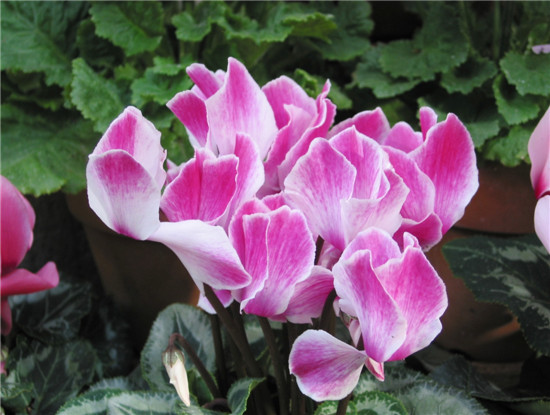
It has more than 20 varieties. According to flower shape, horticultural varieties of cyclamen can be divided into four types. First, the large-flowered type: large flowers, petals entire, flat-spreading, reflexed, with single, double, and fragrant varieties; second, the flat-petal type: petals flat-spreading and reflexed, with fine notches and wavy wrinkles at the edges, buds relatively pointed, and petals relatively narrow; third, the Rococo type: flowers half-open and drooping; petals not reflexed, relatively broad, with wavy wrinkles and fine notches at the edges. The bud tip is round, and the flowers are fragrant. Leaf edge serrations are prominent; fourth, the ruffled-edge type: large flowers, petal edges with fine notches and wavy wrinkles, petals reflexed.
Care of Cyclamen
1. Cyclamen's soil requirements. It likes a sunny, humid, and cool environment, but fears waterlogging. The growing medium needs to be loose, breathable, well-drained, and slightly acidic. In general cultivation, a mixed medium of peat and perlite is used. A mixture of leaf mold and cinder ash can also be used for cultivation. During cultivation, the medium must be disinfected and sterilized to prevent damping-off, root rot, and other diseases. The potting soil needs to remain moist, but water accumulation or waterlogging must be strictly prevented; otherwise, once the roots rot, the whole plant will quickly die.
2. Cyclamen's temperature requirements. It likes a warm environment and is not tolerant of high temperatures or severe cold. The maximum temperature must not exceed 30°C, otherwise it will enter a dormant state; high temperatures around 35°C easily cause rot and necrosis. In winter, it is best to keep it between 10-20°C. Below 5°C, growth is inhibited, leaves curl, and flowers also open poorly with dull colors. In summer, place it in a humid, ventilated place, and keep the potting soil somewhat dry so it can fully dormant through the summer.
3. Pest and disease control for cyclamen. The main diseases of cyclamen include bacterial soft rot, bacterial leaf rot, gray mold, anthracnose, and leaf spot. Among them, soft rot and leaf rot are especially serious. When controlling them, attention should be paid to the following aspects: strictly disinfect seeds, growing soil, tools, and so on; strengthen ventilation, lower temperature and humidity, and avoid rain cultivation as much as possible; promptly remove diseased leaves and diseased plants, and leaf picking and bud picking should be done when conditions are relatively dry; carry out regular chemical control. In addition, cyclamen is also susceptible to damage from root-knot nematodes, mites, aphids, and others, and control should be noted.
Cyclamen's Impact on the Home Environment
1. It has the function of purifying the air. Cyclamen has a relatively strong ability to absorb sulfur dioxide and strong resistance, and it also has a certain ability to absorb some other harmful gases. It absorbs sulfur dioxide through its leaves and, through oxidation, converts it into non-toxic or low-toxicity substances such as sulfates. In addition, cyclamen can also absorb carbon dioxide while releasing oxygen, and it can increase the negative ion content in indoor air and raise air humidity. Placing it at home is entirely appropriate.
2. It has a fragrance that makes people comfortable. Most cyclamen have fragrance; some varieties are very strongly fragrant, some are faintly fragrant, and some have no fragrance. This kind of fragrant cyclamen can help people relax during tense work. The volatile substances it releases have a very good regulating effect on people's emotions. Some of the fragrances released can change people's listless state, lift the spirits, or have a calming and sleep-aiding effect. Combined with its humidifying function, in tightly closed rooms using air conditioning, it plays an important role in protecting the skin. It also continuously replenishes fresh oxygen, which is very beneficial to our bodies. Placing a pleasing cyclamen within your field of view eliminates physiological eye fatigue and cheers you on.
The above is the full content of the daily care methods for cyclamen and the daily care techniques for cyclamen that I have summarized for everyone. I hope this article can help everyone. Please also continue to follow us.
Placing a pleasing cyclamen within your field of view eliminates physiological eye fatigue and cheers you on.The above is the full content of the daily care methods for cyclamen and the daily care techniques for cyclamen that I have summarized for everyone. I hope this article can help everyone. Please also continue to follow us.