What are the uses of honeysuckle vine, and how should it be cultivated?
Honeysuckle, also known as golden-silver vine, mandarin duck vine, or twin flower, is a vine plant. Let us now learn about the uses and cultivation methods of honeysuckle vine!
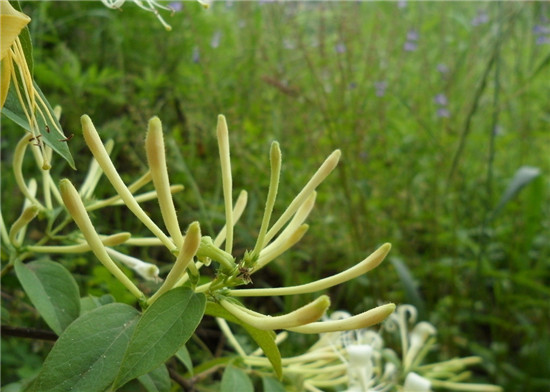
Varieties of Honeysuckle Vine
South China honeysuckle: This species differs from the Caprifoliaceae type in that the young branches, petioles, peduncles, bracts, and bracteoles are all covered with grayish-yellow curled short pubescence, and sparsely covered with minute glandular hairs; the branchlets are pale reddish-brown or nearly brown. The leaves are ovate to ovate-oblong, covered on both surfaces with short rough hairs when young, and hairless on the upper surface when old. The bracts are lanceolate, 1-2mm long; the bracteoles have cilia at the apex; the calyx tube is covered with soft hairs. The fruit is black. The flowering period is April-May, and the fruit ripening period is October.
Giant glandular honeysuckle: This species differs from the previous two in that the underside of the leaves is sometimes powdery green, with stalked or very short-stalked yellow to orange-red mushroom-shaped glands. The bracts are linear-lanceolate, nearly equal in length to the calyx tube, with short rough hairs and cilia on the outside; the corolla is white, sometimes with a pale red tinge, later turning golden yellow, sparsely covered on the outside with reversed minute appressed hairs, and often bearing sessile or short-stalked glands. The fruit sometimes has a white bloom. The flowering period is April-June, and the fruit ripening period is October-November.
Yellow-brown hairy honeysuckle: This species differs from the previous three in that the young branches, petioles, underside of leaves, peduncles, bracts, bracteoles, and calyx teeth are all densely covered with spreading or curved-appressed yellow-brown felted rough hairs, the hairs not exceeding 2mm in length, and the young branches and both surfaces of the leaves are scattered with orange-red short glandular hairs. The leaves are papery, ovate-oblong to oblong-lanceolate. The bracts are subulate; the bracteoles are ovate to linear-lanceolate; the twin flowers lack bract-like leaves beneath; both the corolla and bracts are relatively short, and the outside of the corolla is densely covered with yellow-brown appressed hairs and spreading short glandular hairs. The flowering period is June-July.
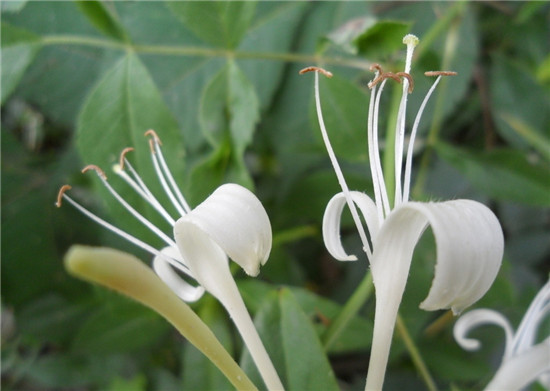
The uses and effects of honeysuckle vine are as follows:
1. Treating hemorrhoids and fistula. Take honeysuckle vine (including flowers, stems, and leaves) in any amount, soak in wine, simmer overnight, remove and sun-dry, add a little licorice, grind together into powder, mix flour with the soaking wine and the powder to form pills the size of wutong seeds. Take fifty to one hundred pills per dose, swallowed with boiled water or wine. This formula is called "Ren Dong Wan" (Honeysuckle Pill).
2. Treating all manner of swellings and toxins (regardless of whether they have ulcerated or not, or whether there is fever at the onset). Take honeysuckle vine (including flowers, stems, and leaves), obtain half a bowl of natural juice and boil it down to 80 percent, then take it orally; at the same time, apply the medicinal residue to the affected area.
3. Treating furuncles, urinary toxicity, throat obstruction, and tonsillitis. The treatment formula is the same as above.
4. Treating malignant sores that will not heal. Take one handful of honeysuckle vine, pound it into a paste, add five fen of realgar, two sheng of water, place in an earthenware jar and boil, seal with several layers of paper, pierce a hole to let the steam out. Hold the sore over the hole to fumigate with the hot steam; wait until the sore discharges a large amount of yellow fluid, then apply a tissue-regenerating medicine, and the illness will be cured.
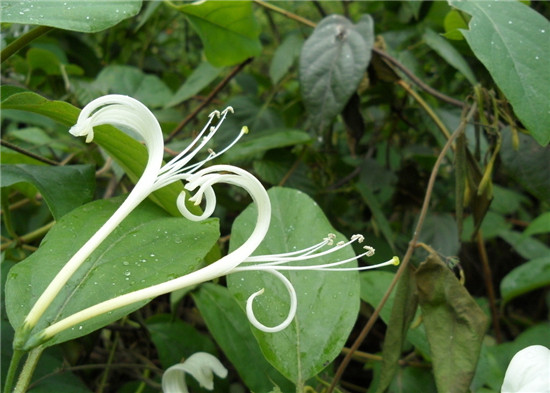
5. Treating heat-toxin bloody dysentery. Boil honeysuckle vine into a thick decoction and drink it.
6. Treating bluish discoloration of the body. Take one liang of honeysuckle vine (including flowers, stems, and leaves), boil in water and take.
7. Treating beriberi (with pulling pain in the tendons and bones). Use honeysuckle vine (including flowers, stems, and leaves). Take two qian per dose, mixed with hot wine.
8. Treating poisoning from wild mushrooms. Gather honeysuckle vine, boil and take.
Cultivation Methods of Honeysuckle Vine
Honeysuckle can be sown from seeds found in its black berries, and can also be propagated by cuttings, layering, and division.
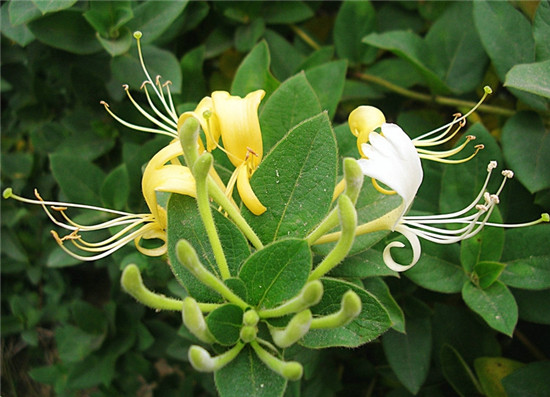
Honeysuckle can climb flower trellises, hedges, walls, and fences. The flowers have a pleasant fragrance, especially the four-season honeysuckle, whose fragrant flowers continue from spring to autumn, with golden and silver flowers intermingling in ceaseless clusters. If planted in a courtyard, it offers both flowers to admire and fragrance to enjoy; in the scorching summer heat, resting in the shade beneath a honeysuckle trellis is a joy beyond measure.
Honeysuckle has no special requirements for soil and can grow in ordinary soil, but it should not be planted in overly shady, overly dry, overly wet, or waterlogged spots. In the second year after planting, a flower trellis should be set up or the plant moved near a hedge, wall, or fence, so that it has something to cling to and twine around as it climbs.
After three or four years, a pruning should be carried out to cut away messy and crossing branches; otherwise, the plant becomes too crowded and prone to aphids, scale insects, and other pests. At the same time, pruning can promote ventilation and light penetration, which benefits flowering. During dry periods, water promptly so that the plant does not suffer drought and drop its flowers. Rice-washing water and the dirty water from washing fish or meat, after full fermentation, can all be used for watering. If aphids or scale insects are found causing damage, spray with dimethoate diluted 1500 times with water, or use tobacco leaves soaked in water to kill them. During high temperatures and drought, sooty mold disease often occurs and covers the leaf surface, which can be prevented and treated by spraying with thiophanate-methyl or carbendazim.
The above is the complete content of my summary of the uses and cultivation methods of honeysuckle vine. I hope this article can help everyone. Please also continue to follow us.