Detailed Information and Complete Introduction to Pansy
Pansy is also called butterfly flower, butterfly violet, and monkey face flower. It is a plant that blooms in spring and summer, and we often see it in open-air flower beds. Next, let us learn about the pansy plant together.
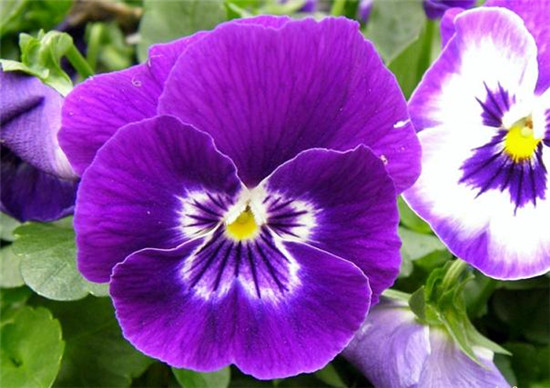
Pansy is a biennial or perennial herbaceous plant of the order Malpighiales, family Violaceae, genus Viola. The basal leaves are long ovate or lanceolate, with long petioles; the stem leaves are ovate, oblong, or oblong-lanceolate, with rounded or obtuse tips and sparsely crenate or obtusely serrate margins.
Pansies are best planted outdoors, and are suitable for flower beds, courtyards, and pots alike. They are not suitable for indoor planting because insufficient light slows growth, prevents the branches and leaves from becoming fully robust, and results in failure to bloom. After blooming, they should also not be moved indoors, so as to prolong the life of the flowers.
Pansy Variety Classification
Giant-flowered series
Flower diameter can reach 10 cm. Examples include Magnifico, Oregon Giant, Roggli, and Jitpin.
Large-flowered series
Flower diameter 6-8 cm. For example, Swiss Giant is a dwarf variety with bright flower colors.
Medium-flowered series
Flower diameter 4-6 cm. Examples include Sanmadu and Haima, suitable for flower bed arrangement.
Cut-flower series
The variety group has tall plants, with flower stalks 15-25 cm long, suitable for protected cultivation.
Characteristics of Pansy
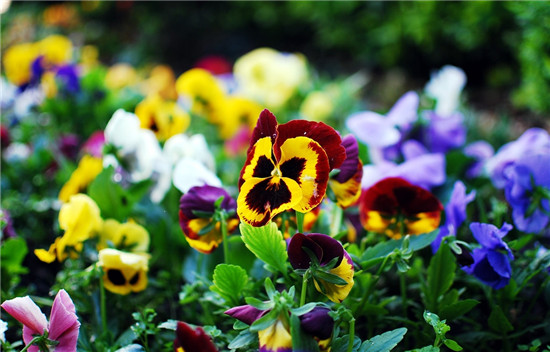
Plant height 10-40 cm, stem erect or slightly inclined, ridged, unbranched or much branched; basal leaves oblong or lanceolate, with long petioles; stem leaves ovate or long lanceolate, with obtuse-rounded tips, rounded bases, and leaf margins with rounded or obtuse sparse teeth; upper petioles long, lower petioles short; stipules large, leaf-like, pinnately parted, 1-4 cm long. Flowers 3.5-6 cm in diameter, 3-10 per stem, each flower usually having three colors of purple, white, and yellow; cultivated varieties have other different colors; pedicels somewhat thick, solitary in leaf axils, with 2 opposite triangular-ovate bracteoles above; sepals green, long lanceolate, 1.2-2.2 cm long, 3-5 mm wide, acute at the tip, with membranous margins, with appendages at the base, 3-6 mm long, margins uneven; the upper petal is generally dark purple, the lateral and lower petals are tricolor with purple stripes, the inner base of the lateral petals is covered with dense villous hairs, and the lower spur is relatively slender, 5-8 mm long; ovary hairless, style short, base conspicuously geniculate, stigma spherical and swollen, with a relatively large stigmatic opening at the tip. Capsule ellipsoid, hairless, 8-12 mm long. Chromosome number 2n=20, 26, 42, or 46. Flowering period April-July, fruiting period May-August.
Pansy Cultivation Methods
How to propagate: by sowing. In South China, autumn and winter are the suitable sowing periods, and the suitable germination temperature for seeds is about 15-20°C. Scatter the seeds evenly in fine tree-fern fiber, keep it suitably moist, and they will germinate in about 10-15 days. If the temperature is too high, germination is difficult, so you can pre-germinate before sowing: fold half a sheet of toilet paper into a square, put it into a small plastic ziplock bag, add a little water drop by drop so that the toilet paper fully absorbs water, then pour the seeds into the bag, seal the bag opening, place it in a refrigerator at 5-8°C, and take it out to sow after about 6-7 days. After germination and seedling formation, when 2-3 true leaves have developed, prickle out into seedling-raising pots, apply fertilizer 1-2 times, and when 5-7 true leaves have developed, transplant for cultivation.
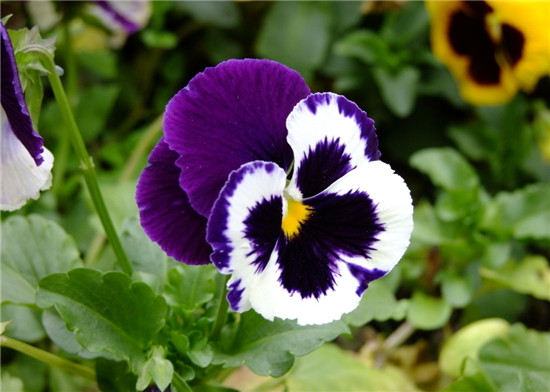
In early summer, propagate by cuttings or layering. Cuttings can be taken from March to July, with early summer being the best. Generally, it is better to cut short shoots sprouting from the central rhizome of the plant as cuttings; flowering branches cannot be used as cuttings. After cutting, roots will form in about 2-3 weeks, with a very high survival rate. Layering propagation also easily survives.
The Legend of Pansy
Long, long ago, it is said that the viola flower was pure white, like clouds in the sky. The mischievous Cupid, god of love, was a little naughty boy. The bow and arrow in his hands had the magic power of love: whoever it struck would involuntarily fall in love with the first person they saw. Unfortunately, the god of love was both mischievous and inaccurate in archery, so love stories in the human world often went wrong. One day, the god of love found another unlucky fellow and prepared to shoot him with an arrow. Who would have thought that just as the arrow was shot, a gust of wind suddenly blew over, and the arrow unexpectedly hit a white viola flower. From the heart of the white viola flower flowed blood and tears, and after this blood and these tears dried, they could never be wiped away again. From then on, the white viola flower became today's pansy. This is the origin of the pansy in mythology.
What Is the Flower Language of Pansy
Flower language of pansy: meditation, happiness, please miss me.
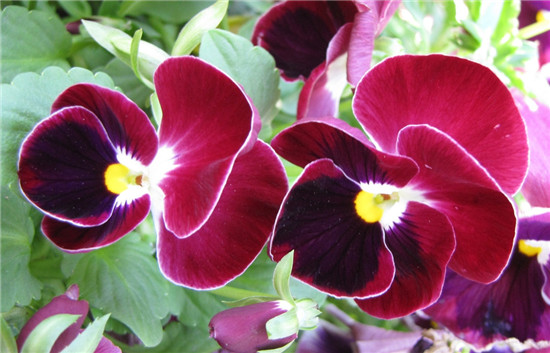
Flower language of red pansy: for pansies with red petals, the flower language is "thoughtfulness, longing," and the attribute is fire.
Flower language of yellow pansy: for pansies with yellow petals, the flower language is "mixed joy and sorrow," and the attribute is earth.
Flower language of purple pansy: for pansies with purple petals, the flower language is "silent," "unconditional love," and the attribute is dark.
Flower language of large pansy: bondage.
The above is all the content of the detailed information on pansy and the complete introduction to pansy that I have summarized for everyone. I hope this article can help everyone. Please also continue to follow us.
The flower language is "silent," "unconditional love," and the attribute is dark.Flower language of large pansy: bondage.
The above is all the content of the detailed information on pansy and the complete introduction to pansy that I have summarized for everyone. I hope this article can help everyone. Please also continue to follow us.