What to Do When Bromeliad Leaves Turn Yellow? Included: How to Grow and Care for It
Bromeliads come in diverse flower shapes and vivid colors, and because of their festive hues they are a top choice for holiday flowers. However, ornamental bromeliads have extremely poor root systems; they mainly rely on their leaves to absorb water and nutrients. Bromeliads prefer a warm environment and a humid climate. The lower leaves of a bromeliad are arranged tightly to form a rosette-shaped leaf tank, and the center of the leaf tank is cup-shaped and can hold water without leaking. Therefore, during cultivation you should water frequently to keep the center and the spaces between the leaves moist, so as to ensure the water supply for the whole plant. To make the bromeliad grow lushly, every two weeks you also need to apply a small amount of foliar fertilizer into the leaf tank, such as Pen Shi Bao; the specific amount depends on the instructions on the foliar fertilizer and the growth of the plant.
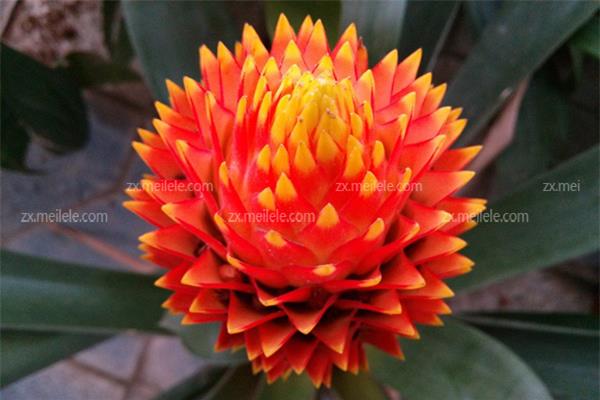
Perhaps many friends have had this experience: when the bromeliad was just bought it may have looked very attractive with very vivid colors, but after some time the bromeliad's leaves may wither and turn yellow. So what causes the leaves to turn yellow? And how should the problem of bromeliad leaves turning yellow be solved? Next I will take everyone to have a look.
Bromeliad leaves turning yellow
Soil
Cause: The soil's drainage is not good enough, leading to waterlogging in the soil, root rot, and water being unable to reach the leaves, which causes the bromeliad's leaves to turn yellow.
Solution: Therefore when choosing soil you should choose soil with good drainage, to prevent waterlogging in the soil, which is bad for the bromeliad's growth.
Water
Solution: Water that is too alkaline, as well as improper watering, can also cause bromeliad leaves to turn yellow. Most of a bromeliad's water comes from the water it absorbs from the leaf cup, and only a very small proportion comes from the roots absorbing it from the soil. So generally when watering a bromeliad, besides watering the soil an appropriate amount, you also need to water the bromeliad's leaf cup. If there is too much water in the soil it will cause root rot, affecting the absorption of nutrients and water, and thus causing the bromeliad's leaves to turn yellow.
Solution: When watering, pay attention to how much water you give and the proportion of water given to different parts, and also the water used for irrigation should be weakly alkaline water.
Light
Cause: Bromeliads like a warm, humid, semi-shaded environment. If the environment is too dry or the light is too strong, the leaves will lose water and the bromeliad's leaves will turn yellow.
Solution: Place the bromeliad in a warm, humid environment, avoid direct sunlight, and maintain the humidity of the environment.
Fertilizing
Cause: The fertilizer applied to the bromeliad is too concentrated, causing inorganic salt ions to accumulate in the leaves; the ion concentration inside the leaf mesophyll cells becomes uneven and protoplast dehydration occurs, which causes the bromeliad's leaves to turn yellow.
Solution: During fertilizing, try to dilute the high-concentration fertilizer liquid into a lower concentration before carrying out the fertilizing process.
Pests and diseases
Cause: Caused by fungal or bacterial infection, or by attached insect pests; the main symptoms are spots appearing, or rot.
Solution: Fungicides and insecticides can be used for control. Solving bromeliad leaves turning yellow requires the right remedy for the cause; only by finding the problem can an effective solution be formulated in time. Once the leaves turn yellow you must check promptly and accurately to see which link has gone wrong, and quickly solve the problem at hand.
Summary: The beauty of bromeliads is special, and even more so unique. Every bromeliad has its own unique beauty, different from the beauty of other plants. After the above analysis, don't you think that growing a bromeliad is not so difficult after all? I hope the above analysis can bring everyone some help.
Recommended reading:
☑ Rohdea japonica ☑ Dianthus ☑ Cordate telosma pictures ☑ Hibiscus pictures ☑ Hydrangea pictures
☑ Wild banana ☑ Strelitzia ☑ Golden Diamond Podocarpus ☑ Adiantum pictures ☑ Guzmania