The Sentimental Mimosa: Telling You Secrets That Cannot Be Told
Mimosa pudica (sensitive plant) is an interesting ornamental plant. Once touched, its leaves close one after another, as shy as a well-bred young lady who never leaves her boudoir. Because of this trait, it is loved by many flower enthusiasts. Below, let us take a look at the mimosa together.
I. Introduction to Mimosa
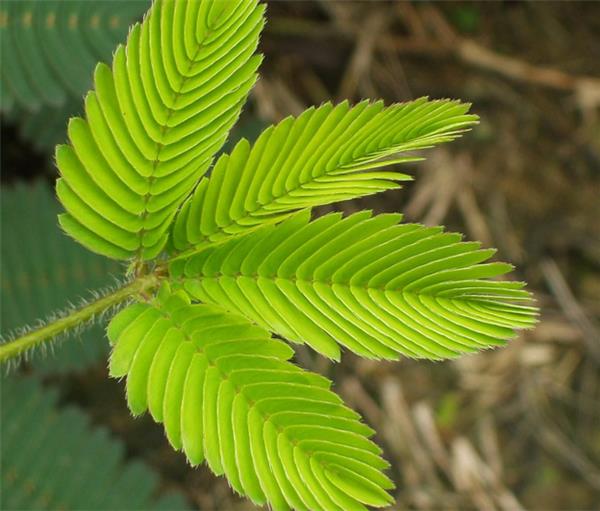
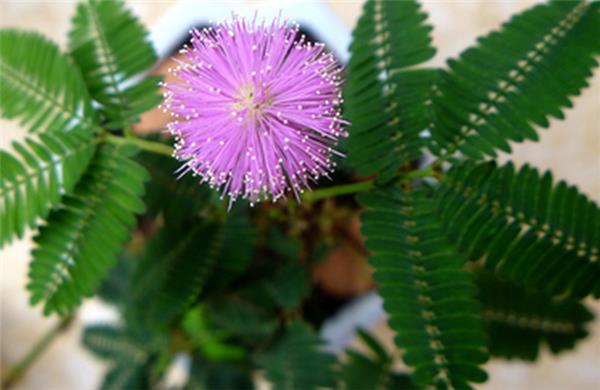
Mimosa pudica is a perennial herb or subshrub of the Fabaceae family. Because its leaves respond to heat and light and close immediately when touched by an external force, it is named mimosa (hánxiūcǎo). It is native to the tropical regions of South America, prefers warmth and humidity, and is not demanding about soil. The flowers are pink, shaped like fluffy balls, and delightfully charming. After flowering, it bears pods, and the fruit is flat and round. The leaves are pinnate compound leaves arranged alternately, in a palmate arrangement. The flowers, leaves and pods of mimosa all have good ornamental value, and it is relatively easy to keep alive, suitable as a potted flower for balconies and indoors, and can also be planted in courtyards and other places. Unlike ordinary plants, when mimosa is touched by the outside world, its petioles droop and its leaflets close. This action is understood by people as "shyness", so it is called mimosa, zhīxiūcǎo, or pàchǒucǎo. It usually blooms after midsummer; the capitulum is oblong, with 2-3 growing in the leaf axils. The flowers are pale red, the calyx is bell-shaped with 8 tiny calyx teeth, the petals are four-lobed, there are four stamens, and the ovary is hairless. The pod is flat, 1.2-2 cm long and about 0.4 cm wide, with bristles on the edges, 3-4 pod segments, each pod segment containing 1 seed, and the segments fall off when mature. The flowering period is September. Mimosa has strong adaptability, prefers warmth and humidity, grows well in moist fertile soil, is not demanding about soil, is not cold-tolerant, likes light but can also tolerate partial shade, and is now mostly grown as an ornamental plant in homes. It generally grows on hillsides in thickets and in damp places beside roads.
II. The Uses and Functions of Mimosa
1. Decorative Application
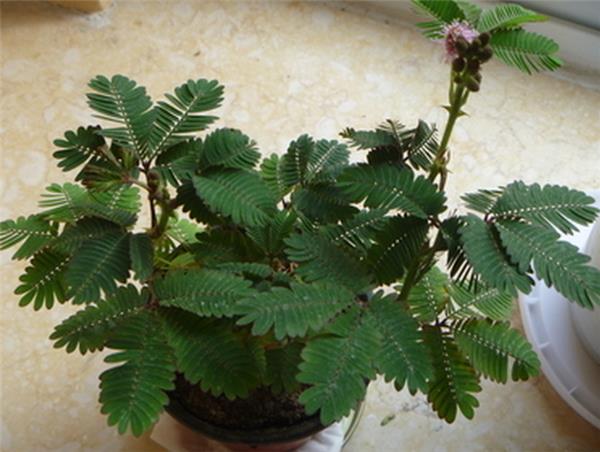
The mimosa plant has a loose form, and its pinnate leaves are slender and elegant. Its leaves close as soon as they are touched, giving people an impression of delicate refinement. When planted in the ground, it can be scattered along courtyard walls. As a potted plant, it can be placed on windowsills and desks.
2. Ornamental Value
The mimosa plant has a loose form, and its pinnate leaves are slender and elegant; its leaves close as soon as they are touched. Mimosa bears many flowers and is delicate and lovely, charming and moving, giving people an impression of delicate refinement. It can be planted in the ground at courtyard walls, or potted on windowsills and desks. When giving it as a gift, gently cover the potted plant with pink gauze and tie on a pink decorative ribbon bow. If it can also be adorned with pink mohair pom-poms, it will be even more interesting.
3. Weather Forecasting
Mimosa is a wonderful plant that can foretell changes between sunny and rainy weather. If you touch it with your hand and its leaves close very quickly but open very slowly, this indicates that the weather will turn clear; if when you touch the mimosa its leaves contract slowly, droop slowly, or even close slightly and then open again, this indicates that the weather will turn from clear to overcast or that it is about to rain. The reason the speed of the mimosa leaves' opening and closing can foretell whether the weather will be cloudy or clear is mainly that at the neck of the mimosa leaf there is a small drum-shaped thin-walled cell tissue, the pulvinus, which is filled with water. When you touch a mimosa leaf with your hand, the leaf vibrates, and the water in the lower cells of the pulvinus immediately flows upward and to both sides. In this way the lower part of the pulvinus deflates while the upper part swells, so the petiole droops and the leaf closes. Therefore, the closing and opening of the leaves is caused by the turgor pressure effect of the pulvinus. And the turgor pressure effect of the pulvinus is closely related to the humidity in the air. When the air humidity is very low, the turgor pressure effect of the pulvinus is obvious, and the leaves close and open quickly; when the air humidity is very high, the leaves open and close slowly. Therefore, the speed of the mimosa leaves' opening and closing indirectly reflects the level of humidity in the air and can serve as a reference for weather forecasting.
4. Earthquake Prediction
According to Turkish seismologist Ercan, several hours before a strong earthquake occurs, the leaves of mimosa, which are sensitive to external touch, suddenly shrivel and then wither. In earthquake-prone Japan, scientists have found through research that under normal conditions, mimosa leaves open during the day and close at night. If mimosa leaves show the abnormal phenomenon of closing during the day and opening at night, it is a precursor to an earthquake. For example: at 7 a.m. on January 11, 1938, the mimosa began to open, but by 10 a.m. the leaves suddenly all closed, and indeed a strong earthquake occurred on the 13th. In 1976, members of the Japan Earthquake Club repeatedly observed the abnormal closing phenomenon of mimosa leaves, and earthquakes occurred afterward each time. These are true events! In addition, mimosa can also predict disastrous weather changes, and will produce growth activities contrary to normal in response to sudden unseasonal temperature differences, geomagnetic changes, geoelectric changes and so on. We can place some potted mimosa plants indoors to observe and help predict and guard against natural disasters.
The above is knowledge related to mimosa. I hope it can help you.
Indeed, a strong earthquake occurred on the 13th. In 1976, members of the Japan Earthquake Club repeatedly observed the abnormal closing phenomenon of mimosa leaves, and earthquakes occurred afterward each time. These are true events! In addition, mimosa can also predict disastrous weather changes, and will produce growth activities contrary to normal in response to sudden unseasonal temperature differences, geomagnetic changes, geoelectric changes and so on. We can place some potted mimosa plants indoors to observe and help predict and guard against natural disasters.The above is knowledge related to mimosa. I hope it can help you.