Introduction to the Night-Blooming Cereus and Its Value and Clever Uses: The Night-Blooming Cereus Is More Than Just a Fleeting Bloom
The night-blooming cereus has elegant, emerald-green branches and leaves, and on quiet nights in summer and autumn it puts on a display of beautiful form and color. As a potted plant it is suitable for accenting a living room, balcony, or reception hall. In the south it can be planted in the ground, and if it spreads fully over a trellis, when it blooms in season it looks like a great drift of flying snow, a truly spectacular sight. Below, we introduce some knowledge about the night-blooming cereus.
I. Introduction to the Night-Blooming Cereus
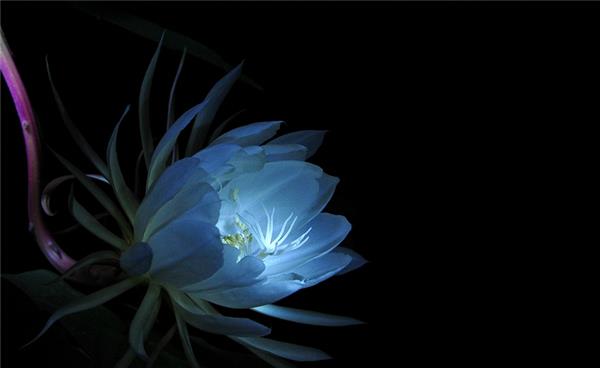
The night-blooming cereus (English name night-blooming cereus) has a shrubby main stem that is cylindrical and woody. The branches are flat and leaf-like, mostly with 2 ribs and occasionally 3 wings, with wavy rounded teeth along the edges. The areoles grow in the notches of the rounded teeth. Young branches have bristle-like spines; old branches have no spines. In summer and autumn it blooms at night with large white flowers, funnel-shaped and fragrant. It originated in Mexico. It likes a warm, humid, and semi-shaded environment. It is not tolerant of frost and dislikes strong direct sun. A sandy loam rich in humus is suitable. In winter the temperature should not fall below 5°C. It is a shrubby succulent plant, 1-2 m tall. The main branch is straight and cylindrical; the stem branches irregularly; the stem segments are leaf-like and flat, 15-60 cm long and about 6 cm wide, green, with wavy or notched edges, no spines, and a thick midrib, with no leaf blades. The flowers emerge from small areoles along the edges of the stem segments; they are large, bilaterally symmetrical, 25-30 cm long and about 10 cm wide, white, turning yellow when dry; the stamens are slender and last only a few hours; the floral tube is longer than the lobes, the tepals are white and turn yellow when dry, and the stamens are slender and numerous; the style is white, longer than the stamens, and the stigma is linear with 16-18 lobes. The berry is oblong, red, with ribs and juicy. It has many seeds. It needs a relatively hot environment.
II. Application Value of the Night-Blooming Cereus
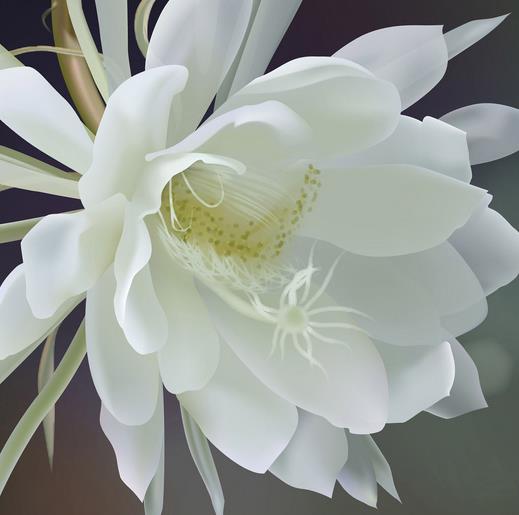
1. How to make night-blooming cereus jelly: The way to eat night-blooming cereus is to put it together with agar in a pot and boil it until the night-blooming cereus has completely dissolved, then add rock sugar and let it cool. Night-blooming cereus jelly is especially delicious after it is chilled, and it is said that night-blooming cereus jelly also has the effect of treating asthma.
2. Medicinal method: Take fresh night-blooming cereus, wash it clean with water, put it in a bowl, add rock sugar, and steam it for 1 hour; take it out and eat it after it cools. It clears heat and moistens the lungs, and has a very good effect on persistent cough.
3. Soup-making method: Wash fresh night-blooming cereus clean with water and dry it in the air for later use. When making soup, soak it open again with water and tear it into pieces; it can be stewed together with pork ribs or free-range chicken, fresh, fragrant, and delicious.
4. Medicinal parts of the night-blooming cereus: Mainly the flowers are used, and the tender stems can also be used as medicine.
5. Collection and processing of the night-blooming cereus: Tender stems can be collected throughout the year; flowers are collected at night during the flowering season. Tender stems are mostly used fresh; flowers can be used either dried or fresh. To make the dried product, usually at night when the flowers are blooming, when the flowers have just opened or are about to open, they are picked and dried by dehydration for later use.
III. Effects of the Night-Blooming Cereus on Home Life
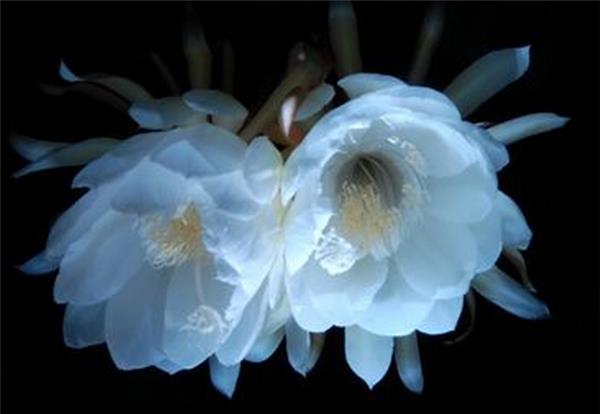
1. Green plants generally carry out photosynthesis during the day, absorbing carbon dioxide and releasing oxygen. At night they all become like the human body, absorbing oxygen and exhaling carbon dioxide. The night-blooming cereus, however, is exactly the opposite. It is a common plant with CAM metabolism (Crassulacean acid metabolism). It closes the stomata on the underside of its leaves during the day, and at night, after the surrounding temperature drops to an appropriate level, it opens the stomata on the underside of its leaves, releases oxygen, and absorbs carbon dioxide. So it can absorb carbon dioxide and release oxygen at night.
2. The night-blooming cereus can increase the negative ion content indoors. Although its bloom is very short, when it flowers it is beautiful and noble, with a rich, clear fragrance filling the air. It can release negative ions, making the indoor air fresh and pleasant. Negative ions can be called the vitamins of the air; if the negative ion content in a room decreases, people will feel suffocated and short of breath. Therefore, the night-blooming cereus, which can increase the concentration of negative ions in the air, is indeed a rare, beautiful, and beneficial flower.
3. The scent of the night-blooming cereus has the ability to sterilize and inhibit bacteria, filling the home environment with a healthy atmosphere.
IV. Feng Shui Effects of the Night-Blooming Cereus
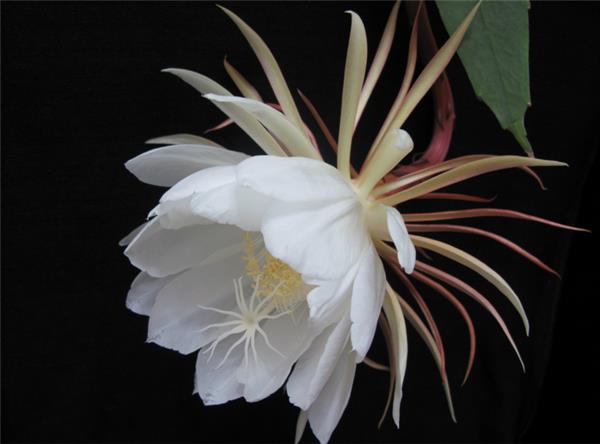
1. The most noteworthy feng shui effect of the night-blooming cereus is its Five Elements attribute. It belongs to metal within water, so placing it in different locations in the home can produce some unexpected effects.
2. If the night-blooming cereus is placed on a balcony, then it is best to choose the li position among the bagua directions - a south-facing balcony. This spot faces the sun and has good air circulation. The night-blooming cereus, which is metal within water, paired with plants belonging to fire and wood, such as gladiolus and orange jasmine, forms a plant energy field that helps regulate the health of family members' hearts and stomachs, and can even correct certain personality problems in some people at home, such as introversion, timidity, and lack of confidence.
3. Most people like to place the night-blooming cereus in a window position, because this cactus-family plant can dissolve negative energy and can neutralize incoming negative energy.
The above is the relevant knowledge about the night-blooming cereus. We hope it can help you.
The above is the relevant knowledge about the night-blooming cereus. We hope it can help you.