How to grow snake plants: grow them this way for more vigorous growth
The snake plant is a well-known ornamental plant for home growing. It is called snake plant because its leaves closely resemble the patterns on a tiger's skin. Do you know how to care for a snake plant? Let's take a look.
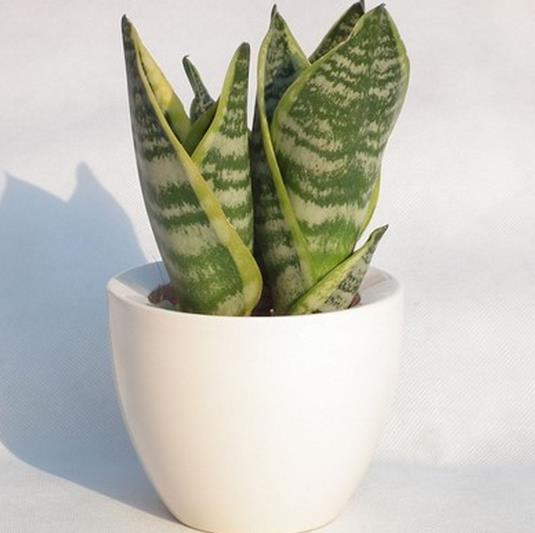
I. Introduction to the snake plant
Tiger tail sansevieria, also known as snake plant or brocade plant, is a plant of the Asparagaceae family, genus Sansevieria. Its varieties include golden-edged snake plant and silver-veined snake plant. The underground stem has no branches; the leaves grow in clusters, tubular at the lower part, flat in the middle and upper parts, with stiff, upright sword-shaped leaves. The plant height is 50 cm to 70 cm, leaf width 3 cm to 5 cm, leaf margins entire, with the surface alternately creamy white, pale yellow and dark green, appearing as horizontal banded markings. The golden-edged snake plant has golden-yellow leaf margins, 1 cm to 1.6 cm wide. The silver-veined snake plant has longitudinal silvery-white stripes on the surface. When well managed as a potted plant at home, the whole plant's leaves can reach over 1.2 m tall. The flower emerges singly from the rhizome, in a raceme, with pale white to light green flowers, in clusters of 3 to 5 borne on the inflorescence axis. There are many snake plant varieties, with considerable variation in plant form and leaf color, and strong adaptability to the environment. The main varieties are golden-edged snake plant and silver-veined snake plant. They are suitable for decorating studies, living rooms and offices, and can be enjoyed for a long time. The snake plant blooms from November to December. The snake plant is highly adaptable, preferring warmth and humidity, tolerant of drought, fond of light yet also tolerant of shade. It is not demanding about soil, doing better in sandy loam with good drainage. Its optimum growing temperature is 20-30°C, and its overwintering temperature is 10°C. The snake plant fears exposure to blazing sun and dislikes waterlogging; it is highly adaptable, preferring warmth and humidity, tolerant of drought, fond of light yet also tolerant of shade. It is not demanding about soil, doing better in sandy loam with good drainage. Its optimum growing temperature is 20-30°C, and its overwintering temperature is 10°C. The snake plant can be propagated by division and by cuttings. The snake plant has horizontal rhizomes. The leaves are basal, usually 1-2, sometimes 3-6 in a cluster, upright, hard and leathery, flat, long strap-shaped and lanceolate, 30-70 (-120) cm long, 3-5 (-8) cm wide, with horizontal banded markings alternating light green and dark green, green margins, tapering downward into grooved stalks of varying length. The flowering scape is 30-80 cm tall, with pale brown membranous sheaths at the base; the flowers are pale green or white, in clusters of 3-8, arranged in a raceme; the pedicel is 5-8 mm long, with the joint at the middle; the perianth is 1.6-2.8 cm long, with the tube and lobes roughly equal in length. The berry is about 7-8 mm in diameter.
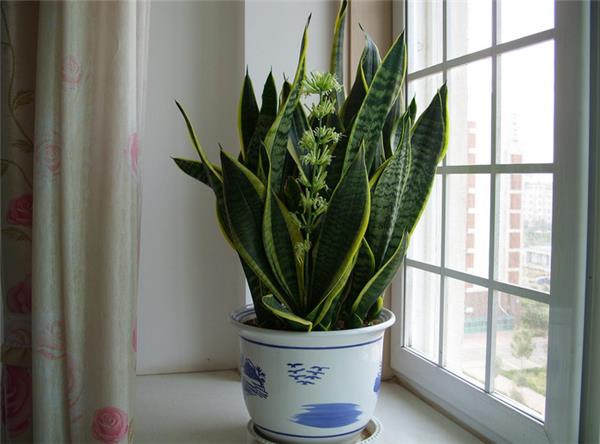
II. Care of the snake plant
Key points for everyday growing
1. Planting it is very simple, and it does not need many conditions. The snake plant is highly adaptable and can be managed rather extensively. For potting, use 3 parts fertile garden soil, 1 part coal cinders, and add a small amount of soybean cake crumbs or poultry manure as base fertilizer.
2. It needs fertilizer mainly during the growing season and has no particular requirements at other times. The snake plant has no great demand for fertilizer, but if you water it once every 10 to 15 days with dilute cake fertilizer water during the growing season, it will grow better.
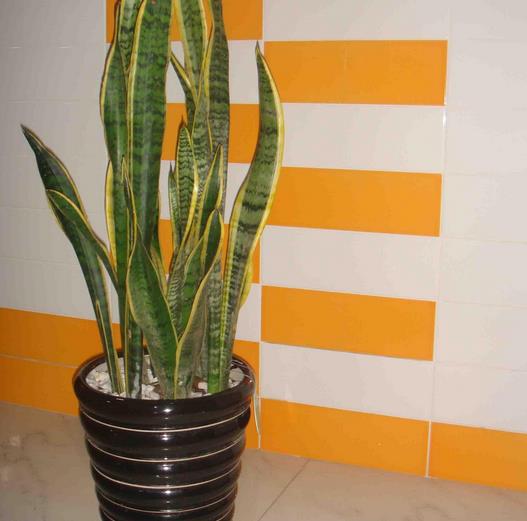
3. It needs a moderate amount of light. Potted snake plants should not be kept in dark places for long periods; give them scattered light often, otherwise the leaves will turn dull and lack vitality. But they must not be moved suddenly into sunlight; first let them adapt in a dimly lit spot.
4. Give special attention to a special snake plant. For potting a snake plant, use equal parts leaf mold and garden soil mixed with a small amount of decomposed base fertilizer as the growing medium. It grows well under sufficient light; apart from avoiding direct blazing sun in midsummer, it should receive plenty of sunlight in the other seasons. If it is placed in too dark a spot indoors for too long, the leaves will turn dull and lack vitality. In addition, if it has been kept indoors for a long time, it should not be moved suddenly into direct sunlight; first move it to a brighter spot and let it go through an adaptation period before exposing it to sunlight, so the leaves do not get scorched.
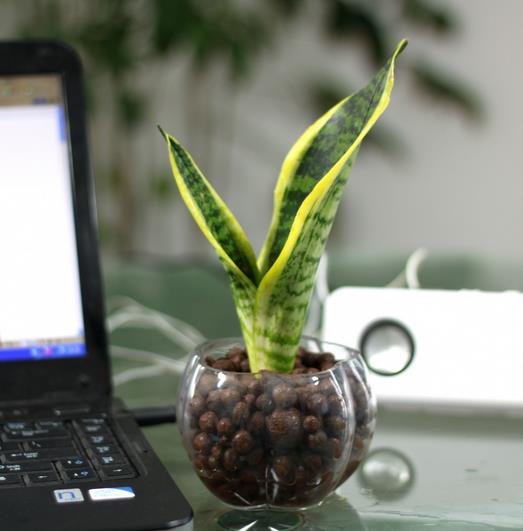
Watering should be moderate, following the principle of preferring dry over wet. Normally wipe dust off the leaf surface with clean water to keep the leaves clean and glossy. In spring, when new plants sprout at the root crown, water a little more to keep the potting soil moist; in the hot summer season, also keep the potting soil moist regularly; after late autumn, reduce watering and keep the potting soil relatively dry to strengthen cold resistance. It has low fertilizer requirements; during the growing season, apply dilute liquid fertilizer 1-2 times a month to keep the leaves verdant and thick.
The above are the care methods for snake plants. The life of a snake plant is indeed a bit like a tiger's: it can fend for itself, but with human attention it will become even more beautiful.