Planting and Management Methods and Medicinal Value of Honeysuckle Seedlings
When people think of honeysuckle, the first thing that comes to mind is traditional Chinese medicine; its greatest effect is clearing heat, but it is also an ornamental plant. Next, let us take a look at its planting management and the medicinal value of honeysuckle.
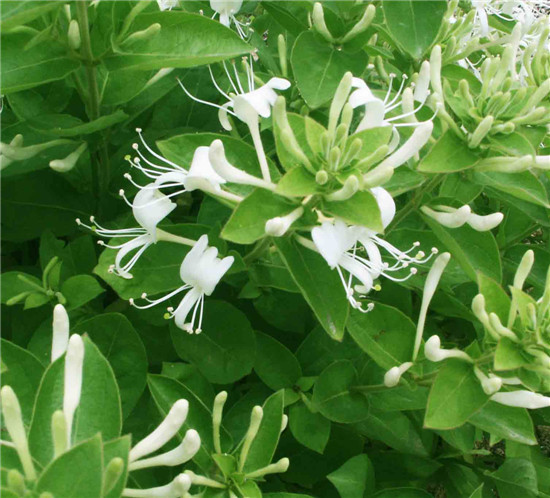
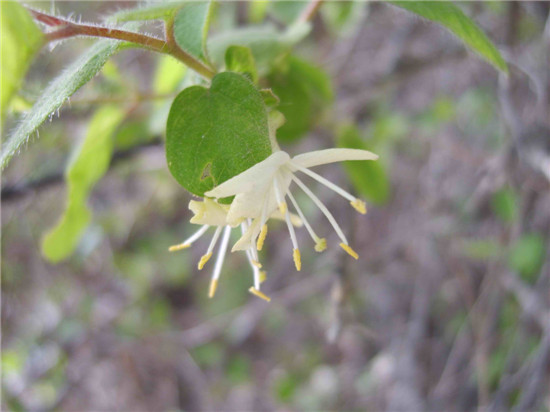
Honeysuckle is the collective name for both a traditional Chinese medicinal herb and the plant. The honeysuckle plant is also known as Japanese honeysuckle (Lonicera japonica), a perennial semi-evergreen twining woody vine of the Caprifoliaceae family. The name "honeysuckle" (jinyinhua) comes from the Compendium of Materia Medica, because the flowers of Japanese honeysuckle first open white and later turn yellow, hence the name "gold-silver flower." The medicinal material honeysuckle consists of the dried flower buds or just-opening flowers of the Caprifoliaceae plant Japanese honeysuckle (Lonicera japonica) and plants of the same genus. Since ancient times, honeysuckle has been praised as an excellent remedy for clearing heat and detoxifying. It is sweet in nature, cold in property, and aromatic in odor; being sweet and cold, it clears heat without harming the stomach, and its aromatic property penetrates and dispels pathogenic factors. Honeysuckle can both disperse wind-heat and is good at clearing and resolving blood toxins. It is used for various heat-related ☆forbidden☆ diseases, such as fever, rash, skin spots, heat-toxin sores and carbuncles, and sore throat, all with remarkable effects.
Biological characteristics: It prefers a mild and humid climate and plenty of sunlight; it is cold-tolerant, drought-tolerant, and waterlogging-tolerant. The suitable growing temperature is 20-30°C. It has low requirements for soil and is tolerant of saline-alkali conditions. However, it is best cultivated in deep, loose humus soil.
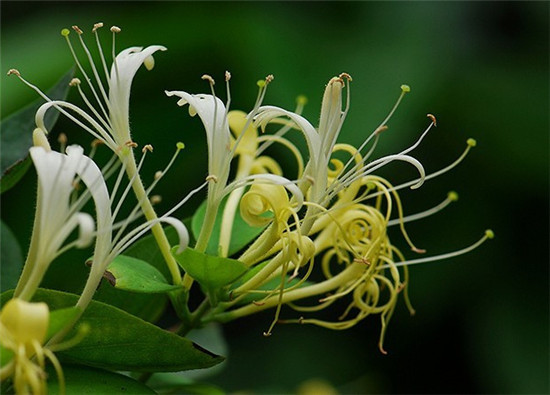
Propagation is mainly by seeds and cuttings. Seed propagation: sow in April; soak the seeds in warm water at 35-40°C for 24h, remove them and mix with 2-3 times their volume of wet sand to promote germination, and sow when about 30% have cracked open. On the seedbed, open furrows at a row spacing of 21-22cm and sow, covering with 1cm of soil, spraying water once every 2d; seedlings emerge in just over 10 days, and they are transplanted after autumn or in the spring of the 2nd year, using about 15kg of seeds per 1hm2. Cutting propagation: generally carried out in the rainy season. In cloudy and rainy weather in summer and autumn, select robust 1-2 year old branches free of pests and diseases, cut them into 30-35cm lengths, remove the lower leaves to make cuttings, and use them as soon as they are cut. On the selected land, dig holes at a row spacing of 1.6m and a plant spacing of 1.5m, with a hole depth of 16-18cm; place 5-6 cuttings per hole, burying them diagonally in the soil in a scattered arrangement, with 7-10cm exposed above ground, then fill and firm the soil. Cutting seedling raising can also be used: during July-August, open furrows at a row spacing of 23-26cm and a depth of about 16cm, with a plant spacing of 2cm; place the cuttings diagonally in the furrow, fill and firm the soil, spray water once after planting, and thereafter, during dry periods, water once every 2d; they can take root in about half a month, and are transplanted in the spring or autumn of the 2nd year.
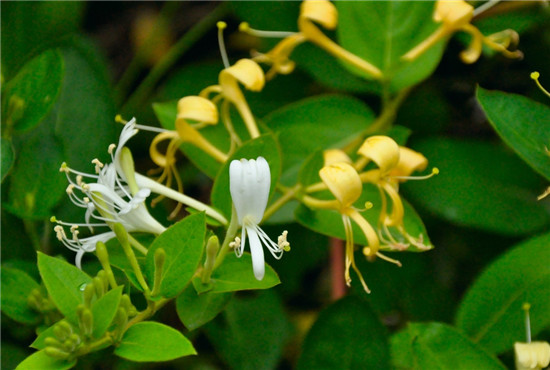
Honeysuckle is cold in nature and sweet in taste; it enters the lung and stomach meridians; it clears heat and detoxifies, and dispels wind-heat. It mainly treats the early stage of carbuncles, swellings, and furuncles with redness, swelling, heat, and pain; externally contracted wind-heat; the early stage of warm diseases; heat-toxin bloody dysentery; summer-heat with thirst and restlessness; and sore throat. Honeysuckle contains components such as isochlorogenic acid, loganin, luteolin, chlorogenic acid, and inositol, and is rich in volatile oil, whose main components are bisabolol, linalool, and others. Those that are yellow-white in color and plump are considered best. Store in a cool, dry place, protecting from moisture and insects.
Four Major Contraindications for Drinking Honeysuckle Infused in Water
First: Never take an excessive amount
Honeysuckle is cold in nature, and taking too much can easily cause discomfort in the stomach and intestines. Some people, in order to enhance honeysuckle's effects on the body, take a large amount of honeysuckle at one time; this brings no benefit to the body, only harm.
Second: Do not take it during menstruation
Menstruation is the most special period for all women. During this stage, women must take good care of themselves and eat or come into contact with as few cold foods or objects as possible. Honeysuckle is cold in nature, so it is best not to take it during menstruation, to avoid adverse effects on the body.
Third: Patients with spleen and stomach deficiency-cold should take it with caution
Honeysuckle is cold in nature, so if a patient's body already has a deficiency-cold constitution and is prone to weakness and frequent illness, then drinking honeysuckle infused in water will not only fail to nourish and support the body, but will instead increase the burden the spleen and stomach must bear, which is very unfavorable to health.
Fourth: Choosing the season for taking it
Honeysuckle is not suitable for taking in all four seasons. Experts suggest that if you want the body to obtain the best health benefits, the best time to take honeysuckle is in summer. Because summer weather is hot and the body is prone to heatstroke and thirst, taking honeysuckle at this time can effectively promote fluid production and quench thirst as well as clear heat and detoxify.
The above is the complete content I have summarized for you on the planting management and medicinal value of honeysuckle seedlings. I hope this article can help everyone. Please also continue to follow us.