How to grow Sedum multiceps? The characteristics and care tips of this adorable succulent
Sedum multiceps has high ornamental value and is a commonly used decorative plant in the home. Sedum multiceps has a rounded shape, with fuzzy leaves like pine needles, and is very much worth people's affection. Below, let us take a look at the relevant knowledge about Sedum multiceps.
I. Introduction to Sedum multiceps
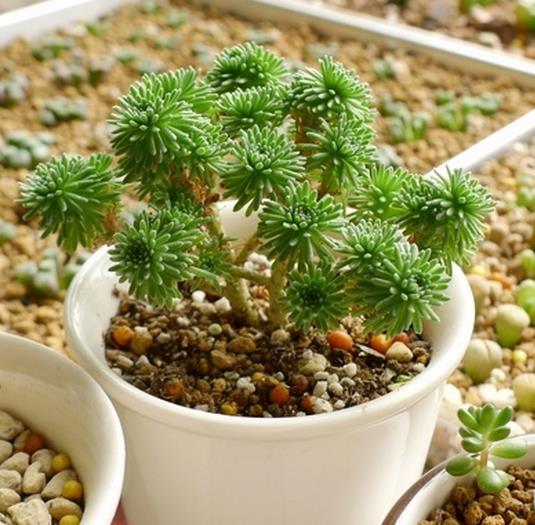
Sedum multiceps, also known as Little Pine Green, is a succulent plant (succulent) of the Crassulaceae family, Sedum genus, with fleshy needle-like leaves, an evergreen herb, native to Africa, Algeria, and has relatively high ornamental value. The Little Pine Green plant is short, with very short branches, and tufts of brown-red hairs grow close to the fleshy stems; the needle-like leaves are about 1 cm long, clustered in groups at the tips of the branches, lush and verdant, with yellow flowers. Little Pine Green prefers warmth and dryness, can also tolerate half shade, and is afraid of waterlogging. The Sedum multiceps plant is low-growing and much branched, with a shape approximating a sphere; the old stems are grayish-white, the new branches light green, later gradually turning grayish-brown; the fleshy leaves are approximately needle-like but slightly wider, about 1 cm long, clustered at the branch tips, green; after the old leaves dry up they stick to the branches, forming cracks similar to pine bark, and only fall off after a long time, revealing the smooth fleshy stems. The small flowers of Sedum multiceps are yellow and star-shaped.
II. Cultivation techniques for Sedum multiceps
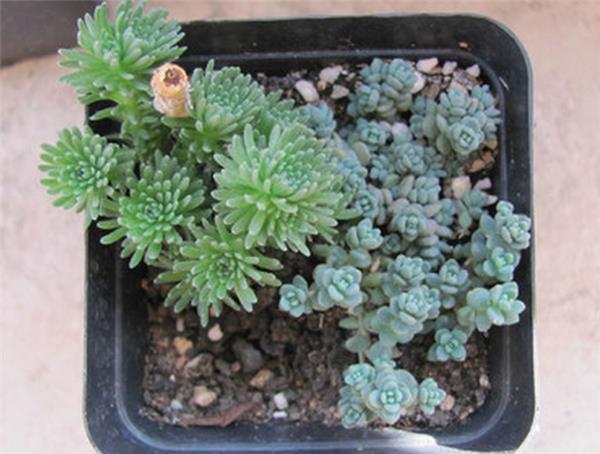
Sedum multiceps can be planted in generally well-aerated soil. The flower pot should not be too large. In summer, when the temperature is above 27°C, it enters a semi-dormant state, so watering should be controlled; water only after the potting soil has thoroughly dried, and provide half shade. In winter, overwinter it indoors, with the lowest temperature above 5°C, and under conditions of sufficient sunlight it can continue to grow. Little Pine Green is propagated by cuttings and roots very easily. In the spring and autumn growing seasons, break off well-developed small branches as a cutting, insert it into the potting soil, control the soil temperature, and place it in a spot with relatively sufficient scattered light; it roots in about 10 days and becomes a new plant.
1. Light
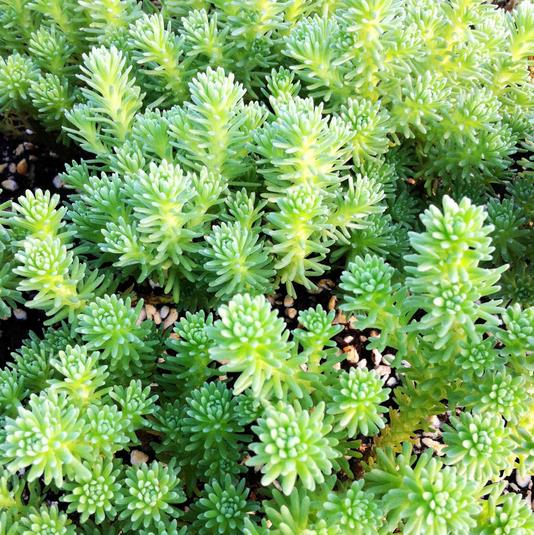
Its growing season is from September to May of the following year, and it can be placed in a spot with sufficient light for care. If there is insufficient sunlight, the plant will become leggy, the distance between leaves will lengthen, and it will lose its compact and beautiful plant shape, seriously affecting its ornamental value.
2. Fertilizer and water
For watering Sedum multiceps, follow the principle of "better dry than wet," and avoid long-term water accumulation to prevent root rot. In order to maintain the beauty of the bonsai shape, it is generally not necessary to apply additional fertilizer during care.
When temperatures are high in summer, Sedum multiceps is in a dormant state, and plant growth stalls. It can be placed in a well-ventilated, half-shaded spot for care, with attention paid to controlling watering and avoiding rain, to prevent the plant from rotting. In winter, move it indoors to a spot with sufficient light and control watering to keep the plant dormant; it can tolerate 5°C, or even lower temperatures. Repot once every autumn. The potting soil should be loose, breathable, and have good drainage, and can be mixed from materials such as garden soil and sandy soil.
3. Pruning
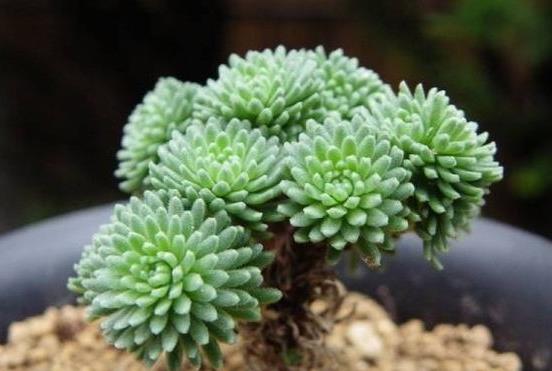
Sedum multiceps readily sprouts side branches, so attention should be paid to pruning during care. Promptly cut off overly dense and messy branches, especially new branches at the base, to keep the bonsai appropriately sparse and dense, natural and beautiful. It should be pointed out that the branches and stems of Sedum multiceps are relatively thin, so attention should be paid to controlling the height of the plant so that the proportions between branches and stems are natural and coordinated. The pruned branches can be used as cuttings for propagation; except during the high-temperature period of midsummer, regardless of length, they root very easily.
4. Daily care
After a finished bonsai is made, first place it in a spot without direct sunlight for about 7 days to acclimatize, to promote the recovery and development of the root system. After that, place it in a spot with sufficient light for care. If there is insufficient sunlight, the plant will become leggy, the distance between leaves will lengthen, and it will lose its compact and beautiful plant shape, seriously affecting its ornamental value; whereas plants grown in a spot with sufficient sunlight have short and compact branches and leaves, and have more of that steadfast and upright charm of a pine tree. For watering, follow the principle of "better dry than wet," and avoid long-term water accumulation to prevent root rot. In order to maintain the beauty of the bonsai shape, it is generally not necessary to apply additional fertilizer during care. When temperatures are high in summer, Sedum multiceps is in a dormant state, and plant growth stalls. It can be placed in a half-shaded spot for care, with attention paid to controlling watering and avoiding rain, especially prolonged rain, to prevent the plant from rotting. After the weather turns cool in autumn and the plant begins to grow, resume normal management. In winter, move it indoors to a spot with sufficient light and control watering to keep the plant dormant; it can tolerate 5°C, or even lower temperatures. As long as it is not below 10°C, it can grow normally. Repot once every autumn. The potting soil should be loose, breathable, and have good drainage, and can be mixed from materials such as garden soil and sandy soil. When repotting, cut the overly long old roots shorter to promote the growth of robust new roots.
Sedum multiceps has strong sprouting ability and readily sprouts side branches, so attention should be paid to pruning during care. Promptly cut off overly dense and messy branches, especially new branches at the base, to keep the bonsai appropriately sparse and dense, natural and beautiful, and to cultivate an independent main trunk. The pruned branches can be used as cuttings; let them dry for 1-2 days, and after the wounds have dried, carry out cutting propagation. Except during the high-temperature period of midsummer, regardless of length, they root very easily. In addition, Sedum multiceps is a succulent mainly grown for its foliage and posture (that is, its bearing and plant shape); its flowers are not beautiful, so once flower spikes appear they should be cut off promptly to avoid consuming too many nutrients and adversely affecting plant growth.
The above is the knowledge about Sedum multiceps. I hope it is helpful to you.
to promote the growth of robust new roots.Sedum multiceps has strong sprouting ability and readily sprouts side branches, so attention should be paid to pruning during care. Promptly cut off overly dense and messy branches, especially new branches at the base, to keep the bonsai appropriately sparse and dense, natural and beautiful, and to cultivate an independent main trunk. The pruned branches can be used as cuttings; let them dry for 1-2 days, and after the wounds have dried, carry out cutting propagation. Except during the high-temperature period of midsummer, regardless of length, they root very easily. In addition, Sedum multiceps is a succulent mainly grown for its foliage and posture (that is, its bearing and plant shape); its flowers are not beautiful, so once flower spikes appear they should be cut off promptly to avoid consuming too many nutrients and adversely affecting plant growth.
The above is the knowledge about Sedum multiceps. I hope it is helpful to you.