How to grow Gazania? Introduction to the Glory Flower and growing tips
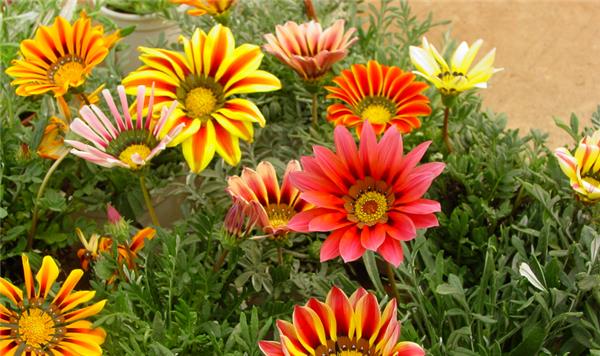
Gazania is an ornamental plant with a unique flower shape and rich colors. Its flower center has a dark eye spot, shaped like a medal, with a strong wild charm. It is a common potted flower and flowerbed flower in gardens. Below, let us take a look at the knowledge about Gazania.
I. Introduction to Gazania
Gazania, also called treasure flower, is a perennial herbaceous plant of the genus Gazania in the Asteraceae family. It is native to South Africa and Mozambique, prefers warmth and sunshine, and is a very good garden flower, suitable for arranging flowerbeds and flower borders, and is also a good cut flower material. Because its entire inflorescence resembles a medal, it is named Gazania. Gazania flowers are brilliant and colorful, with glossy petals, opening in the morning and closing at night, lasting more than 10 days; the flowering period is roughly from late spring to early summer. It likes sunlight and prefers to grow in cooler places, is drought-tolerant, and tolerant of poor soil; it is semi-hardy, so it can overwinter smoothly in areas with milder winters. Gazania is a perennial herb, with single flower heads, solitary, bearing long peduncles. Gazania has a unique flower shape and colorful flowers, with dark eye spots in the flower center, shaped like a medal, with a strong wild charm. It is one of the common potted flowers and flowerbed plants in gardens. It propagates by seed. It likes a warm, dry environment with sufficient light, opening in the sun during the day and closing at night. It grows robustly and has few pests and diseases. It tolerates extensive management. When overwintering in the north, it should be slightly covered. The suitable sowing temperature is 20°C, height 15-20 cm, flowers golden yellow with reddish-brown stripes, clump-forming, long flowering period. For sowing in autumn, winter, and spring, in South China the main season is autumn sowing, with a high germination rate, for pots and flowerbeds.
II. Growing methods for Gazania
1. Potted flowers
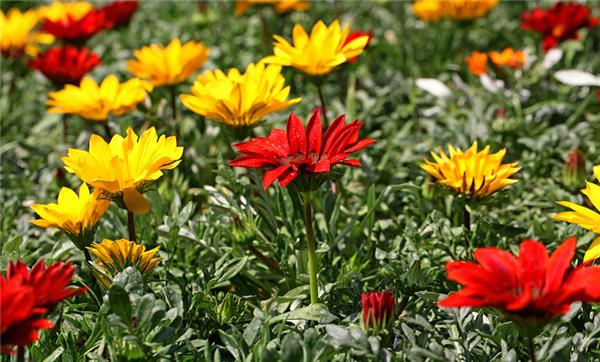
Use 10 to 16 cm flower pots for cultivation, and use a well-drained medium for cultivation. The pH value of the medium is 5.8 to 6.2, and the EC value is 1.0 to 1.5. Keep the potting soil dry, and water only after the potting soil dries each time. Watering is best done in the morning to help the leaf surface stay dry at night and prevent disease. Too much water will cause excessive growth, while too little water will cause early flowering, and under strong light it is easy to burn the leaf surface.
2. Light control
Gazania is a strongly sun-loving flower and needs to grow in a place with sufficient sunlight. The flowers need to be in sunlight to open, and on cloudy days the flowers will close. If the cultivation site has insufficient light, the plant leaves will be soft, the flower buds will decrease, the flowers will become smaller, and the flower color will fade. On the contrary, with sufficient sunlight, the flower color is bright and flowering is continuous.
3. Temperature regulation
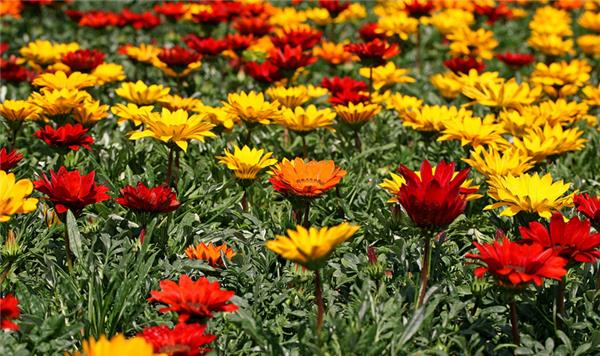
After transplanting into pots, the temperature can be lowered to 12°C to 16°C at night and 16°C to 22°C during the day. When the temperature is higher than 26°C, the plant is prone to excessive growth; at this time, spraying with the growth retardant daminozide (B-9) will have a certain effect. In winter, the temperature should not be lower than 5°C, but it can tolerate a low temperature of 0°C for a short time; if it lasts a long time, frost damage is likely to occur.
4. Cultivation management
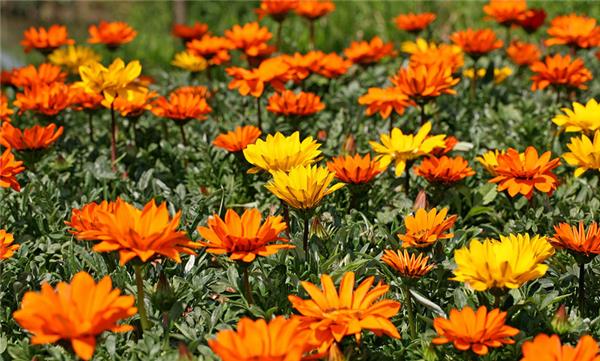
Gazania is a flower with strong resistance, and as long as there is sufficient sunlight it can bloom. It is drought-tolerant, heat-tolerant, and even salt-alkali tolerant, so it can be said to be suitable for various environments. Gazania is relatively sensitive to moisture. Although the soil needs to be moist during the stem and leaf growth period, if the soil has too much water during the plum rain season, the plant is prone to waterlogging and the whole plant may die. At the same time, during high summer temperatures, the air humidity should not be too high, and the potting soil should not accumulate water; otherwise, both are unfavorable to the growth and flowering of Gazania. After the flowers fade, remove the spent flowers in time, which can reduce nutrient consumption and promote the formation of more flower buds. If kept indoors in winter, it can continue to bloom.
Gazania has few pests and diseases, only some leaf spot disease, aphids, and red spider mites. As long as humidity is controlled and fungicides and insecticides are used in time, they can be effectively controlled. Usually, for leaf spot disease, spray once every 7 to 10 days with 25% carbendazim wettable powder or chlorothalonil 700 to 1000 times solution for control; for aphids, spray once every 10 to 15 days with 2000 times decamethrin or 1000 times dichlorvos for control; for red spider mites, 40% omethoate emulsifiable concentrate 1500 times solution can be sprayed to kill them. The growth period varies with the season. Usually, the fastest time from sowing to flowering is about 12 weeks, of which the seedling stage is 2 to 4 weeks.
The above is the introduction to Gazania. I hope it can help you.