How to grow Cleome? Introduction to Cleome and growing methods
Cleome is an ornamental plant. Its flowers are bright and colorful, with a graceful bearing. They start out pinkish white, then turn pink, and later become purplish red. It is a favorite of many flower growers. Now let us take a look at some knowledge about Cleome.
I. Introduction to Cleome
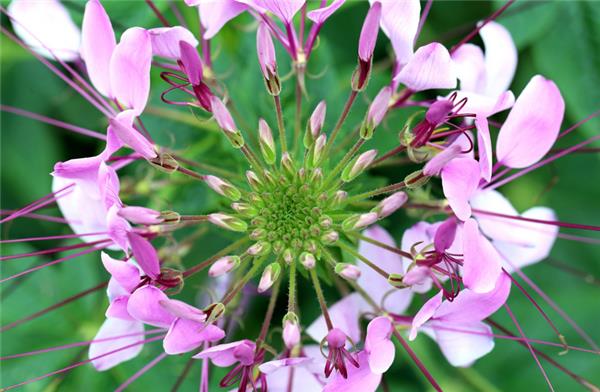
Cleome has long and sturdy peduncles, and the raceme forms a lush flower ball. The flower shape is elegant and distinctive, with petals round like a fan and prominent stamens like claws, resembling butterflies in flight. The flower color is delicate and gorgeous: at first pinkish white, then turning pink, and later purplish red. One flower has multiple colors and also has nectar glands, which often intoxicate flying butterflies, hence the name. The long stamens extend beyond the corolla, resembling a spider, and also like dragon whiskers, which is quite interesting. When Cleome blooms, the petals slowly open, and the long claws go from curved to popping out from the flower, a process like a movie sequence played in slow motion. When planted in the ground, it can be placed by courtyard walls and under trees. When potted, it can be displayed on a windowsill or desk, and the plant shape should be controlled so it does not grow too tall.
II. Morphological characteristics of Cleome
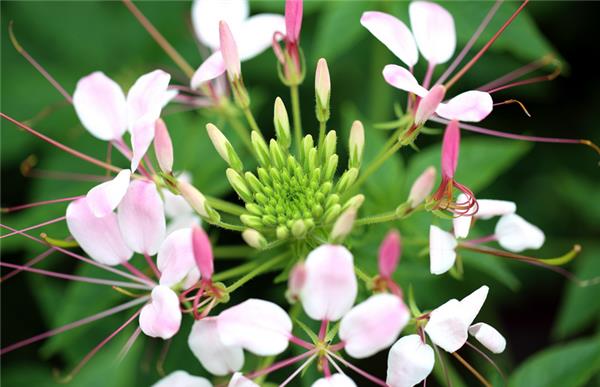
Annual robust herb, 1-1.5 m tall, the whole plant covered with sticky glandular hairs, with a special odor, and with stipular spines, the spines up to 4 mm long, sharp, recurved. Leaves are palmately compound with 5-7 leaflets; leaflets herbaceous, elliptic-lanceolate or oblanceolate, the central leaflet largest, 6-8 cm long, 1.5-2.5 cm wide, the outermost smallest, about 2 cm long, about 5 mm wide, base cuneate, narrowly extending into a petiolule, slightly webbed where it joins the petiole, apex gradually narrowed or acute, with a short mucro, both surfaces hairy, the midvein on the back sometimes also with spines on the lateral veins, lateral veins 10-15 pairs; petiole 2-8 cm long, often with pale yellow prickles. Raceme up to 40 cm long, densely covered with sticky glandular hairs; bracts solitary, leaf-like, ovate-oblong, 5-20 mm long, sessile or nearly sessile, base more or less cordate; buds cylindrical, about 2.5 cm long, 4 mm in diameter, glabrous; pedicels 2-3 cm long, covered with short glandular hairs, solitary in the axils of bracts; sepals 4, the long ones 6 mm, oblong-elliptic, apex acuminate, outside covered with glandular hairs; petals pink, rarely white, imbricate in bud, glabrous, claw 5-12 mm long, limb obovate-spatulate, 10-15 mm long, 4-6 mm wide, apex rounded, base gradually narrowed; stamens 6, filaments 3.5-4 cm long, anthers linear, 7-8 mm long; androgynophore 1-3 mm long; gynophore 4 cm long, slightly enlarged in fruit; ovary linear-cylindrical, 3-4 mm long, glabrous; style almost absent, stigma capitate. Capsule cylindrical, 5.5-6.5 cm long, about 4 mm in diameter in the middle, both ends slightly blunt, surface nearly flat or slightly moniliform, with fine, dense and not very distinct veins. Seeds about 2 mm in diameter, surface nearly smooth or with small wart-like protrusions, without an aril. Flowering in early summer, fruiting in late summer and early autumn.
III. Cultivation techniques for Cleome
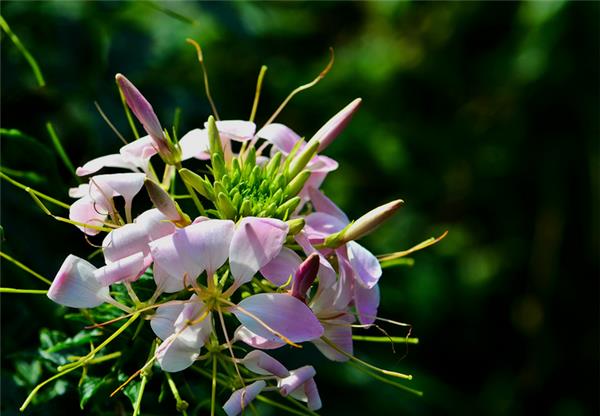
Seedlings should be thinned in time. Transplant when they have 2-3 true leaves. Set out or pot in June. It is a taproot plant with small fibrous roots, and recovery after transplanting is difficult. Generally, sow directly outdoors in spring, or transplant when seedlings grow to about 5 cm tall, into fertile soil. Generally, no additional topdressing is needed. During the growing period, fertilize once every half month. During growth, water and fertilizer should be controlled to prevent excessive vegetative growth and avoid affecting flowering. When flower buds form and during flowering, apply topdressing 2-3 times, which can prolong the flowering period. Usually water to maintain a semi-moist state; in dry weather, water frequently.
When flowering, set up supports to prevent lodging. If seed is not to be kept, promptly cut off spent flowers after they fade so they do not set seed, reducing nutrient consumption and helping prolong the flowering period. The whole plant has sticky hairs and uses relatively little water. Except for the flowering period, when water demand is higher, seedlings can be watered little or not at all, making it relatively easy to manage. In summer, water at least once a day. If high temperature and drought occur, it can be moved to a shady place, and after the potting soil cools slightly, water again. In autumn and winter, reduce watering, and water again when the soil surface dries. Light and temperature: Cleome likes high temperatures and tolerates summer heat. The most suitable growing temperature is 20°C to 32°C. It likes light. Although it can also grow under semi-shade conditions, to keep it dwarf, expose it to direct light as much as possible, preferably more than 4 hours a day. When planting in flower beds, spent flowers should be removed promptly so they do not set seed, thereby prolonging the flowering period.
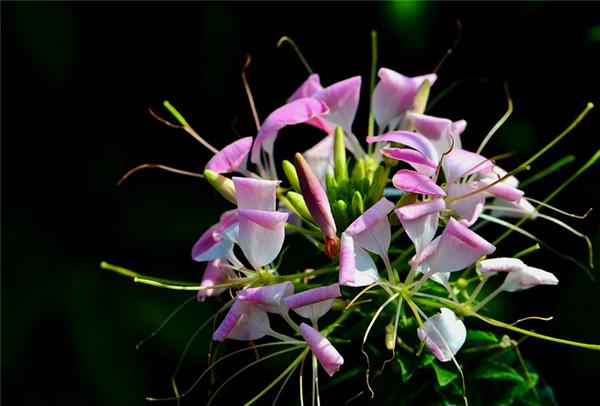
For those used as potted plants, remove the terminal buds at the seedling stage and control nitrogen fertilizer application to dwarf the plant. For those used as cut flowers, plant slightly densely and remove side buds to promote development of the terminal inflorescence. If you want Cleome to bloom during the Spring Festival, pot-sow in autumn, move indoors to a sunny place before winter, keep the indoor temperature at about 20°C, and regularly keep the potting soil slightly moist. During the bud stage, apply 2-3 times of dilute compound liquid fertilizer, and it can bloom during the Spring Festival.
The above is knowledge about Cleome. I hope it can help you.
Regularly keep the potting soil slightly moist. During the bud stage, apply 2-3 times of dilute compound liquid fertilizer, and it can bloom during the Spring Festival.The above is knowledge about Cleome. I hope it can help you.