How to care for Aeonium arboreum 'Rubrolineatum'? Growing tips and variety introduction
Aeonium arboreum 'Rubrolineatum' is an evergreen ornamental plant, like a blooming green lotus. It is native to the Canary Islands in the Atlantic Ocean. The leaves are thick and blue-green, sometimes with a red blush. Below, let us take a look at the relevant knowledge about Aeonium arboreum 'Rubrolineatum'.
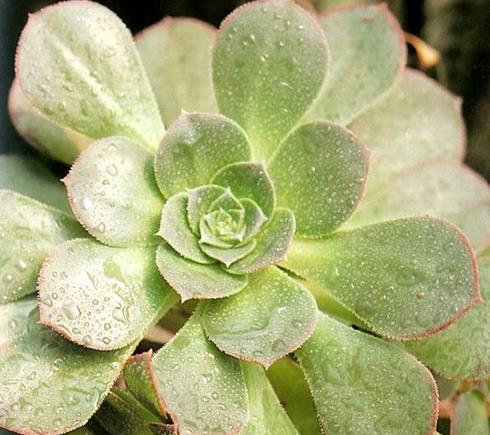
I. Introduction to Aeonium arboreum 'Rubrolineatum'
Aeonium arboreum 'Rubrolineatum' belongs to the order Rosales and the family Crassulaceae, and is native to the Canary Islands in the Atlantic Ocean. The leaves are thick, blue-green, covered with a white bloom, with red-brown leaf margins. The cyme is shallow yellow, sometimes with a red blush. The leaves are arranged in a rosette, rather thin, with shapes including obovate, tongue-shaped and kidney-shaped, with short hairs on the leaf margins; the inflorescence is a raceme, and the plant dies after flowering.
II. Morphological characteristics of Aeonium arboreum 'Rubrolineatum'
Aeonium arboreum 'Rubrolineatum' is a perennial succulent herbaceous plant; the plant is subshrub-like with many branches, 25-50 cm tall, and the leaves at the tips of the branches are arranged in rosettes. The leaves are obovate with a fine point, 2.5-5 cm long, somewhat thick, blue-green to gray-green, covered with a white bloom, glossy on the surface, with red to red-brown margins and fine teeth. The cyme is shallow yellow, sometimes with a red blush. Aeonium is a plant of the genus Aeonium; the plant is much branched, and the succulent leaves are arranged in rosettes at the tips of the branches. The leaves are rather thin, with shapes including obovate, tongue-shaped and kidney-shaped, with short hairs on the leaf margins; the inflorescence is a raceme, and the plant dies after flowering.
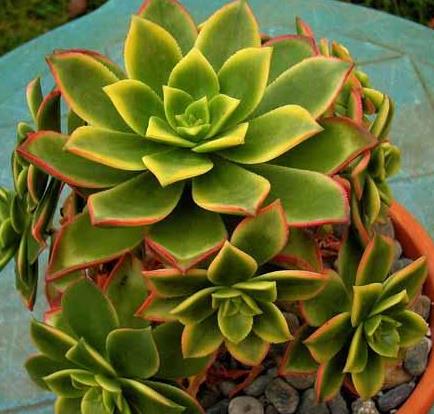
III. Ecological habits of Aeonium arboreum 'Rubrolineatum'
Aeonium arboreum 'Rubrolineatum' prefers a cool, dry and sunny environment; it is drought-tolerant and dislikes waterlogging. It has the habit of growing in the cool season and going dormant at high summer temperatures. In summer, the plant can be placed on a balcony or in a courtyard in a well-ventilated spot for care, with watering appropriately reduced to prevent root rot or leaf drop, and with a little shading to avoid scorching sun. In winter, place it indoors in a cool spot with ample sunlight, keeping it at around 10°C; temperatures too high or too low are both unfavorable to the plant's growth, and keep the potting soil slightly dry. It is a subshrub; in its place of origin, summers are dry and hot with little rain and an average temperature of 25°C, while winters are mild and humid with an average temperature of 10°C and annual rainfall of 1000 mm. It likes ample sunlight and requires well-drained sandy loam.
IV. How to grow Aeonium arboreum 'Rubrolineatum'
1. Planting
Plant before sprouting in spring. In southern regions it can be planted in the ground and overwinter outdoors. It should be planted in a sunny, ventilated, well-drained spot in loose, fertile sandy loam. In northern regions, pot cultivation is preferable, making it easier to overwinter indoors. For the potting soil, use a mixed growing medium of leaf mold, garden soil and coarse sand, etc. The pot should not be too large; before planting, place some broken tiles or broken bricks at the bottom of the pot for drainage. When the roots become crowded and interfere with watering, the soil and pot should be changed in time. Generally, the potting soil is changed once every 1-2 years. When changing the soil, thin out some old roots and overly dense or overly long roots. After planting, water once, place in a shady spot, and move to a sunny spot for growing once growth resumes.
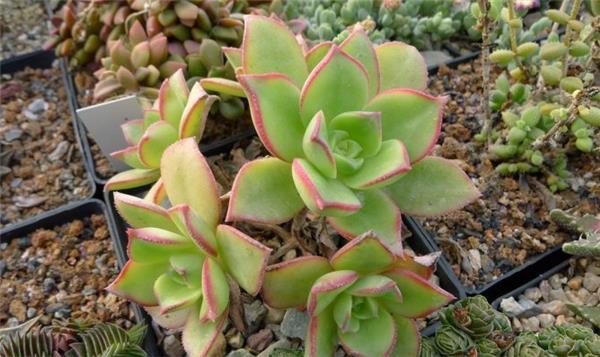
2. Management and care
(1) Light and temperature: during the growing season, place it in a sunny, well-ventilated spot. In summer it enters dormancy and requires a semi-shaded, well-ventilated environment; when temperatures are high, set up a shade frame or place it in the dappled shade under a large tree, or it can be placed indoors, but good ventilation should be maintained and the temperature should be above 25°C. In winter, place it in a greenhouse or in a sunny spot indoors, keeping the room temperature above 10°C; the lowest temperature must not be below 5°C, and if the temperature is too low, cold-protection measures should be taken.
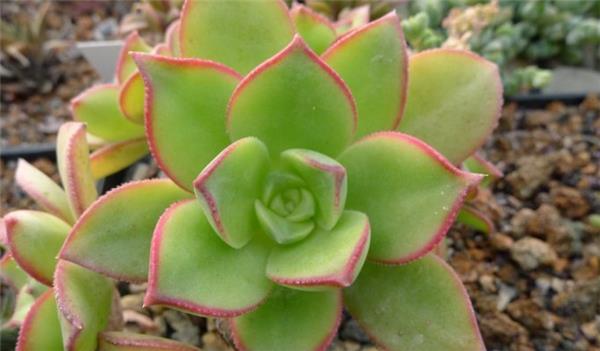
(2) Watering and fertilizing: during the peak growing seasons of spring and autumn, pay attention to watering and keep the potting soil moist but on the dry side; it must not be waterlogged or overly wet. In summer it enters dormancy, and especially in a high-temperature, high-humidity environment, good ventilation conditions should be maintained and watering controlled to avoid leaf drop and root rot. In winter, reduce watering, and keep the potting soil slightly dry. Watering should follow the principle of "water when dry, and water thoroughly when you do."
The above is the relevant knowledge about Aeonium arboreum 'Rubrolineatum'; I hope it helps you.