Coneflower Introduction and Cultivation Tips: Easily Grow Beautiful Coneflowers
The coneflower is a beautiful ornamental plant, and coneflowers can be divided into several different genera and species. Let's take a look together below.
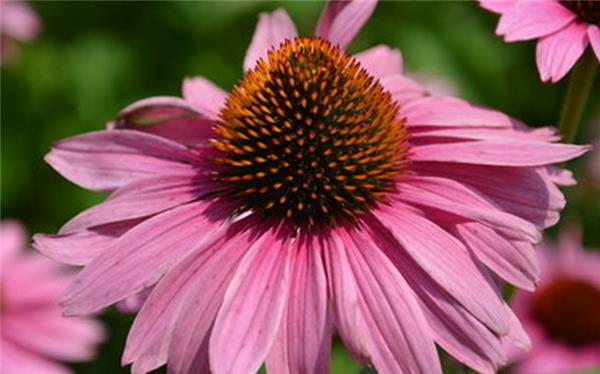
I. Introduction to the Coneflower
Plants of three genera in the Asteraceae family, weeds native to North America. Each genus has species with reflexed ray florets. The genus Echinacea bears purple flowers, is perennial, and is often planted as a border plant (especially narrow-leaved purple coneflower [E. angustifolia] and purple coneflower [E. purpurea]); its roots are black with a strong odor, its stems are hairy, and its leaves are basal with long petioles. The genus Ratibida has yellow ray florets and pale brown disk florets, with finely divided leaves. Ratibida columnifera (R. columnaris) and R. pinnata are planted in wildflower gardens. The genus Rudbeckia has about 25 species, annual, biennial, or perennial; leaves are simple or lobed, ray florets are yellow, and disk florets are brown or black. Black-eyed Susan (R. hirta), thimbleflower (R. bicolor), and cutleaf coneflower (R. laciniata) are grown as border flowers. Rudbeckia laciniata var. hortensia (the garden variety of cutleaf coneflower) is a popular double-flowered ornamental. Asteraceae, genus Echinacea, perennial herbaceous plant, plant height 60-150 cm, the whole plant covered with coarse hairs, stems upright; basal leaves ovate or triangular, stem leaves ovate-lanceolate, petiole base slightly clasping the stem; flower heads solitary at the top of branches, or several clustered together, flower diameter up to 10 cm, ray florets purple-red, disk florets orange-yellow. Flowering period June-July. Named for its flower heads resembling pinecones, native to North America.
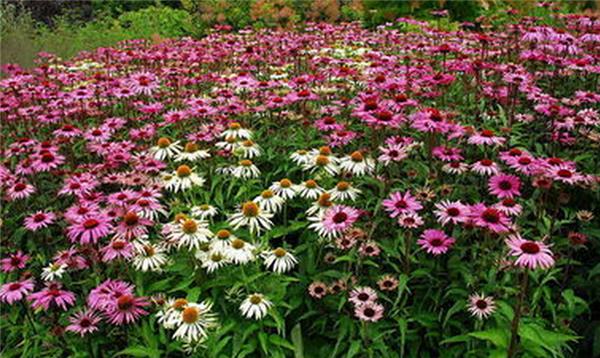
II. Pot Cultivation Techniques for Coneflower
Potting soil should be a loose, fertile mixed soil or potting mix. When planting, depending on the pot size, 3-5 seedlings can be planted per pot. In the early growth stage, pinch back once to encourage branching. It is best to renew cultivated plants once a year. Do not water excessively; during the plum rain season, when air humidity is high, watering should be controlled even more. During the growth period, apply dilute liquid fertilizer to promote growth. When flower buds form, fertilize once a week. After each fertilization, sprinkle clean water to prevent fertilizer from sticking to the plant. To protect from rain, cultivation is generally carried out in a greenhouse, and plants should be placed in a well-ventilated, sunny spot. The minimum temperature must not be lower than 10°C, and in hot summer, appropriate shading is needed.
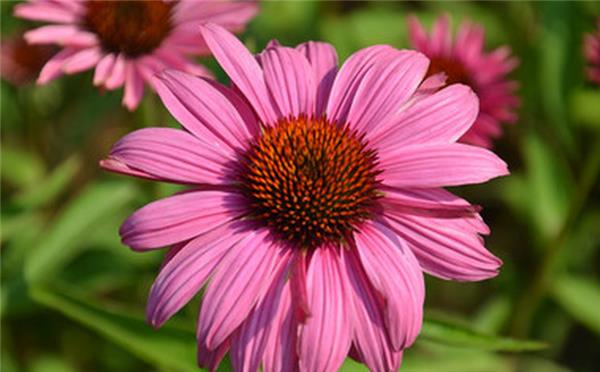
III. Seed Propagation of Coneflower
Sowing can be done in late April in spring or early September in autumn. After deep digging and leveling the outdoor seedbed, water thoroughly, and once the water has fully seeped into the ground, broadcast the seeds, keeping each seed occupying an area of 4 sq cm, and control the temperature at around 22°C; germination occurs in 2 weeks. When seedlings grow to 2 true leaves, thin and transplant them. When seedlings are about 10 cm tall, plant them out. Planting spacing is 40 cm × 40 cm.
IV. Division Propagation of Coneflower
For perennial mother plants, division propagation can be done in spring and autumn. Each division needs 4-5 crown buds cut away from the rhizome.
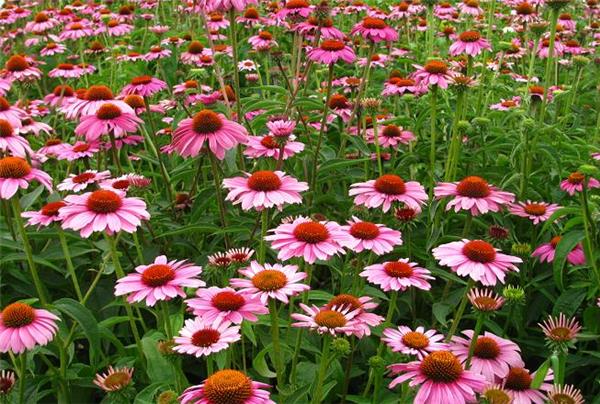
V. Cultivation Management of Coneflower
Whether from division or sowing, when planting out, always choose a sunny environment, deep dig the soil, and apply decomposed manure or add a certain amount of bone meal, sesame residue, etc. Determine the plant spacing according to need for planting out, and water thoroughly. During the growth period, increase fertilizer and water. Near the flowering period, foliar spray with potassium permanganate liquid fertilizer twice, which will make the flower color brilliant and long-lasting, and the plant shape full and well-proportioned. For plants overwintering in the open ground, after flowering, remove spent flowers, flower stems, and dead leaves, water thoroughly with winter water, or cover the underground part with compost or mound soil over it. To make coneflowers bloom more, two methods can be used: staged sowing and timely pruning after flowering.
(1) Staged sowing: If sown in autumn of the previous year, they will bloom in late April or early May of the following year, and the flowering period can last over two months; if sown in a greenhouse in early spring, they can bloom in July-August; if sown in May, they can bloom in September; if sown in June, they can bloom in October.
(2) Prune spent flowers to regulate the flowering period. For example, if pruned after flowers fade in June, while providing good fertilizer and water conditions, they can bloom again in September-October.
The above is an introduction to the coneflower. I hope it can help you.