Introduction to the Oxeye Daisy and Growing Tips, the Feminist's Close Confidante
The oxeye daisy is a beautiful ornamental plant, with lovely flower shapes and elegant, understated colors that reveal softness within firmness. The oxeye daisy symbolizes feminism. Now, let us take a look together.
I. Introduction to the Oxeye Daisy
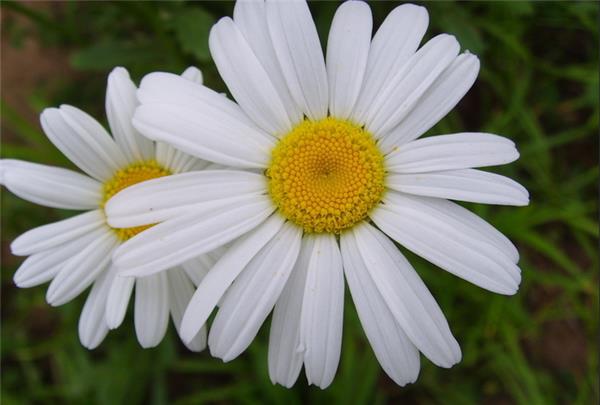
The oxeye daisy, also known as the French daisy, French chrysanthemum or ox-eye daisy, is a flowering plant native to the temperate regions of Europe and Asia, and can be cultivated in parks for ornamental viewing. The oxeye daisy belongs to the family Asteraceae and the genus Leucanthemum. The plant can reach a height of 70 cm. The leaves are alternate, lanceolate, with toothed margins. The flower head grows at the top of the stem and measures 9-11 cm in diameter. The ray florets of the flower disk are white, and the tubular florets are yellow. The flowering period is long, blooming continuously from May to August. The oxeye daisy is a perennial herb, 15-80 cm tall. The stem is erect, and at the top of the stem there are small flower heads (no more than 5 cm), composed of about 20 white ray florets and numerous yellow disk florets. The stem is mostly unbranched and grows laterally from the root. The leaves are dark green on both sides. The basal and middle leaves are petiolate, obovate to spatulate, and serrated. The upper leaves are shorter, sessile, and grow along the stem. It has numerous flat seeds without pappus. The basal leaves persist during the flowering period, are oblong, oblanceolate, obovate or ovate, 3-8 cm long and 1.5-2.5 cm wide, with a wedge-shaped base tapering into a long petiole; the petiole is longer than the leaf blade itself, and the margins are rounded or obtusely serrated. The middle and lower stem leaves are oblong or linear-oblong, narrowing toward the base, with auriculate or nearly auriculate enlarged bases that half-clasp the stem; the part below the middle or near the base is sometimes pinnately lobed. The upper leaves gradually become smaller, sometimes pinnately parted. All leaves are hairless on both sides, with inconspicuous glandular dots. The flower heads are solitary at the top of the stem, with long peduncles, or the stem bears 2-5 flower heads arranged in a loose corymb. The involucre is 10-20 mm in diameter. All phyllaries are hairless, with white or brown scarious margins. The ligules are 10-25 mm long. The achenes are 2-3 mm long, without pappus, or the ray floret achenes have lateral marginal crown teeth up to 0.4 mm long. The flowering and fruiting period is from May to October.
II. The Flower Language of the Oxeye Daisy
Flower language: sincerity, friendliness, friendship.
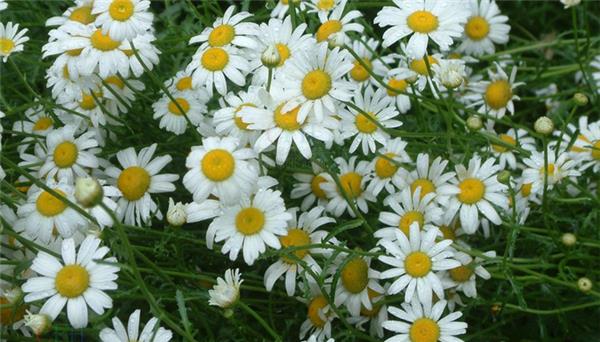
The oxeye daisy blooms in May and June, with flower heads, yellow tubular florets, white ray florets, and slender, upright peduncles; it lasts a relatively long time as a cut flower. The "bin" in "binju" (oxeye daisy) is homophonous with the "bin" in "binke" (guest); a guest is a friend. It symbolizes that friendship between friends is as pure and candid as the oxeye daisy.
Flower language: feminism
This is the flower chosen to honor the first female saint in church history - Saint Tecula - and therefore the flower language of the oxeye daisy is "feminism." Anyone born under the blessing of this flower, as its flower language suggests, has a strong sense of independence and self-determination. They believe that everything can only be accomplished by relying on oneself. However, if you carefully observe the people around you, there will surely be a friend of the opposite sex who can respect this mindset of yours. So, as long as you can manage the friendship well, it will develop into love.
September 23 birthday flower
The flower of Saint Tecula of Iconium, the first female saint
Since ancient times, Christianity has had the custom of linking saints with specific flowers. This originated from the church's practice of decorating the altar with blooming flowers when commemorating saints. In medieval Catholic monasteries, various flowers were cultivated almost like in a gardening center. Over time, the church paired the 366 saints of the year with different flowers, forming what is known as the flower calendar. At that time, most monasteries were located in Southern Europe, and Southern Europe has a Mediterranean climate, which is extremely suitable for planting flowers and plants. The oxeye daisy was chosen to honor Saint Tecula, who is regarded as the first female saint in church history. It is found throughout Europe, and its clustered traces can be seen all the way to Russia; it can also be found in various parts of the United Kingdom.
III. Propagation Methods of the Oxeye Daisy
Seed sowing and division propagation. The oxeye daisy is a flowering plant native to the temperate regions of Europe and Asia. It has been introduced to North America, Australia and New Zealand, and in some areas it has replaced local plants and become a weed. Controlling or eradicating them is very difficult, because as long as part of the rhizome remains, it can grow again.
The above is the relevant knowledge about the oxeye daisy. I hope it can help you.