Dutch Tulips: Characteristics and Introduction, Explained in One Article
The tulip is the most widely cultivated flower in the Netherlands and also the national flower of the Netherlands. Next, let us take a look at the characteristics of Dutch tulips.
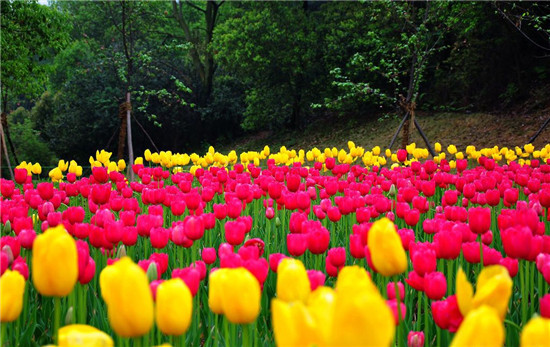
The tulip symbolizes beauty, solemnity, magnificence and success. In the Netherlands, there is also a beautiful legend about the tulip: in a castle lived a beautiful princess, and three warriors fell in love with her at the same time, each giving the princess a gift - a crown, a sword and a piece of gold. But the princess loved none of them. So the princess prayed to the flower goddess, and the flower goddess turned the crown into flowers, the sword into green leaves and the gold into stems and roots, and thus the tulip was born.
The tulip originated in the Middle East and was only introduced to Europe in the 16th century. Because the tulip resembles a Muslim turban, it is called dulband in Persian. The history of the Dutch tulip begins with a horticulturist. The horticulturist Clusius was a well-known botanist who, by chance, obtained tulip seeds, and through his careful cultivation, the tulip finally sprouted, grew and bloomed in Europe.
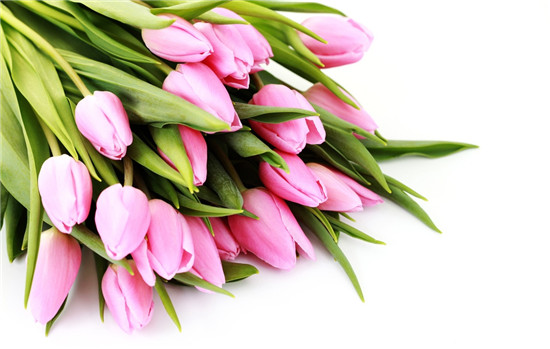
The commonly used cultivation method for Dutch tulips is bulb division propagation, mainly by separating the small bulbs. In autumn, from September to October, the small bulbs are planted separately, and the mother bulb is annual. Inside the scale leaves of the mother bulb, one new bulb and several daughter bulbs are produced, and the number of daughter bulbs varies depending on the variety, and the cultivation conditions also affect them. In early June, the dormant bulbs can be dug up and cleaned of soil. Store them in a dry, ventilated environment, which is beneficial for the differentiation of flower buds in the bulbs. The daughter bulbs need to be stored in a ventilated place at 5-10 degrees Celsius and planted in September-October in autumn.
Now the Netherlands cultivates about 9 billion flowers every year. If divided equally, every person in the world could get two. Among them, there are 3 billion tulips. Some people infer that if all these tulips were lined up, they could circle the equator 7 times. Just imagine: if the blue Earth wore a string of colorful tulip garlands, would it not be extraordinarily enchanting?
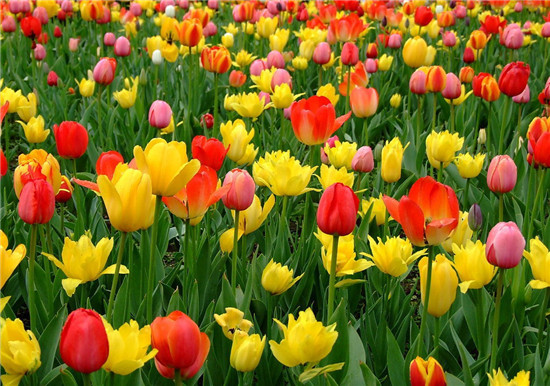
Every year when the tulips bloom, tourists from all over the world flock to visit the Keukenhof Park in the Netherlands. Keukenhof Park is located in Lisse (Liess), a central city of the Netherlands. It is the largest bulb garden in the world and also the necessary route of the annual flower parade. Around the park are stretches of flower fields, and inside the park, tulips, daffodils, hyacinths and various bulb flowers form a richly colorful picture. There are more than 6 million flowers of various kinds in the park, and many rare varieties that are seldom seen. Every spring, a flower show lasting about 8 weeks is held here, and many related activities such as gardening and flower arranging, as well as various themed exhibitions, are also arranged.
Varieties of Dutch Tulips
After long-term crossbreeding and cultivation by horticulturists, there are now more than 8,000 varieties worldwide, of which about 150 are mass-produced. They are brightly colored and highly variable, with red, yellow and purple being the most popular. But tulips that bloom with black flowers are regarded as rare treasures. In the 19th century, the romance novel The Black Tulip written by the French writer Alexandre Dumas praised this flower as "so brilliant that it dazzles the eyes, so perfect that it takes the breath away." In fact, there are no pure black flowers. The black flowers of the black tulip are not truly black; like the black rose, they are merely a dark purple that tends toward purple from red. These black flowers are mostly hybrids bred through artificial crossbreeding. Varieties such as the Dutch-bred "Diane's Widow," "Peerless Beauty," and "Black Queen" do not bloom in pure black either.
Classification by color:
1. Tulip [red] Liliaceae, Tulipa genus
The tulip is the national flower of the Netherlands. From 1634 to 1637, there was a period known in Dutch history as "tulip mania." New varieties and rare varieties of tulips were bought and sold at high prices and became investment objects that people competed to chase.
Flower-giving etiquette: place several stems of red tulips on square stiff backing paper, fix the positions with adhesive tape, carefully wrap them in transparent plastic paper, and decorate the four corners with golden ribbons to add a sense of magnificence.
2. Tulip [yellow] Liliaceae, Tulipa genus
In Europe and America, yellow flowers are usually not very popular, and the related flower meanings also tend to be rather negative. In fact, clear yellow contains the joy of spring. How could anyone not like such eye-catching bright flowers?
Flower-giving etiquette: because tulip stems have a rather beautiful curve, it is appropriate to use slightly larger wrapping paper with a white background and a floral pattern, tie 4-5 long stems into a bunch, and the ribbon must be yellow.
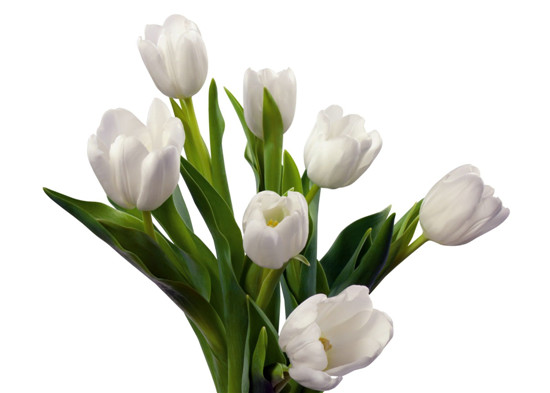
3. Tulip [white] Liliaceae, Tulipa genus
When the Australian ambassador who came to Turkey in the 16th century first saw this flower, he asked the Turks nearby for its name, and the answer was: tulip. In fact, this pronunciation refers to a Turkish turban. The Turk misunderstood the ambassador's meaning, but the flower name was thus created and has continued to be used.
Flower-giving etiquette: just use a few white tulips to make a bouquet, with no other embellishments. Wrap the outside with pink gauze, then gently tie it with a few thin red ribbons.
The above is the full content of the introduction to Dutch tulips and the characteristics of Dutch tulips that I have summarized for everyone. I hope this article can help you. Please also continue to follow us.
The related flower meanings also tend to be rather negative. In fact, clear yellow contains the joy of spring. How could anyone not like such eye-catching bright flowers?Flower-giving etiquette: because tulip stems have a rather beautiful curve, it is appropriate to use slightly larger wrapping paper with a white background and a floral pattern, tie 4-5 long stems into a bunch, and the ribbon must be yellow.
3. Tulip [white] Liliaceae, Tulipa genus
When the Australian ambassador who came to Turkey in the 16th century first saw this flower, he asked the Turks nearby for its name, and the answer was: tulip. In fact, this pronunciation refers to a Turkish turban. The Turk misunderstood the ambassador's meaning, but the flower name was thus created and has continued to be used.
Flower-giving etiquette: just use a few white tulips to make a bouquet, with no other embellishments. Wrap the outside with pink gauze, then gently tie it with a few thin red ribbons.
The above is the full content of the introduction to Dutch tulips and the characteristics of Dutch tulips that I have summarized for everyone. I hope this article can help you. Please also continue to follow us.