Introduction to Spring Azaleas and How to Make Bonsai
Spring azaleas are beautiful flowers. In spring, during the season when spring azaleas are in full bloom, the large blossoms are delicately gorgeous and extremely spectacular and flourishing. Now, let us take a look at spring azaleas.
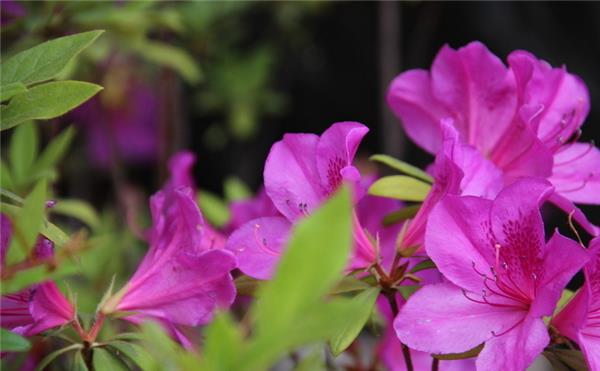
I. Introduction to Spring Azaleas
Spring azalea, also known as yingshanhong, manshanhong, shanzhizhu, hongzhizhu, and shanshiliu, is a deciduous shrub about 2 m tall; it has many branches, and the branches are slender and straight. The leaves are alternate, oblong-ovate, with pointed tips, dark green on the surface with sparse stiff hairs, and light green on the underside. It has racemose inflorescences, with flowers solitary or terminal, funnel-shaped, in diverse colors and with many cultivars. There are evergreen azaleas and deciduous azaleas; according to the flowering period, they are divided into spring azaleas, summer azaleas, and spring-summer azaleas. By flower type, they are divided into single, semi-double, and double. The petals are also divided into flat, slightly wavy-edged, and wavy-edged. The flowering period is April-May, and the fruit ripening period is October. It mostly grows on mountain slopes and in hilly thickets.
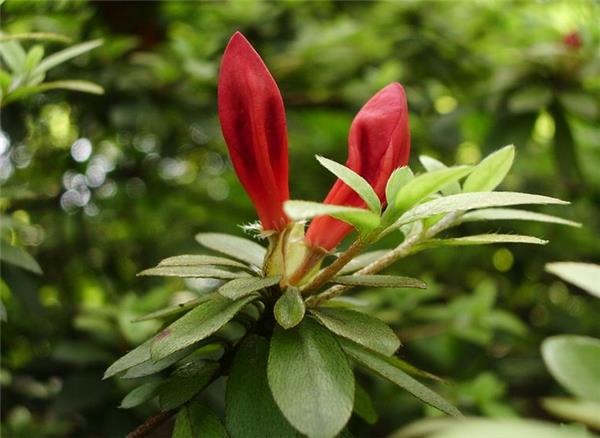
II. Making Bonsai from Spring Azaleas
Spring azaleas can be propagated by layering, cuttings, division, grafting, and other methods. Old spring azalea stumps that have grown for many years and have ancient, elegant, and unusual roots and trunks can also be used to make bonsai. They are mostly dug and transplanted in late autumn and early winter or before the flowers fade in spring. When transplanting, keep plenty of original soil, properly prune the main trunk and main roots, cut off branches that affect the shape, and keep more lateral roots and fibrous roots. For large branches and trunks, examine them carefully and remove them only after confirming they are not needed for the design. First plant them in clay pots or in the ground to grow the stock. The soil should be well-drained sandy soil. For stumps dug in late autumn and early winter, after planting, cover them completely with sandy soil, leaving only a little of the branches and trunk exposed. After watering thoroughly, cover with a plastic bag to keep warm and moist; stumps dug in spring should also be buried 2/3 into the soil. After planting, keep the soil moist but not waterlogged. After the plant has established and sprouted, gradually remove the sandy soil from the trunk area. During the stock-growing process, frequently spray water on the leaves and trunk to increase air humidity, but do not let the roots become too wet, and especially avoid waterlogging, otherwise root rot will occur. In summer, pay attention to shading to prevent scorching by the hot sun.
Spring azaleas can be made into many forms of bonsai, such as straight-trunk style, slanting-trunk style, curved-trunk style, double-trunk style, multi-trunk style, exposed-root style, cascade style, root-over-rock style, and water-and-land style. For seedlings propagated by cuttings, layering, and other methods, shaping can be carried out gradually year by year after 3 to 4 years of growth. The shaping time is mostly before bud break in spring or during the growth seasons of summer and autumn. The method is mainly pruning, supplemented by wiring. When shaping, follow the principle of first thick then thin: properly wire the main trunk and main branches, while shaping other branches by pruning. Because spring azalea branches and trunks are relatively fragile and easy to break, be careful during operation. During the growing season, if some branches crack, apply yellow mud to the wound, wrap it with plastic film, and it will heal and recover quickly. Old spring azalea stumps, however, rely on pruning for shaping, though some branches can also be properly wired. To improve ornamental value, old stumps of Mao Bai spring azalea that have grown for many years, with thicker branches and trunks and graceful forms, can also be used as rootstock, with high-quality spring azalea cultivars as scions, grafted by approach grafting or cleft grafting. Depending on the condition of the stump, part of the soil can also be gradually removed and the roots raised above the soil surface, making the roots exposed and claw-like, simple and vigorous.
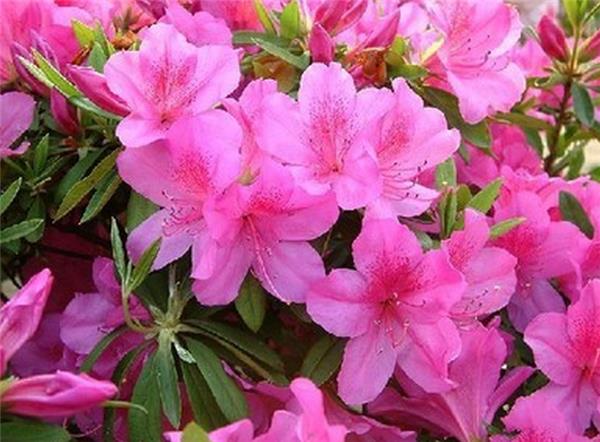
Spring azaleas like a warm, humid, semi-shaded environment and require good ventilation. At ordinary times, they can be placed in bright light for care. In the high-temperature seasons of summer and early autumn, shading is needed to avoid scorching by the hot sun, otherwise strong light will burn the leaves, but they should not be too shaded either, lest the plants grow leggy and flowering be affected. They can be cared for under a shade shed or under tree shade. During the growing season, keep the soil moist, but do not let it become waterlogged. Pay attention to drainage during the rainy season. When the air is dry, sprinkle water on the plants and the surrounding ground to increase air humidity and prevent the leaves from drying up. A layer of soft grass can also be spread on the surface of the potting soil to prevent the hot sun from burning the fine fibrous roots on the soil surface. Apply a once every 15 days or so diluted decomposed liquid fertilizer. To prevent chlorosis, add a small amount of black alum to the fertilizer solution so that the leaf color becomes dark green and glossy. During the bud stage, apply 1 to 2 additional phosphorus fertilizers such as bone meal and superphosphate to promote large and brightly colored flowers. In winter, move them indoors to a sunny place, keep the soil above 0°C and not frozen, and control watering so that the potting soil is only slightly moist.
After flowering each year, prune once, cutting off diseased and insect-damaged branches, dead and dry branches, crossing branches, overlapping branches, thin and weak branches, and leggy branches. Also properly shorten overly long branches so that the plant shape is graceful and the branches are reasonably distributed, strengthening ventilation and light penetration in the inner canopy, which is beneficial to plant growth. Repot once every 2 years or so in spring or late autumn. The potting soil should be fertile, loose, slightly acidic sandy soil rich in humus. Use as a plant dye: as a foil for flowers, the role of spring azalea branches and leaves has not been valued by people; in fact, it is a natural dye.
In a home environment, spring azaleas are best grown in pots. The best time for potting is early spring or late autumn. Spring azalea roots expand slowly. For 1-2-year-old plants, use 3-inch pots; for 3-4-year-old plants, use 4-inch pots; repot once every 3-4 years, and trim the root system at the same time. Watering should be flexibly controlled according to specific conditions. Water less when the temperature is low; when it is high, water as the soil dries, but absolutely do not let it become waterlogged. Fertilize by applying thin fertilizer frequently. For 2-4-year-old seedlings, to accelerate plant shaping, often promote new branches by pinching off growing tips and flower buds; after the plant is shaped, mainly cut off diseased branches, weak branches, and overlapping and disordered branches, all mainly by thinning pruning.
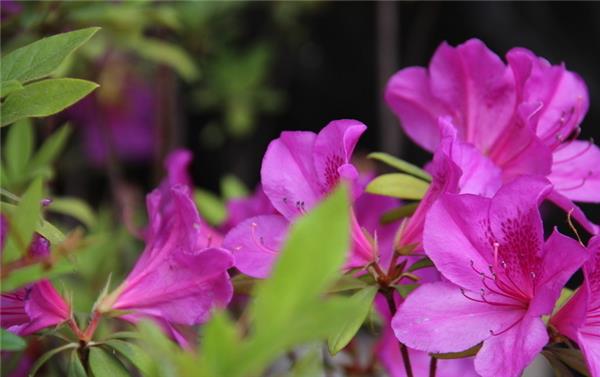
III. Disease Control of Spring Azaleas
Focus on prevention. In winter and before new shoots sprout in spring, spray the flower pots, potting soil, and plants 2-3 times with a 600-800 times solution of thiophanate or an equal-strength Bordeaux mixture; after new buds sprout, spray with a 600 times solution of 50% wettable carbendazim once a week for 3 consecutive sprays; in midsummer, red spiders are likely to occur and can be killed by spraying with a 2000 times solution of 50% dichlorvos emulsion.
The above is knowledge about spring azaleas. I hope it can help you.
Spring azalea roots expand slowly. For 1-2-year-old plants, use 3-inch pots; for 3-4-year-old plants, use 4-inch pots; repot once every 3-4 years, and trim the root system at the same time. Watering should be flexibly controlled according to specific conditions. Water less when the temperature is low; when it is high, water as the soil dries, but absolutely do not let it become waterlogged. Fertilize by applying thin fertilizer frequently. For 2-4-year-old seedlings, to accelerate plant shaping, often promote new branches by pinching off growing tips and flower buds; after the plant is shaped, mainly cut off diseased branches, weak branches, and overlapping and disordered branches, all mainly by thinning pruning.
III. Disease Control of Spring Azaleas
Focus on prevention. In winter and before new shoots sprout in spring, spray the flower pots, potting soil, and plants 2-3 times with a 600-800 times solution of thiophanate or an equal-strength Bordeaux mixture; after new buds sprout, spray with a 600 times solution of 50% wettable carbendazim once a week for 3 consecutive sprays; in midsummer, red spiders are likely to occur and can be killed by spraying with a 2000 times solution of 50% dichlorvos emulsion.
The above is knowledge about spring azaleas. I hope it can help you.