How to Grow Potted Pomegranate Flowers: A Detailed Care Guide
Pomegranate flowers are beautiful in appearance and brilliant in color, and are deeply loved by people. So do you know how to grow potted pomegranate flowers? Let's take a look together!
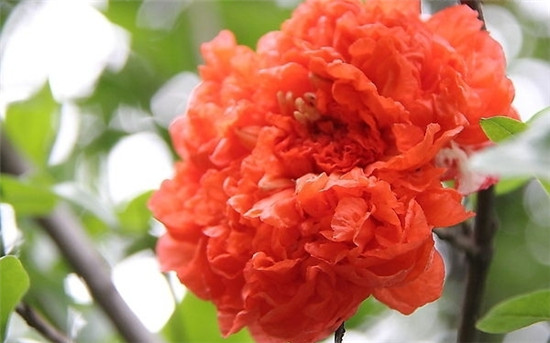
How to Grow Pomegranate Flowers
Pomegranate flowers are commonly propagated by cuttings, division, and layering. For cuttings, you can either select two-year-old branches in spring or use semi-lignified branches in summer; roots will form 15-20 days after planting. For division, you can dig up vigorous root-sucker seedlings and replant them in early spring in April when the buds begin to sprout.
Layering can be done in both spring and autumn, and there is no need to make a wound; before the buds sprout, bend a root-sucker branch from the base into the soil, and after it roots through the summer, cut it away from the mother plant, and by autumn it will become a seedling.
For outdoor cultivation, choose a site with sufficient light and good drainage. During the growing process, you need to frequently remove root-sucker shoots and prune dead branches, diseased branches, dense branches, and leggy branches to facilitate ventilation and light penetration.
For pot cultivation, it is best to plant shallowly, control watering, and keep it dry rather than wet. During the growing season, pinch the tips to control the growth of vegetative branches and promote flower bud formation.
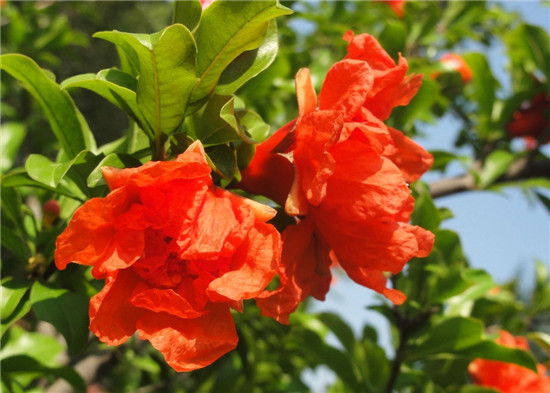
When Do Pomegranate Flowers Bloom?
The pomegranate itself likes a sunny and dry environment, is relatively cold-tolerant and drought-tolerant, but is not tolerant of waterlogging or shade. It is not strict about soil requirements, but fertile, loose, nutrient-rich sandy loam is best for growing pomegranates. The flowering period is from May to July each year.
The pomegranate flower is the flower of the deciduous shrub or small tree pomegranate. The trunk of the pomegranate is grayish brown, with flaky peeling, and the young branches are yellow-green and smooth, often four-angled, with branch tips mostly thorn-like and no terminal buds. Whenever the flowering season arrives, 1 to several small flowers grow at the branch tips or leaf axils of the pomegranate. The calyx is bell-shaped, fleshy, with 6 lobes at the tip, smooth and waxy on the surface, and orange-red. The pomegranate flower has 5-7 petals, which are red or white, single or double. The pomegranate flower's berry is yellow-red and spherical.
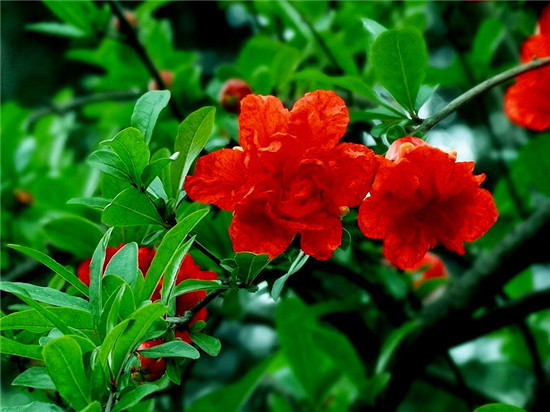
How to Make Bonsai Pomegranates Bloom and Bear More Fruit
1. Repotting: Repot once every 1-2 years. Young trees should be moved into a slightly larger pot, while old stumps can remain in the original pot. When repotting, remove half of the old potting soil, add new soil, and prune old roots and overly long fibrous roots to encourage new root growth. Use humus soil made by composting cake fertilizer, poultry manure, leaves, weeds, sandy soil, and so on; it contains more phosphorus and potassium fertilizer, which is beneficial for pomegranate flowering and fruiting. If you do not repot for many years, there will be many fibrous roots in the pot, little soil, and insufficient fertilizer, so it will bloom less or not bloom at all.
2. Fertilizing: Pomegranates like fertilizer more than general potted ornamental plants, so apply a good base fertilizer when repotting. When growing pomegranates in general cultivation soil, apply liquid fertilizer containing more phosphorus, and appropriately apply 0.2% potassium dihydrogen phosphate several times.
3. Light and Water Control: During the pomegranate's bud stage, in addition to sufficient light, you should also control water to keep the potting soil on the dry side. When the leaves are slightly wilting, first place the pomegranate in a shaded area for about 30 minutes, and after the temperature of the potting soil and the pomegranate plant has dropped somewhat, spray clear water on the leaf surface, then after a moment water the pot again. Repeat several times, and flower buds will appear in about 25 days.
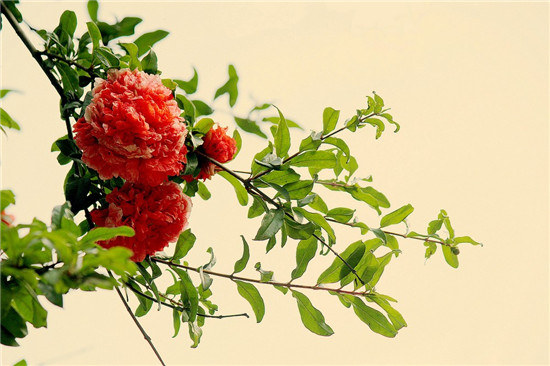
4. Pollination: If cloudy weather occurs during the flowering period, it will affect natural pollination. At this time, move the pomegranate to a ventilated, rain-sheltered place, and after the weather clears, place it back in the sunlight for care. Pomegranate flowers are divided into male and female: male flowers are large at the front and smaller where the rear connects to the flower stalk; female flowers are small at the front and larger where the rear connects to the flower stalk. To increase the fruit-setting rate, artificial pollination can be used. The method is: when the first flush of flowers has just opened, gently dab a writing brush on the pistil a few times, then gently dab the writing brush on the pistil a few more times, repeating several times, to assist pollination. Pollination is best done in the morning; the weather is hot at noon, which is unfavorable for pollination.
5. Branch Thinning: After leaf fall or before spring sprouting, prune and shape the pomegranate once. If there are too many flower buds, promptly cut off some of them. After fruit set, cut off unnecessary fruits according to the shape, with a layout that is staggered in height and well spaced in density, further enhancing its overall beauty.
The above is the full content I have summarized for you on how to grow potted pomegranate flowers. I hope this article can help everyone. Please also continue to follow us.