What are the effects and uses of pomegranate flowers?
Everyone knows that pomegranate flowers can be enjoyed for their beauty, and once they mature you can also taste their fruit. In fact, pomegranate flowers have another value, namely medicinal value. Let's take a look together!
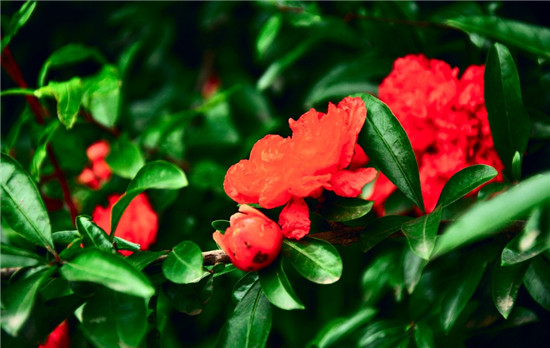
Pomegranate flowers belong to a deciduous shrub or small tree. The pomegranate plant is 2-5 m tall, up to 7 m. The trunk is grayish brown, with flaky peeling; young branches are yellow-green and smooth, often four-angled, mostly spiny at the tips, with no terminal bud. Leaves are simple, opposite or clustered, oblong or obovate, 2-8 cm long, entire, smooth on the surface, short-stalked, with new leaves tender green or bronze. One to several flowers are borne at the branch tips or in leaf axils; the calyx is bell-shaped, fleshy, with 6 lobes at the apex, smooth and waxy on the surface, orange-red, and persistent. Petals are 5-7, red or white, single or double. The berry is spherical, yellow-red.
Pomegranate flowers are unisexual; the flowers on one tree are divided into female flowers and male flowers, and both are very attractive. The base of the male flower is smaller, forming an obtuse triangle from the side, and it falls off after flowering; the base of the female flower is noticeably swollen (visible when flowering), and only this flower will bear fruit.
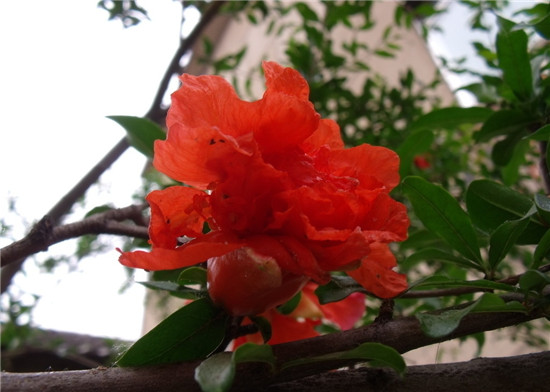
Pomegranate is a deciduous shrub or small tree. The plant is 2-5 m tall, up to 7 m. The trunk is grayish brown, with flaky peeling; young branches are yellow-green and smooth, often four-angled, mostly spiny at the tips, with no terminal bud. Leaves are simple, opposite or clustered, oblong or obovate, 2-8 cm long, entire, smooth on the surface, short-stalked, with new leaves tender green or bronze. One to several flowers are borne at the branch tips or in leaf axils; the calyx is bell-shaped, fleshy, with 6 lobes at the apex, smooth and waxy on the surface, orange-red, and persistent. Petals are 5-7, red or white, single or double. The berry is spherical, yellow-red. Seeds are numerous with a fleshy outer seed coat, and the fruit ripens in September-October. Cultivated pomegranate varieties are divided into two major groups: fruiting pomegranates and flowering pomegranates.
Value and uses of pomegranate flowers
Pomegranate flowers can be enjoyed both for their flowers and their fruit. Small potted plants are used for display on windowsills, balconies and in living rooms; large potted plants can be placed in public places and meeting halls; pomegranates planted in the ground are suitable for landscaping in scenic areas.
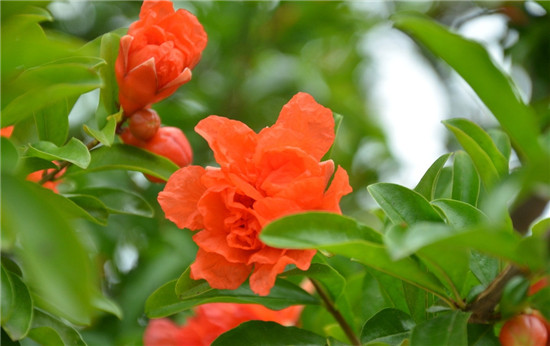
Pomegranate has a long history as medicine, and it is recorded in various ancient medical texts. Through clinical practice, physicians of past dynasties held that pomegranate is cool in nature and has effects such as clearing heat, detoxifying, strengthening the stomach, moistening the lungs, astringing the intestines and stopping bleeding. Among these, the most commonly used medicinal part is pomegranate peel, often applied after being stir-fried. Pomegranate flowers can stop nosebleeds, vomiting of blood and bleeding from external injuries, and can also treat excessive vaginal discharge. Used externally, they can treat otitis media. Tender pomegranate leaves strengthen the stomach and regulate the intestines, dissolve food stagnation and aid digestion; used externally, they can treat eye diseases and skin diseases. Modern medical research believes that pomegranate peel contains "pomegranate root bark alkaloid," which has an inhibitory effect on various bacilli and skin fungi. Sour pomegranate contains relatively more tannins, has an astringent and sterilizing effect, can treat diarrhea and dysentery, and can also stimulate the appetite and aid digestion. The root bark of the pomegranate tree contains tannins and has the effect of expelling tapeworms and roundworms.
The fruit is edible; the juice can be brewed into wine; the fruit peel and root bark have astringent, antidiarrheal and insecticidal effects; they can also be used as a black dye; the leaves can be stir-fried and used as a substitute for tea.
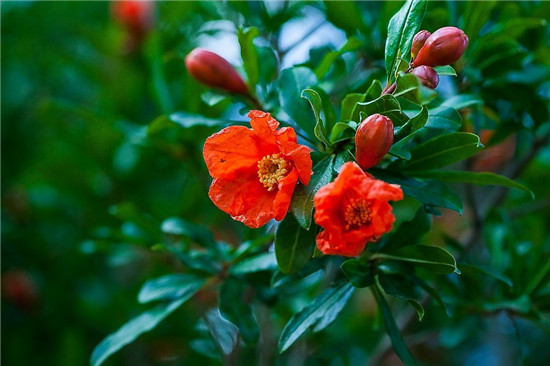
Practical simple remedies using pomegranate flowers
1. Bad breath, stomatitis: 1 pomegranate, peel and take the seeds, mash and add water to decoct into a juice, hold in the mouth and then swallow, several times a day.
2. Anal prolapse: 30 g pomegranate peel, 15 g alum, decoct in water, wash the affected area.
3. Otitis media: pomegranate flowers, dried by heating, add a little borneol, grind into a fine powder, blow into the ear.
4. Chronic diarrhea and prolonged illness: old pomegranate peel, dried by heating and ground into a fine powder, take 10 g each time, swallowed with rice water, 2 times a day.
5. Kidney stones: pomegranate root bark and Lysimachia christinae each 30 g, decoct in water and take.
6. Scald and burn: an appropriate amount of pomegranate peel, ground into a fine powder, mixed evenly with sesame oil, apply to the affected area.
7. Bleeding from external injury: dried pomegranate flowers and Chinese cabbage in equal parts, sun-dried and ground into powder, apply to the wound, then press with a dressing.
8. Eczema, prickly heat: fresh tender pomegranate leaves, decoct in water, wash the affected area.
The above is all the content I have summarized for you on the effects and uses of pomegranate flowers. I hope this article can help everyone. Please also continue to follow us.