Introduction to the Cotton Bush and Its Propagation: The Green Balloons Hanging from the Tree
The Cotton Bush (Gomphocarpus physocarpus) is an ornamental plant with butterfly-shaped flowers and balloon-like fruit that is pale green and covered with bristly hairs. Its full bloom period is from June to September. It can be grown as a houseplant for ornamental display and used as a landscaping plant. Now let us take a look at the introduction to the Cotton Bush.
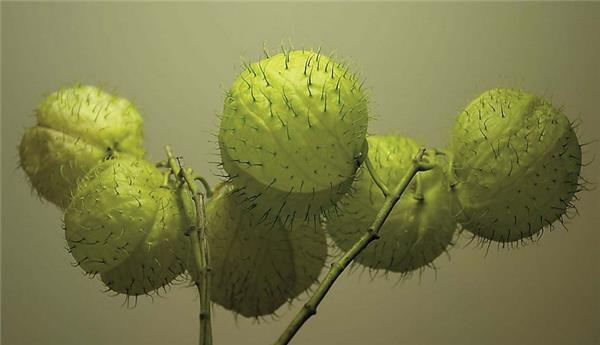
I. Introduction to the Cotton Bush
The Cotton Bush, also known as the Balloon Plant or Hairy Balls, is native to Africa. It is a shrubby herbaceous plant. The plant grows about 2 m tall. The stems are erect, grayish-green, and covered with white hairs. The leaves are linear. The leaf blades are linear or long lanceolate, resembling willow leaves. The surface is smooth, the leaf color is deep green, and the underside is slightly paler. The flowers are axillary, in cymes; the corolla is broadly ovate, reflexed, and the corona is hood-shaped; the flowers are white. The fruit is yellow, conical, with prickly protrusions on the surface, and the exocarp bears soft spines. The fruit is very thin, swollen and spherical; when gently squeezed by hand, it seems as if air escapes, very much like a small balloon, and the fruiting period is long. It belongs to the genus Asclepias in the family Apocynaceae (formerly milkweed family). It is native to South Africa. The branches bear white fine hairs. The leaf blades are 5-10 cm long and 0.6-0.8 cm wide, lanceolate, nearly smooth. The umbel-like cymes are axillary, with 5-10 white flowers per cluster, and the lobes are recurved.
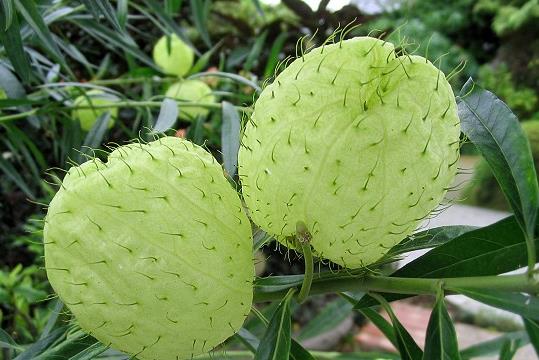
II. Morphological Characteristics of the Cotton Bush
1. Stem: An erect shrub, 80-150 cm tall, with numerous branches and milky sap; the branches are slender, erect or ascending obliquely; young branches are green, old branches grayish-white, with fine soft hairs.
2. Leaves: Leaves opposite, lanceolate or linear-lanceolate, 10-13 cm long, 1-2 cm wide, apex acuminate or acute, base obtuse and extending to the petiole, papery, entire, glossy green on the upper surface, pale green on the underside; both surfaces smooth and hairless; the midrib is slightly sunken on the upper surface and prominently raised on the underside, lateral veins inconspicuous; petiole 0.5-0.9 cm long, smooth and hairless.
3. Flowers: Numerous, white, unscented, 0.9-1.1 cm in diameter when open, borne in umbel-like cymes; the inflorescence arises between the petioles of opposite leaves, 2-4 cm long, slightly pubescent; the pedicels are slender, 1.2-2 cm long, pubescent; the calyx is deeply 5-lobed, the lobes lanceolate, 0.5-0.6 cm long, apex acuminate, hairy; the corolla is divided into 5 lobes almost from the base; the lobes are ovate-oblong, reflexed, 0.7-0.8 cm long and about 0.4 cm wide, apex obtuse, both surfaces smooth and hairless, with a ciliate margin; the staminal column is about 0.4 cm long; the corona scales are 5, ovate, white, 0.2-0.4 cm long, apex obtuse. The flowers are white to pale yellow, and the flowering period is extremely long, blooming from autumn to spring.
4. Fruit: The fruit is a follicle, ovate or roundly ovate, 5-8 cm long, 3-6 cm in diameter, like an inflated balloon, hollow with no flesh, containing numerous seeds; when mature it is green, densely covered with bristles or spines, and also sparsely covered with soft hairs; after maturity it splits open, and the seeds are roundly ovate, 0.3-0.4 cm long, without a tuft of hairs, turning black when mature, and the seeds bear white fluff that allows them to be dispersed by wind; it fruits from spring to autumn. The fruit is yellow-green, ovate, and roundly plump, looking both like a fully inflated balloon and like a pufferfish that is puffing itself up in anger, hence the elegant names balloon fruit and pufferfish fruit; it is very peculiar. Apart from the seeds, the interior of the fruit is hollow with no flesh; a gentle pinch flattens it, and it soon springs back, much like a balloon.
5. Seeds: After the fruit matures, it can burst open on its own; the upper part of the seed bears silvery-white fluff, shaped like a parachute, and when the wind blows it drifts everywhere to sow itself, hence it is also called the Wind Boat Cotton Bush.
6. Characteristics: A perennial herbaceous erect shrub of the family Apocynaceae (formerly milkweed family), 80-150 cm tall, flowering from April to February of the following year; it can be seen in the mountain areas of central Taiwan, China, and in places such as Alishan. Young branches are green, old branches grayish-white, slender and erect. Leaves opposite, linear and slender; flowers white, in drooping umbel-like inflorescences that are terminal or axillary, with about a dozen small flowers; the fruit is like an inflated balloon, hollow with no flesh, its surface covered with coarse hairs; after maturity it splits open, and the seeds bear white fluff that allows them to be dispersed by wind.
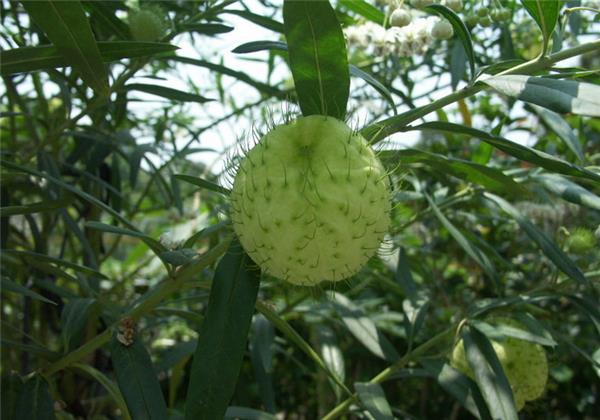
III. Ecological Habits of the Cotton Bush
It prefers a hot, humid environment with plenty of sunlight; it is not cold-tolerant, slightly tolerant of shade and drought, and requires fertile, loose, slightly acidic sandy loam soil; the winter temperature should not be lower than 10°C. It is suitable for cultivation in South China.
IV. Landscape Uses of the Cotton Bush
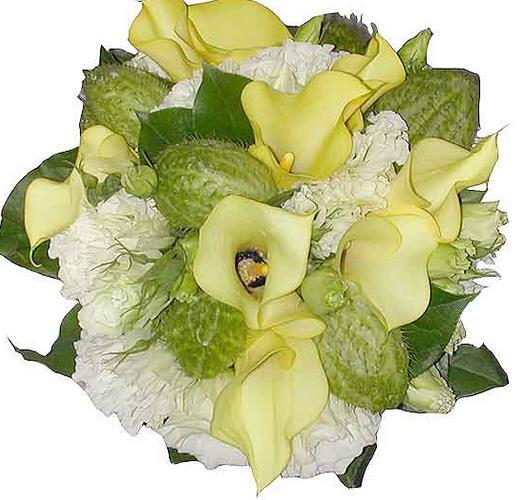
Used for horticulture and flower arranging. Suitable for potted cultivation and garden beautification. The Cotton Bush is a peculiar and interesting ornamental plant; in autumn and winter, flowers and fruit are present at the same time, and the ornamental period is long. It can be grown in the open ground to accent a courtyard, and its cut branches are excellent material for flower arranging.
V. Propagation Methods of the Cotton Bush
Sowing and cuttings; spring and autumn are the suitable propagation periods. The optimum temperature for seed germination is 20-25°C, and germination takes place in 15 days. For cuttings, take mature branches 10-15 cm long, wash off the milky sap with clean water, then insert them for rooting, which takes 20-30 days. When cultivating, choose a sheltered spot and set up stakes for support to prevent the plant from being blown over by wind.
VI. Flower Language of the Cotton Bush
Sweetness and tender attachment.
The above is the knowledge about the Cotton Bush; I hope it can help you.