What are the characteristics of the melastoma? A detailed guide for you
Nowadays people rarely see wild peonies anymore, so why not come with me and take a look at the characteristics of this wild peony!
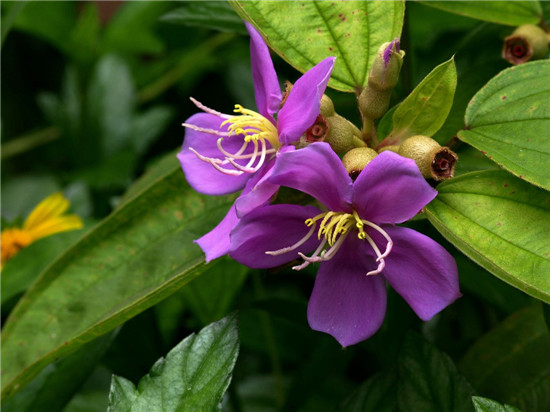
Melastoma, also known as: mountain pomegranate, big golden incense burner, pig ancient rice, leopard tooth orchid, is a shrub in the family Melastomataceae, genus Oxyspora, 0.5-1.5 m tall, with many branches; the stem is obtusely four-angled or nearly cylindrical, densely covered with appressed scale-like strigose hairs, the hairs flat with fimbriate margins. The leaves are firm-papery, ovate or broadly ovate, acute at the apex, shallowly cordate or nearly rounded at the base, entire, with 7 basal veins, both surfaces covered with strigose hairs and short soft hairs, the basal veins raised on the underside and covered with scale-like strigose hairs, the lateral veins raised and densely covered with long soft hairs; densely covered with scale-like strigose hairs; the seeds are embedded in the fleshy placenta. The flowering period is May to July, and the fruiting period is October to December.
Shrub, 0.5-1.5 m tall, with many branches; the stem is obtusely four-angled or nearly cylindrical, densely covered with appressed scale-like strigose hairs, the hairs flat with fimbriate margins. The leaves are firm-papery, ovate or broadly ovate, acute at the apex, shallowly cordate or nearly rounded at the base, 4-10 cm long and 2-6 cm wide, entire, with 7 basal veins, both surfaces covered with strigose hairs and short soft hairs, the basal veins raised on the underside and covered with scale-like strigose hairs, the lateral veins raised and densely covered with long soft hairs; the petiole is 5-15 mm long and densely covered with scale-like strigose hairs.
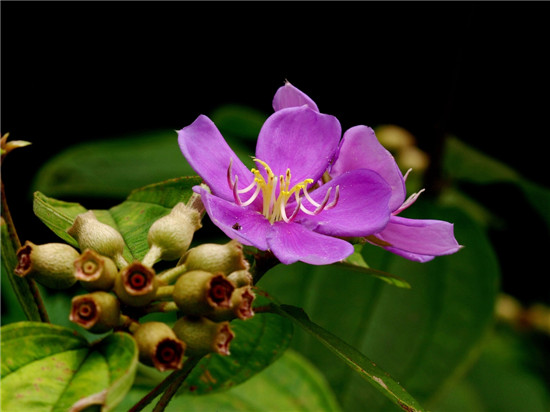
The corymb is borne at the top of the branches, nearly head-like, with 3-5 flowers, rarely solitary, with 2 leafy involucral bracts at the base; the bracts are lanceolate or narrowly lanceolate, densely covered with scale-like strigose hairs; the pedicel is 3-20 mm long and densely covered with scale-like strigose hairs; the calyx is about 2.2 cm long, densely covered with scale-like strigose hairs and long soft hairs, the lobes ovate or slightly broader, equal to or slightly longer than the calyx tube, acuminate at the apex with a fine point, both surfaces hairy; the petals are rose-red or pink, obovate, 3-4 cm long, rounded at the apex, densely ciliate; in the longer stamens the connective is extended at the base and curved, with 2 deep clefts at the end, while in the shorter stamens the connective is not extended, and the base of the anther sacs bears 1 pair of small tubercles; the ovary is semi-inferior, densely covered with strigose hairs, with 1 whorl of bristles at the apex.
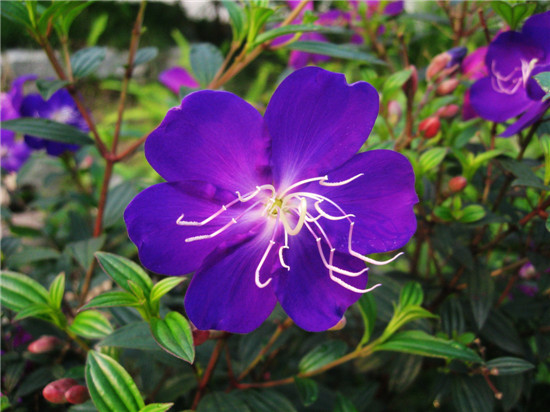
Some say the peony is the king of flowers, so the melastoma should be the king of wildflowers. In fact, flowers of the Melastomataceae family do not have the domineering air of a king; on the contrary, the bright yet somewhat delicate pink flowers, without losing their own wildness, are the original appearance of the Melastomataceae family.
Its flowers bloom in summer, in broad-leaved forests where a little sunlight reaches, and sometimes beside roads at over 1,000 m you can see it in bloom. Its flowers open in groups, so you can enjoy both the overall display and the beauty of a single flower.
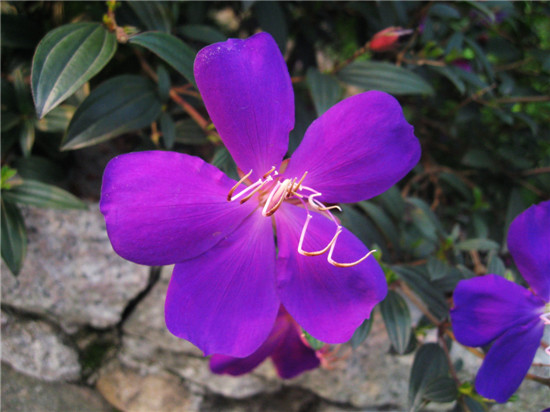
The melastoma is a beautiful flowering plant, and can be planted alone or in groups in gardens. It is suitable for embellishing courtyards or for pot cultivation. The flowers are large, rose-red and beautiful, and it is praised as the wild peony flower, hence the name melastoma.
The above is all of the characteristics of the melastoma and the detailed introduction I have summarized for you. I hope this article can help you. Please also keep following us.