Blue-eyed Daisy: Introduction and Growing Tips to Help You Grow Beautiful Flowers
The blue-eyed daisy is colorful and can be used as a potted flower placed on a balcony or desk for viewing, or as a garden and open-field flower in early spring and early summer, mass-planted to arrange flower beds and flower borders; when planted, set off against green grass and interesting stones, it better shows its harmonious natural beauty. A few trailing varieties can be grown as ground cover. Let's take a look at what we know about the blue-eyed daisy.
I. Introduction to the Blue-Eyed Daisy
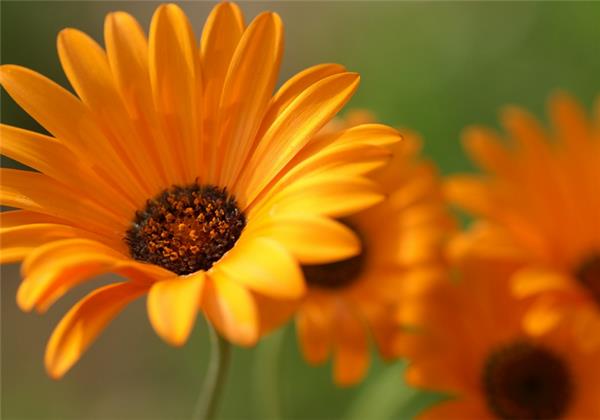
The blue-eyed daisy is a genus under the Calenduleae tribe of the Asteraceae family. The blue-eyed daisy was originally part of the genus Dimorphotheca, and later split off from it, with only the annual species remaining in that genus, while the perennial ones were placed in the genus Osteospermum. Osteospermum is a close relative of the genus Chrysanthemoides. The scientific name of the blue-eyed daisy comes from the Greek word for "bone" and the Latin word for "seed." It is also known as the African daisy, South African daisy, cape daisy, and blue-eyed daisy, among other names. There are about 50 species under the genus Osteospermum, all native to Africa, of which 35 are in southern Africa and Arabia. They are half-hardy plants, so wild blue-eyed daisies cannot withstand winter. The alternate leaves of the blue-eyed daisy are green, and some varieties have beautiful markings on the leaves. The leaves are spear-shaped with entire margins, but the hardy species have serrated edges.
II. Cultivation Techniques for the Blue-Eyed Daisy
1. Planting
The blue-eyed daisy likes a warm, sunny environment and fertile soil. However, they can also tolerate poor soil, high salinity, or dry conditions. Today's cultivated varieties have a longer flowering period, and proper watering and fertilizing can keep the plants blooming continuously. There is no need to cut off faded flowers, because they do not easily set seed. If grown in containers, avoid letting the soil dry out, because they will go dormant to withstand such dry conditions; when the plant is dormant, it causes flower buds to drop, and it is not very easy for them to bloom again afterward. Furthermore, after a drought, when watering again, do not water too much; if the soil is too wet, the roots will rot very easily.
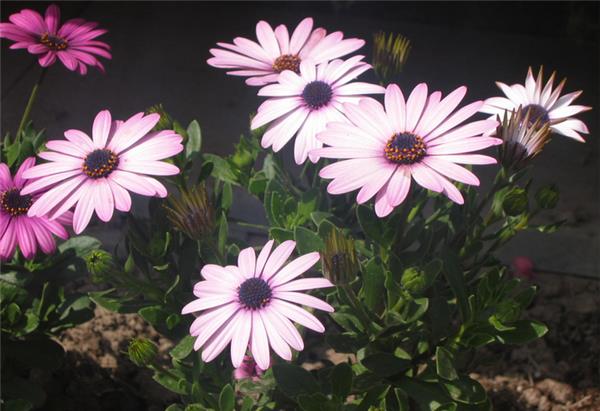
Blue-eyed daisy flowers are very common in nurseries. Propagation is mainly done by cutting propagation. Many hybrids and cultivated varieties have been bred. Yellow cultivated varieties generally have yellow or pale white flower centers. One very popular blue-eyed daisy is the wheel daisy, with spoon-shaped ray florets ranging from purple to pale violet-blue and blue disk flowers. It is an evergreen plant, about 40 cm tall. At night or in cold weather, the ray florets close up.
2. Planting Precautions
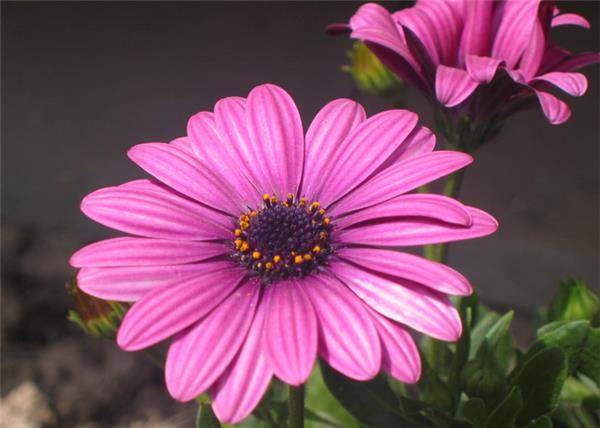
One common disease is root rot, mostly caused by overwatering. It can be prevented by controlling water appropriately and keeping the medium slightly moist to somewhat dry. Once root damage is found, repot promptly and replace the medium. The second is yellow leaves. The causes of yellow leaves and their control measures are as follows: ① Yellow leaves are mainly on young leaves and often show spots (the cause is that the medium pH is too low, causing iron toxicity); this can be adjusted by watering with limewater at an appropriate concentration to adjust the medium pH; ② The temperature during the seedling stage is too low, so the nighttime temperature can be appropriately raised; ③ Nitrogen fertilizer is insufficiently applied, so the amount of nitrogen fertilizer can be appropriately increased.
III. Garden Uses of the Blue-Eyed Daisy
Horticultural Development
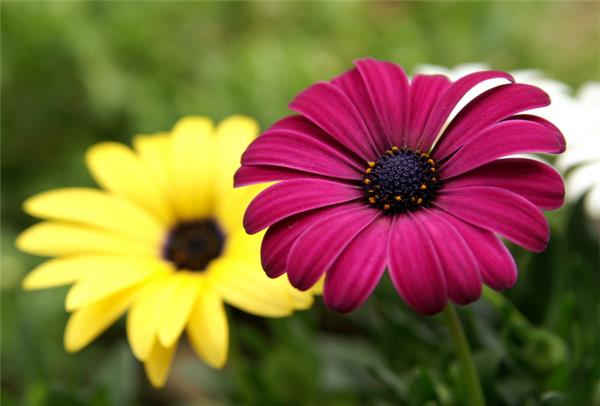
There are about 50 species under the genus Osteospermum, all native to Africa, of which 35 are in southern Africa and Arabia. They are half-hardy plants, so wild blue-eyed daisies cannot withstand winter. The alternate leaves of the blue-eyed daisy are green, and some varieties have beautiful markings on the leaves. The leaves are spear-shaped with entire margins, but the hardy species have serrated edges. The flowers resemble daisies and include tubular florets and ligulate florets, growing singly on the stems, and sometimes also in cymes. The tubular florets are pseudo-sexual and come in many colors, such as blue, yellow, and purple, while the hardy species have a dark blue center. The ligulate florets have only pistils and also come in many colors, such as white, cream, pink, purple, lavender, and yellow. Some cultivated varieties have spoon-shaped petals. Many varieties bloom a second time in late summer, while the hardy species bloom in spring but do not have a second bloom. With features such as variously shaped flower forms, a riot of colorful flower colors, compact and dense dwarf plant habits, and a flowering period lasting several months, as soon as they were discovered they attracted the attention of horticultural circles in Europe and the United States and were quickly applied in gardens. The blue-eyed daisy has already been widely used as a potted and ground-planted flower in countries such as Europe and the United States, and many European countries have already carried out large-scale commercial production. At the same time, through interspecific and intervarietal hybridization, many new varieties have been bred. The genus Osteospermum has several species of subshrubs and herbaceous plants. In gardens, they are also grown as annual and biennial herbaceous flowers, and most of the blue-eyed daisy cultivated varieties sold are annual.
The above is what we know about the blue-eyed daisy. I hope it helps you.
The blue-eyed daisy has already been widely used as a potted and ground-planted flower in countries such as Europe and the United States, and many European countries have already carried out large-scale commercial production. At the same time, through interspecific and intervarietal hybridization, many new varieties have been bred. The genus Osteospermum has several species of subshrubs and herbaceous plants. In gardens, they are also grown as annual and biennial herbaceous flowers, and most of the blue-eyed daisy cultivated varieties sold are annual.The above is what we know about the blue-eyed daisy. I hope it helps you.