How do you grow Sedum clavatum so it looks even more beautiful? Start by understanding its characteristics and care methods
Sedum clavatum is a succulent plant in the Crassulaceae family, Sedum genus. In Japan it is called "Otome Botan" or "Ohime Botan"; "Laura" is the Korean translated name for this variety. Now let's take a look at how to grow Sedum clavatum.
I. Morphological characteristics of Sedum clavatum
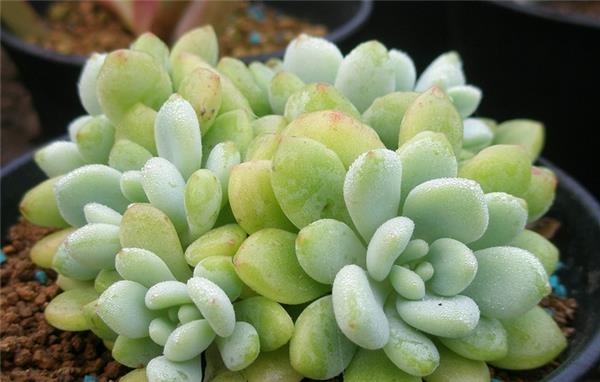
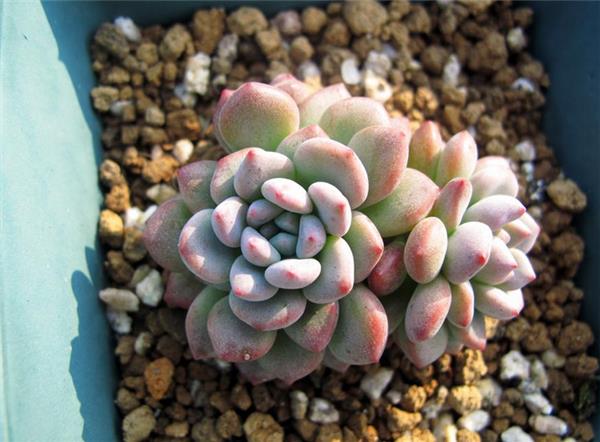
Sedum clavatum is a perennial subshrub with many branches. Sedum clavatum often sends out new shoots from the lower part of the stem, forming clusters. The leaves are spoon-shaped, alternate, and arranged in a rosette; the surface is smooth, the front is flat, and the back is slightly raised, fleshy and thick, emerald green or tender green, covered with a white powder on the leaf surface, and revealing densely packed extremely fine white granules. In an environment with sufficient light and a large temperature difference, a beautiful and lovely small red dot will appear at the leaf tip, and the leaf color will change to a jelly-like light green or yellow-green, just like frozen, translucent jade fat that seems ready to break at a touch. Sedum clavatum has two different forms. One has relatively narrow and long leaves with less frosty powder; the other has wider leaves with more frosty powder (sometimes called "Laura"); but both forms belong to Sedum clavatum.
II. Cultivation techniques for Sedum clavatum
Sedum clavatum likes a cool, dry, and sunny environment and well-drained sandy soil.
1. Light
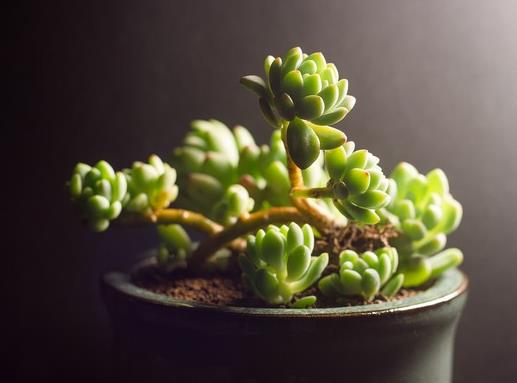
The more sufficient the light and the greater the temperature difference between day and night, the more vivid the leaf color. When temperature permits, it is best to place it outdoors for care to ensure sufficient light. When light is insufficient or the soil is too moist, it will become leggy, the whole plant will turn light green or dark green, the leaves will be sparse and the spacing will stretch, accelerating upward growth, seriously affecting its ornamental value, and it may even die because the plant's photosynthesis is hindered.
2. Water
Because the plant has a high internal water content, Echeveria 'Purple Pearl' is very prone to rot in an overly humid environment. Absolutely avoid overwatering.
To avoid water accumulating at the roots, it is best to choose a pot with drainage holes at the bottom. Beginners can use a red clay pot with good breathability; glass containers absorb heat and have poor breathability, so use them with caution. Reference watering amount: about once every 10 days, and just water thoroughly each time. The watering frequency can be increased or decreased as appropriate according to climate differences in different regions and seasons.
3. Soil
It is suitable to cultivate with sandy soil that has good drainage and breathability, so as to facilitate the removal of excess water and the growth of the plant's roots; it can be prepared with 1/3 leaf mold soil, 1/3 sandy soil, and 1/3 garden soil. Repot once every 1-2 years in spring, and the dead old roots can be trimmed off.
4. Temperature
Below 5°C, growth stops or there is slight frost damage; at 0°C and below, the water in the leaves freezes and the cells die. When the temperature is too high (above 35°C) or too low (below 5°C) in winter and summer, the plant stops growing. At this time, watering should be temporarily reduced or stopped, and the watering frequency should be resumed when the temperature is suitable. During high summer temperatures, pay attention to ventilation and prevent prolonged exposure to the sun to avoid sunburn.
6. Pruning
Usually, dry and withered old leaves need to be removed promptly to prevent accumulation from causing bacterial growth. When the plant becomes leggy or grows too tall, the top branches and leaves can be pruned to shape it and control the plant height, so as to maintain a beautiful plant form. The cut top portion can be dried at the wound and then inserted into slightly moist sandy potting soil to take root and become a new plant. The stem and branches and leaves at the bottom can sprout more side shoots.
7. Fertilizer
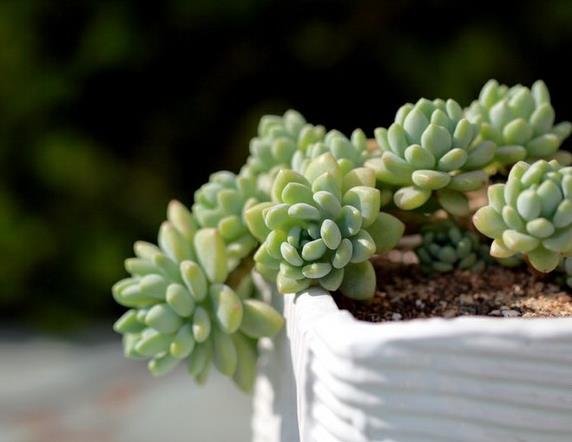
Fertilizing should not be excessive, especially nitrogen fertilizer, otherwise it will cause the plant to become leggy and the leaf color will not turn red. Apply a thin fertilizer mainly of phosphorus and potassium once a month. Care for it in a ventilated environment, otherwise it is prone to disease. Its suitable growth temperature is 15-25°C, and in winter not lower than 5°C; during the growing season, water only after the soil has dried out, and water thoroughly; when the air is dry, you can sprinkle water around the plant, but water should not accumulate on the leaf surface, especially in the center of the leaf rosette, otherwise it will cause heart rot; during the growing season, fertilize generally about once every 20 days. The growing seasons are spring and autumn. Water only after the potting soil has completely dried out. In summer, shade is needed and watering should be reduced.
The above are the cultivation tips for Sedum clavatum. I hope they can help you.