A Detailed Introduction to the Golden Spider Lily and Its Cultivation Techniques
"Crab-claw stamens and silken petals twine in rivalry, the colorful pom-pom hydrangea's charm is rare indeed. Silent all day, secretly gathering strength, when autumn comes the mountain streams ripple with laughter across the land." The golden spider lily (Lycoris aurea) is a plant both excellent in flower and foliage and very unusual: its originally luxuriant clumps of green leaves, at the start of each early summer, wither away without a sound, vanishing without a trace; in midsummer, its flower stalks suddenly shoot up from the ground, blooming with uniquely charming, brilliantly golden flowers, bringing people delight and surprise, and it is from this that its name is derived. Let us take a look together below.
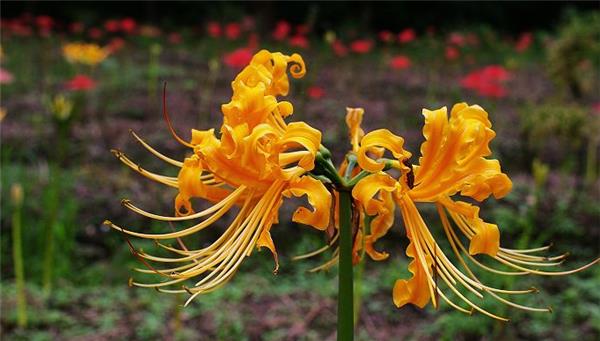
I. Introduction to the Golden Spider Lily
The golden spider lily, also known as iron-colored arrow (per the Compendium of Materia Medica) and yellow-flowered stone garlic, is a plant of the genus Lycoris in the amaryllis family (Amaryllidaceae).
II. Morphological Characteristics of the Golden Spider Lily
Perennial herb. Bulb ovoid, about 5 cm in diameter. Leaves basal, thick in texture, broadly linear, emerging in autumn, sword-shaped, about 60 cm long, up to 2.5 cm at the widest point, gradually narrowing toward the base to about 1.7 cm wide, apex acuminate, with an obvious pale-colored band in the middle. Flower stalk about 60 cm tall; involucral bracts 2, lanceolate, about 3.5 cm long, about 0.8 cm wide; umbel with 4-8 flowers; flowers yellow or orange; tepal lobes with a pale green midrib on the back, oblanceolate, about 6 cm long, about 1 cm wide, strongly recurved and wrinkled, tepal tube 1.2-1.5 cm long; stamens slightly exserted beyond the tepals, about 1/6 longer than the tepals, filaments yellow; upper part of the style rose-red. Capsule three-angled, loculicidal; seeds few, nearly spherical, about 0.7 cm in diameter, black, each locule of the capsule containing several seeds. Flowering period August-September, fruiting period October.
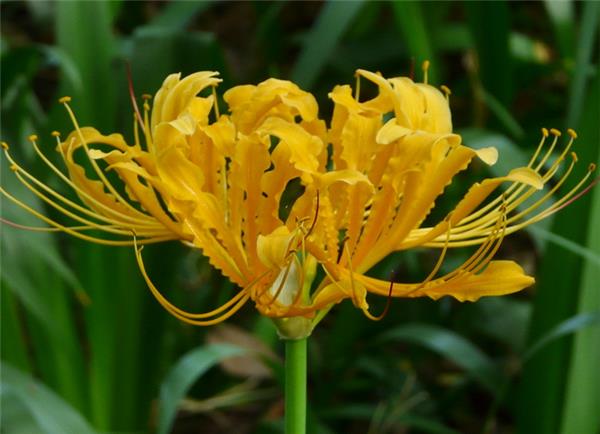
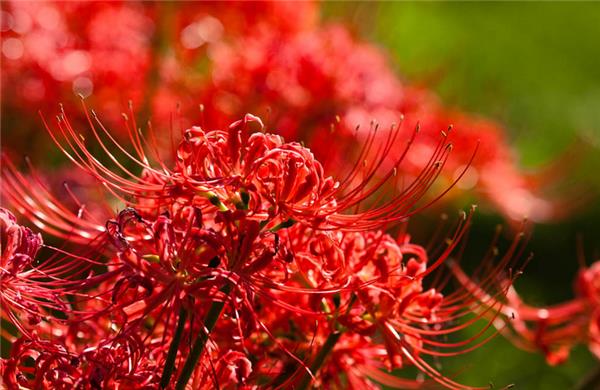
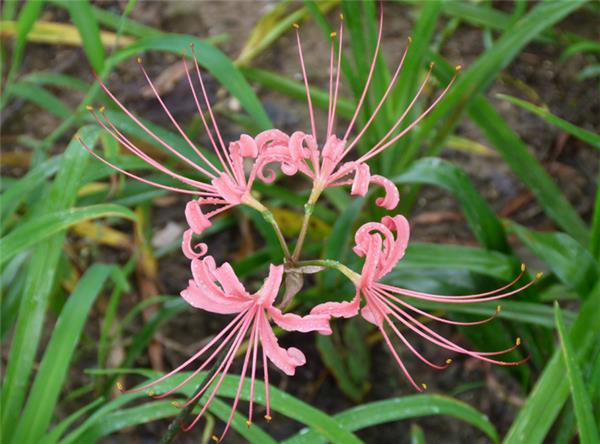
Perennial herb. Bulb broadly elliptical. Leaves emerge in early winter, linear or band-shaped. Flower stalk emerging before the leaves, about 30 cm tall, bearing 4-6 flowers at the top; flowers bright red or with white edges, tepal tube extremely short, upper part 6-lobed, lobes narrowly lanceolate, 4 cm long, margins wrinkled, recurved outward; stamens 6; ovary inferior, 3-locular, style slender. Capsule dehiscing along the back. Seeds numerous. Flowering period September-October, fruiting period October-November. Grows on shady, damp mountain slopes or under forest canopies, and is also cultivated. Stem up to 6 cm tall, composed of 10-20 layers of persistent leaf-sheath bases, outer skin brown. Leaves emerge in autumn, and there are also cases where flowers and leaves emerge together in summer and autumn. Leaves 4-8, sword-shaped, green, leathery, 50-60 cm long, 2-3.5 cm wide, gradually narrowing toward the base and folded, apex acuminate, midrib flat on the upper surface and raised on the back. Flower stalk 60-80 cm tall, some reaching 100 cm, green, sometimes tinged with purple, 5-15 mm thick. Involucral bracts 2, lanceolate, membranous, white, 3-4 cm long, 1-1.5 cm wide, apex acuminate, recurved at full bloom; umbel with 4-9 flowers, each flower with 1 bractlet, bractlet white, linear-lanceolate, 0.5-1.5 cm long, 1-2 mm wide; pedicel green, three-angled, 1 cm long; tepals 7 cm long; tepal tube) cm long; tepal lobes 6, yellow, in an inconspicuous 2 whorls, equal, band-shaped, gathered above, recurved upward, 5-6 cm long, 5-10 mm wide, midrib keeled on the back, apex with a beaked small point, both lateral margins thin in texture, with 3-6 pairs of wavy wrinkles; stamens 6, gathered below, filaments yellow, base fused with the tepal tube, separating at the throat, 6-7 cm long, sometimes reaching 10 cm, extending forward, then curving upward; anthers purplish-brown, linear, 10 mm long, about 1.2 mm wide, dorsifixed and T-shaped, 2-locular, dehiscing outwardly, shrinking and curving downward into a horseshoe shape after dehiscence; style linear, yellow, upper part purple, 9-10 cm long; ovary green, nearly spherical, 3-4 mm long. Capsule three-angled, loculicidal; seeds few, black, nearly spherical, 6-7 mm in diameter, surface with fine tubercles. Flowering period May-August, fruiting period November. Bulb ovoid-spherical, 2-3 cm in diameter, outer skin brown. Leaves emerge in autumn. Leaves band-shaped, over 40 cm long, 1.5-2 cm wide. Involucral bracts 2, lanceolate. Umbel with 3-8 flowers, pedicel 3.5-4 cm long; tepals bilaterally symmetrical, about 7.5 cm long; red, tepal tube up to 1.5 cm long, lobes oblanceolate, 6 cm long, about 1.2 cm wide, apex obtuse; stamens gathered below, apex curving upward, filaments 6.5 cm long, nearly equal in length to the tepals; style 8 cm long.
III. Ecological Habits of the Golden Spider Lily
It grows on shady, damp rocks or in fertile soil beneath stone cliffs. A shade-loving plant, it prefers warm, shady, damp environments, and is also slightly tolerant of cold; it has a habit of summer dormancy and is not particular about soil, but soil rich in humus, moist and well-drained is preferable. It prefers warm, humid environments and grows on shady, damp rocks or in fertile soil beneath stone cliffs. Its cold tolerance is somewhat poor; in the middle and lower reaches of the Yangtze River region, the above-ground parts often wither due to frost damage in winter, but the underground bulb can safely overwinter. It has a habit of summer dormancy, with a flowering period of August-September.
The golden spider lily can also be grown hydroponically for ornamental display like narcissus, offering a unique charm. The method is as follows: after June each year, when the above-ground leaves of the golden spider lily have completely fallen off, dig the bulb out of the soil, taking care to keep the root system as intact as possible, soak the roots in warm water at 25°C-30°C with a little potassium permanganate for 24-36 hours, then plant it in a narcissus bowl or other container with water and fix it in place with crushed stones, and place it indoors in a well-ventilated, well-lit spot; generally it will bloom with beautiful flowers in 10-15 days. During its flowering period, apart from adding water promptly, generally no fertilization is needed. After the flowers fade, the flower stalk can be cut off and the bulb replanted in soil and cared for until the following year. In daily management, the golden spider lily is cold-tolerant, drought-tolerant, and salt-alkali-tolerant, but fears waterlogging and scorching sun; excessive light is the main factor causing it not to bloom. Daily management should pay attention to keeping the soil moist, especially before the flowering period; in case of dry weather, it is also necessary to water thoroughly 2-3 times in succession. During its growing period, some thin, quick-acting chemical fertilizer may be applied as appropriate; when the flower stalk gradually begins to emerge, a thin, well-rotted phosphorus-potassium fertilizer may be applied once more along with watering. As it approaches the dormant period, watering should be gradually reduced and fertilization stopped.
The above is the knowledge about the golden spider lily; I hope it can help you.
When the above-ground leaves of the golden spider lily have completely fallen off, dig the bulb out of the soil, taking care to keep the root system as intact as possible, soak the roots in warm water at 25°C-30°C with a little potassium permanganate for 24-36 hours, then plant it in a narcissus bowl or other container with water and fix it in place with crushed stones, and place it indoors in a well-ventilated, well-lit spot; generally it will bloom with beautiful flowers in 10-15 days. During its flowering period, apart from adding water promptly, generally no fertilization is needed. After the flowers fade, the flower stalk can be cut off and the bulb replanted in soil and cared for until the following year. In daily management, the golden spider lily is cold-tolerant, drought-tolerant, and salt-alkali-tolerant, but fears waterlogging and scorching sun; excessive light is the main factor causing it not to bloom. Daily management should pay attention to keeping the soil moist, especially before the flowering period; in case of dry weather, it is also necessary to water thoroughly 2-3 times in succession. During its growing period, some thin, quick-acting chemical fertilizer may be applied as appropriate; when the flower stalk gradually begins to emerge, a thin, well-rotted phosphorus-potassium fertilizer may be applied once more along with watering. As it approaches the dormant period, watering should be gradually reduced and fertilization stopped.The above is the knowledge about the golden spider lily; I hope it can help you.