The Complete Guide to Growing Kalanchoe: A Detailed Explanation of the Entire Care Process
Many people ask online about how to grow kalanchoe, but how many actually know? Let's take a look together!
An Introduction to Kalanchoe
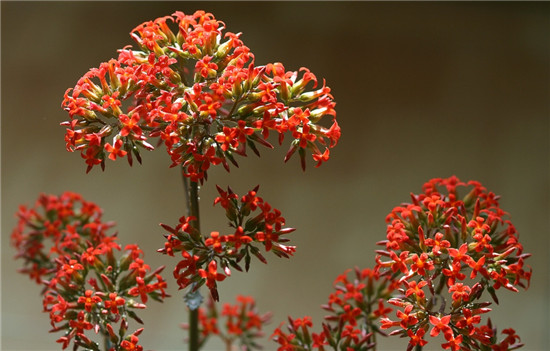
Kalanchoe is a succulent plant, forming low clusters of thick, glossy leaves that stay emerald green all year round. In spring, summer and autumn it is planted in the open ground as a border edging, and from December to April of the following year it produces brilliant, eye-catching flowers. Each flowering stem can bear as many as dozens of flowers, and the blooming period lasts more than 4 months, which is how kalanchoe got its name.
Kalanchoe is a succulent plant of the genus Kalanchoe in the Crassulaceae family, forming low clusters of thick, glossy leaves that stay emerald green all year round. In spring, summer and autumn it is planted in the open ground as a border edging, and from December to April of the following year it produces brilliant, eye-catching flowers. Each flowering stem can bear as many as dozens of flowers, and the blooming period lasts more than 4 months, which is how kalanchoe got its name. It is an ideal potted flower for giving to relatives and elders at New Year's Day and during the Spring Festival.
The Morphological Characteristics of Kalanchoe
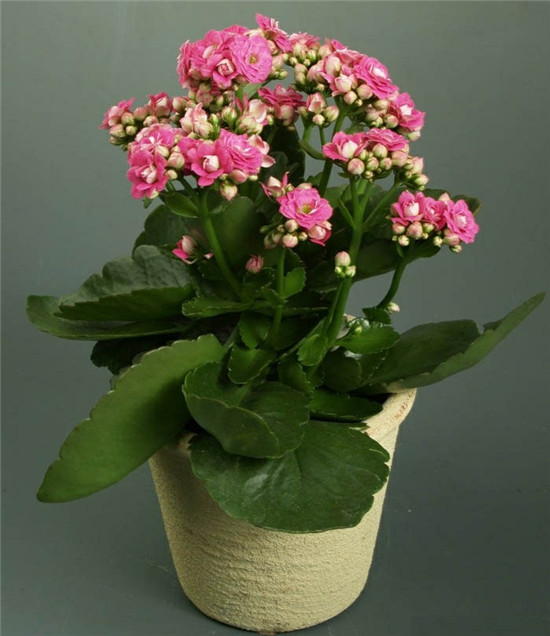
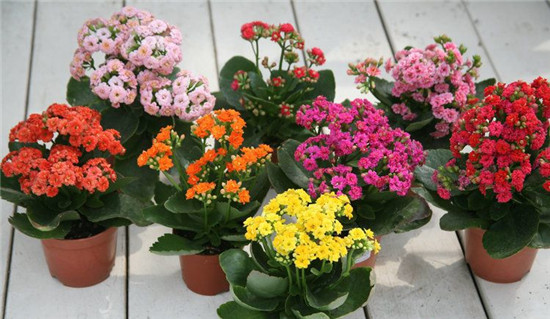
Kalanchoe is a perennial succulent herb. The stems are upright, with a plant height of 10-30 cm. The leaves are fleshy and decussate, elliptical to oblong, dark green and glossy, with slightly reddish edges. Plants grown in round pots bear conical cymes, with flower colours including crimson, peach red, orange red, yellow, orange yellow and white. The corolla is long and tubular, slightly swollen at the base, and the flowering period runs from December of the previous year to the end of April.
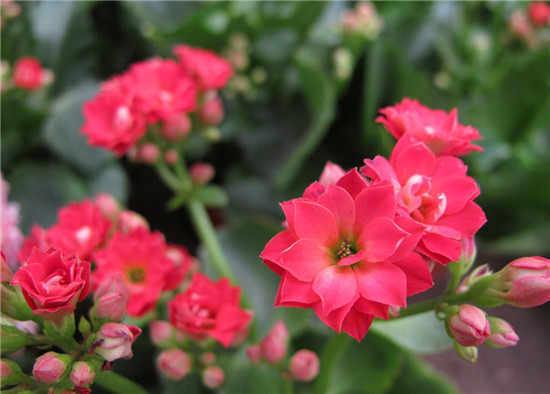
An evergreen perennial succulent herb. The stems are upright, with a plant height of 10-30 cm. The simple leaves are alternate and decussate, ovate, 4-8 cm long and 2-6 cm wide, fleshy, with wavy blunt teeth along the upper leaf margins and entire lower margins, bright green and glossy, with slightly reddish leaf edges. The paniculate cyme is upright, with the inflorescence 7-10 cm long. Each plant has 5-7 inflorescences, bearing 60-250 flowers. The flowers are small, salverform, 1.2-1.6 cm in diameter, with 4 petals, in colours of pink, crimson or orange red. Kalanchoe blooms from January to April.
On Stem Cuttings of Kalanchoe
After flowering or after the summer, old kalanchoe plants should be repotted with fresh soil, otherwise their growth will weaken; at the same time, larger clumps can be cut into several parts with a sharp knife and planted separately. Kalanchoe is an extremely vigorous plant and easily survives. Kalanchoe is mainly propagated by stem cuttings. Cuttings can be taken in any season, with spring and autumn being best. Summer and winter also work, but rooting is slow. When taking cuttings, cut healthy stems with more than four mature leaves; once the wound has dried, the cutting can be inserted. The rooting medium can be anything - perlite, vermiculite, peat, river sand and so on all work; you can also root them in water and then move them into a pot, or simply place them on the surface of moist soil and mist frequently to keep the air humid, which will also induce rooting. From the start of cutting until rooting, shade is required. Since the cuttings do not yet have roots to absorb water, a certain humidity must be maintained. You can cover them with plastic film or mist manually to keep them moist.
On the Growing Period of Kalanchoe
Kalanchoe is drought-tolerant and does not need large amounts of water; follow the principle of watering thoroughly only after the soil has dried out. In winter, when temperatures are low, water must be controlled to avoid root rot. The differentiation period of kalanchoe is from October to November, so during this period the water requirement is not high, and maintaining humidity at around 50% is ideal.
Kalanchoe likes warm winters and cool summers, and fears intense heat and severe cold. During the growing period, a temperature of around 18 degrees is best, with a minimum temperature of 10 degrees. From October onward until before flowering, take care to increase ventilation and light, and the flowers will last longer. In summer, when high temperatures exceed 30 degrees, growth is checked; in winter, room temperature needs to be 12-15 degrees. If room temperature exceeds 24 degrees during the winter and spring flowering period, flowering will be inhibited, while at around 15 degrees it will flower continuously.
In winter, kalanchoe requires sufficient light; if light is insufficient for a long time, the leaves will drop and the flower colours will fade. Also take care to rotate the direction of the pot so that the plant receives light evenly. In summer, strong light must be avoided, and it is best placed in a well-ventilated, semi-shaded spot.
Apart from the Paris series, other varieties grow relatively quickly. During growth, stick to the principle of preferring dry over wet - water only when the soil is nearly dry, and do not let water accumulate in the pot. A semi-shaded environment is most suitable for kalanchoe's growth. A 10-12 cm pot is suitable; a large pot is not conducive to recovering from transplanting or to growth.
Fertilising is not advisable during the recovery period. Once the plant begins vigorous growth, apply light fertiliser frequently; both foliar feed and solid fertiliser are fine. Foliar feeds such as Pervical can be sprayed on the leaves once a week - be careful not to make the solution too concentrated - and solid fertiliser should not be applied too frequently. Stop fertilising during the high temperatures of summer. Some varieties grow rather tall, and sometimes, to keep the plant dwarfed or better shaped, it is best to pinch off the tips to stimulate side shoots and make the plant fuller. Generally, the more side branches, the more flowering branches. In addition, it is not advisable to mix different varieties in one pot, because different varieties grow at different rates, and mixed planting may make the weaker ones even weaker until they eventually disappear.
Points to Note About Kalanchoe
Kalanchoe belongs to the cool-growing type; it grows fastest in spring and autumn, flowers in winter and spring, and is basically dormant in summer. Therefore, in summer you should reduce watering and place it in a cool, ventilated spot to get through the summer.
In addition, in winter, growers in the north should take care to protect kalanchoe from the cold. Although kalanchoe can sometimes tolerate low temperatures of 0 degrees, it is afraid of frost and snow. So northern growers had best place it on an enclosed balcony.
The above is the complete content of my summary of the complete guide to growing kalanchoe and a detailed explanation of kalanchoe care. I hope this article can help everyone. Please also continue to follow us.