Red Cloud at the Horizon: An Introduction to the Chinese Fringe Flower (Red Loropetalum) and Its Cultivation Tips
The Chinese fringe flower (red loropetalum) is a beautiful tree with a brilliant red color that is very eye-catching and lovely in summer and autumn. Now let us take a look at what we know about the Chinese fringe flower.
I. Introduction to the Chinese Fringe Flower
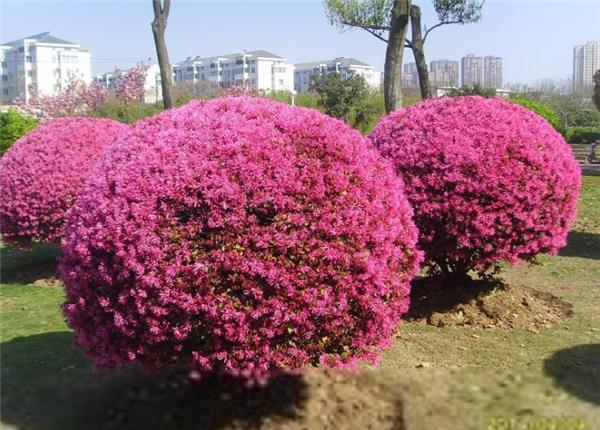
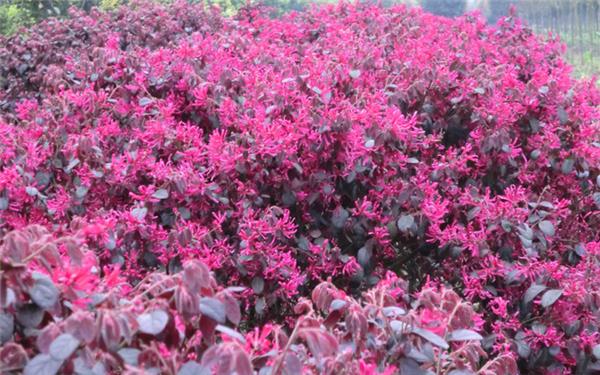
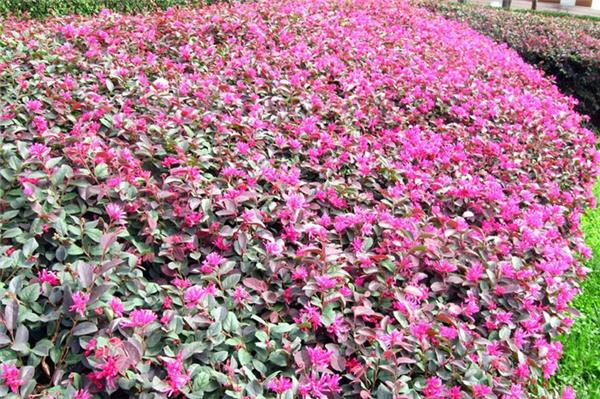
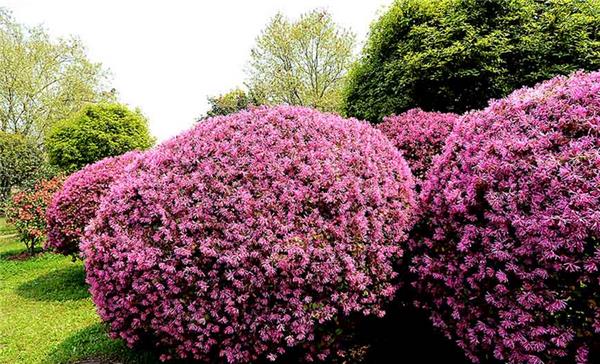
The Chinese fringe flower has bark that is dark gray or light grayish-brown, with many branches. The young twigs are reddish-brown and densely covered with stellate hairs. The leaves are leathery, alternate, ovate or elliptic, 2-5 cm long, with a short pointed tip and a rounded, oblique, asymmetrical base; both surfaces bear stellate hairs, the margins are entire, and the color is dark red. The flowers have 4 petals, purplish-red, linear, 1-2 cm long, and 3-8 flowers are clustered at the tips of the small branches. The capsule is brown and nearly ovoid. The Chinese fringe flower blooms from April to May, with a long flowering period of about 30-40 days, and can bloom again around National Day. The 3-8 flowers are clustered on a common peduncle in terminal head-like inflorescences and are purplish-red. The fruiting period is August. It is mainly distributed in the middle and lower reaches of the Yangtze River and areas to the south, and in northern India. The flowers, roots and leaves can be used medicinally.
II. Cultivation Methods for the Chinese Fringe Flower
Potting Methods and Management
1. Potting up
Transplanting nursery-raised seedlings or field-grown tree stumps into flower pots is called potting up. The specific method is as follows: according to the different grades of seedlings or the height of the tree stumps, the size of the crown and the distribution of the root system, choose flower pots of a suitable size; use two suitably sized tile pieces to cover the two sides of the drainage hole at the bottom of the pot (without completely covering the opening), then place one more large tile piece over the opening, just enough to cover it, or arrange three tile pieces in an overlapping tile pattern over the drainage hole; when filling with soil, first place the sieved coarse particles at the bottom of the pot, then add the growing medium on top; when the fill reaches 1/3 of the pot height, you can begin to move the seedling in. If it is a bare-root transplant, make the center of the pot soil mound-shaped so that the root mass spreads downward and does not curl; when the growing medium is filled to about 3.5 cm from the rim of the pot, gently shake the pot so that the soil settles, and press lightly with your hands on the soil on both sides of the seedling so that the young plant keeps an upright posture. After moving it into the greenhouse, water the pot soil thoroughly with a fine-hole watering can so that the soil and root mass are in close contact. Before new roots have formed, do not shake the pot at will, so as not to affect rooting.
2. Repotting
The operation of moving a potted plant into another pot is called repotting. Generally there are two different situations for repotting: first, as the seedling grows, the root mass no longer has room to spread in the pot soil, so growth is restricted, and some roots often grow out through the drainage hole or are exposed above the surface; at this time it should be moved from a small pot into a larger pot. Second, for a plant that has already fully grown, there is no need to change to a larger pot; it is simply that after many years of cultivation, the original pot soil, through the selective absorption by the plant, retains a large amount of toxic substances (trioxides), which makes the physical and chemical properties of the soil deteriorate, and the entire pot soil becomes filled with old roots. At this time, repotting is only for trimming the root system, and when repotting only the growing medium is replaced; the pot need not be changed.
In addition, when going from a small pot to a large pot, one should gradually move it to a larger pot according to the size of the plant's development, and must not change directly to a large pot in one step. This is because doing so not only wastes labor and materials and costs more, but also makes water difficult to regulate, causes poor aeration of the plant roots, and results in weak growth or even excessive vegetative growth, delayed flower bud formation and a lower flowering rate. Greenhouse flowers grow rapidly, and generally need to be repotted 2-3 times before flowering. More frequent repotting can make the plant strong and full in growth, lower the plant height and make the plant compact, but it will delay flowering. The last repotting before flowering is called final planting. For established red-flowered plants, potted flowers and bonsai, repot once every 2-3 years; if there are special needs, they can be repotted at any time or given an outer decorative pot to enhance their ornamental value. When repotting, spread the fingers of the left hand and press them on the base of the plant at the pot surface, lift the pot and turn it upside down, and lightly tap the rim of the pot with the right hand, and the pot soil can then be taken out. If it is not easy to remove, use an iron stick to gently pry around the pot, then turn the pot sideways, use the iron stick to push the tile piece over the drainage hole, and then invert the flower pot as before, and the pot soil with roots can be lifted out. After the pot soil is removed, scrape off part of the original soil from the plant, and cut off excessive and overly long old roots, dead roots and coiled roots, but the twisted and interlacing roots on the surface of the bonsai should be kept as they are and must not be thinned out, otherwise the vigorous and antique ornamental value will be damaged.
3. Turning the pot
Turning the pot is done to regulate the light received by potted flowers in the greenhouse and to control and balance the growth vigor of the whole plant. In a single-slope greenhouse or an unequal-slope greenhouse, light mostly enters from the south, so potted flowers placed in the greenhouse for too long often lean toward the direction from which the light comes because of phototropic growth. The degree and speed of this leaning are closely related to the growth rate of the plant; potted flowers with a fast growth rate also lean more and faster. In order to prevent the tilted growth of potted flowers and the destruction of the plant's originally symmetrical and rounded shape, the direction of the flower pot should be changed after a certain number of days so that the plant tends to develop normally. For flower pots placed in the open field, the phenomenon of phototropic growth is not very obvious; turning the pots at fixed times is mainly to prevent the plant roots from growing through the drainage hole into the ground. If the pot is moved after too long a time, the roots extending outside the pot will be broken, affecting the normal growth of the potted flowers.
4. Loosening the pot soil
Loosening the pot soil can make loose the soil on the pot surface that has become compacted by continual watering, which is beneficial to gas exchange and plant growth, and can also remove moss and weeds on the pot surface. The formation of moss affects the circulation of air at the pot surface and is unfavorable to plant growth; moreover, once the pot surface is covered by moss, it is difficult to judge the moisture condition of the pot soil, making timely watering inconvenient. But some people also believe that moss can indicate whether the pot soil is dry or wet: yellow moss means lack of water, green moss means there is water, and it can also retain water and increase the beauty of the bonsai. Loosening the soil is an objective necessity, and for small and medium potted flowers it is still better to remove the moss. Use an iron stick or a bamboo strip to loosen the soil, gently prying the surface soil, but do not pry at the whole plant, to prevent root damage that causes wilting.
5. Fertilizing
When potting up or repotting, base fertilizer is often applied, and during the growing period, topdressing is applied.
The above is what we know about the Chinese fringe flower. I hope it can help you.
the plant leans toward the direction from which the light comes. The degree and speed of this leaning are closely related to the growth rate of the plant; potted flowers with a fast growth rate also lean more and faster. In order to prevent the tilted growth of potted flowers and the destruction of the plant's originally symmetrical and rounded shape, the direction of the flower pot should be changed after a certain number of days so that the plant tends to develop normally. For flower pots placed in the open field, the phenomenon of phototropic growth is not very obvious; turning the pots at fixed times is mainly to prevent the plant roots from growing through the drainage hole into the ground. If the pot is moved after too long a time, the roots extending outside the pot will be broken, affecting the normal growth of the potted flowers.4. Loosening the pot soil
Loosening the pot soil can make loose the soil on the pot surface that has become compacted by continual watering, which is beneficial to gas exchange and plant growth, and can also remove moss and weeds on the pot surface. The formation of moss affects the circulation of air at the pot surface and is unfavorable to plant growth; moreover, once the pot surface is covered by moss, it is difficult to judge the moisture condition of the pot soil, making timely watering inconvenient. But some people also believe that moss can indicate whether the pot soil is dry or wet: yellow moss means lack of water, green moss means there is water, and it can also retain water and increase the beauty of the bonsai. Loosening the soil is an objective necessity, and for small and medium potted flowers it is still better to remove the moss. Use an iron stick or a bamboo strip to loosen the soil, gently prying the surface soil, but do not pry at the whole plant, to prevent root damage that causes wilting.
5. Fertilizing
When potting up or repotting, base fertilizer is often applied, and during the growing period, topdressing is applied.
The above is what we know about the Chinese fringe flower. I hope it can help you.