Winter Jasmine Bonsai: How to Make It and Branch and Foliage Pruning Tips
Winter jasmine is not only elegant and lovely in flower, but also has the fine quality of not fearing the cold, making it one of people's favorite plants. Next, let us take a look at how to make a winter jasmine bonsai and prune its branches and foliage!
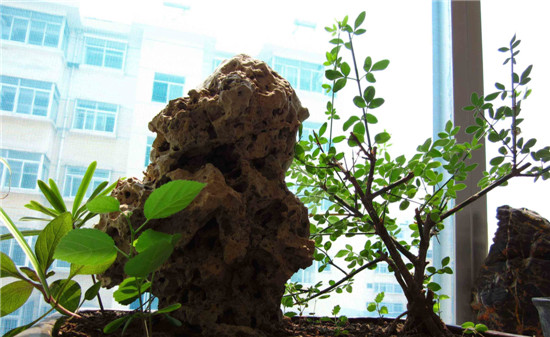
The materials for making a winter jasmine bonsai are mainly artificially cultivated plants and thick old stumps dug up in the wild, because it tolerates pruning well and has strong sprouting ability. Heavy pruning can be used: after the plant grows to about 0.3 m or reaches a certain design requirement, cut off the terminal buds and develop a certain crown. Or through certain shaping and pruning, remove the basal buds at the roots at any time to encourage more branching and flowering.
When digging in the wild, the priority is to protect the roots, keeping the root system as intact as possible, removing damaged and dead roots, straightening out the roots, planting deeply in a pot, and gradually exposing the roots. The method for exposing the roots is: fill the lower half of the pot with nutrient soil, and add fine sandy soil to the upper half. When planting, first bury all the roots in the pot, then firm the soil, water thoroughly, and carry out careful management.
After a period of cultivation, the root system develops normally, fibrous roots grow in the growing medium, and the plant is already deep-rooted and lush. At this point, the fine sandy soil can gradually be removed so that the upper roots slowly become exposed. After another period of cultivation, the exposed roots have gradually aged, and the lateral roots are also relatively thick. At this point, the plant can be moved into a shallow pot. When transplanting, fully protect the roots and bring the original growing medium along. In this way, a winter jasmine bonsai with exposed hanging roots and claws, quaint and vigorous, can gradually be cultivated.
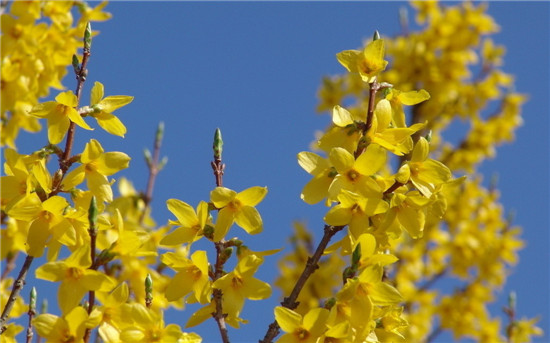
How to make a winter jasmine bonsai:
1. Choosing a flower pot
For winter jasmine bonsai, it is generally suitable to use purple clay ceramic pots or glazed ceramic pots in medium-to-deep colors. The shape of the pot is determined according to the styling of the winter jasmine bonsai. For a cascade-style winter jasmine bonsai, a deep cylindrical pot can be used; sometimes, to emphasize the beauty of the roots, a shallow pot is also used. The pot color is best chosen to set off the beauty of the winter jasmine's small yellow flowers, such as dark blue, light blue, black, or purple-red.
2. Bonsai styling
Because winter jasmine's branches naturally droop and its roots have distinctive features, it is very suitable to train into a weeping-branch style and an exposed-root style, and the two are often combined: the roots are coiled and exposed, while the trunk is made into a lying-trunk style or curved-trunk style, with small branches drooping and brushing, giving it a unique charm.
3. Pruning methods
After digging up the winter jasmine, cut off the branches, because if there are too many branches while the roots are damaged, it will die; if the branches are too short, the buds are not easily induced to sprout. Expose one third of the roots and plant it firmly. After planting, place it in a shady place and do not expose it to strong sunlight. Be careful not to water too much. Wait until it survives, then look at the winter jasmine's styling and prune appropriately. The growth of winter jasmine branches must be controlled; if they are too long, it will affect the treatment of the overall shape.
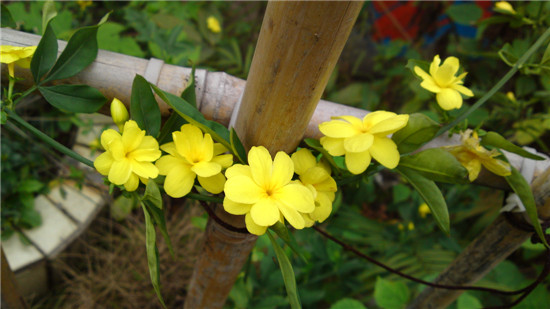
4. Repotting techniques
Winter jasmine is generally repotted once every two years, preferably in spring or after leaf fall in autumn. When repotting, root pruning can be combined with it: cut off dead roots and overly long roots to promote the development of fibrous roots. Bean cake crumbs can also be placed at the bottom of the pot as a base fertilizer. For winter jasmine that needs root exposure, the roots can be lifted appropriately when planting, and soil mounded around the roots; later, as watering leaches the soil, the roots will naturally become exposed.
Points to note when pruning a winter jasmine bonsai
Winter jasmine likes light and tolerates drought and cold. It is not demanding about soil, and a neutral sandy loam with good drainage is preferable; it can also adapt to slightly acidic soil or lightly saline-alkaline soil, and does not tolerate waterlogging. For winter jasmine bonsai, leaf mold mixed with loam can be used, or fully decomposed vegetable garden soil, which is rich in nutrients and loose and soft in texture, suitable for the growth and development of winter jasmine bonsai.
A winter jasmine bonsai needs pruning to regulate tree vigor and save nutrients, so that the branches are evenly distributed and the crown is neat and beautiful, and more importantly, so that it favors more flowering. Whether the timing of pruning winter jasmine is appropriate is a key part of growing winter jasmine well.
Winter jasmine flower buds form on the previous year's branches, so pruning is not suitable in either autumn or winter. If pruned at this time, the branches formed in summer that bear flower buds will be cut off, resulting in no flowers to bloom. The most suitable time to prune a winter jasmine bonsai is within 10 days after all the flowers have withered, leaving two to three buds per branch.
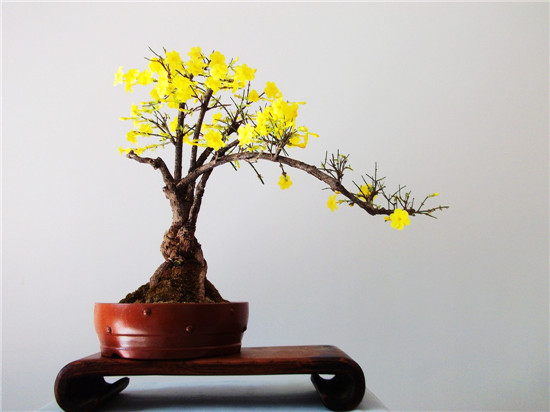
After the winter jasmine bonsai finishes flowering in spring, prune once, cutting off all the current year's branches and leaving 1-2 buds. After it grows for a period, prune once more, and according to how evenly the branches of the stump crown are distributed, cut off the weak branches. If the branches grow too fast, another short back pruning can be done in late March or early April; after lateral buds grow, remove one lateral bud according to the growth direction of the branch.
In early June, the winter jasmine bonsai should have unwanted wheel branches, reverse branches, and overlapping branches cut off, and areas where shoots are too dense should be thinned appropriately to allow light through. When pruning and training a winter jasmine bonsai, the new shoots must strictly follow the natural laws of plant growth, fully embodying the combination of the plant's natural beauty and artificial beauty.
After two to three years of pruning and training, a winter jasmine bonsai with roots replacing the trunk, aged and full of variety, will appear before your eyes. After the shape is set, excess branches and foliage must be thinned every year to keep the tree shape unchanged.
The above is all the content I have summarized for you on making a winter jasmine bonsai and pruning its branches and foliage. I hope this article can help everyone. Please also continue to follow us.
Prune once more, and according to how evenly the branches of the stump crown are distributed, cut off the weak branches. If the branches grow too fast, another short back pruning can be done in late March or early April; after lateral buds grow, remove one lateral bud according to the growth direction of the branch.In early June, the winter jasmine bonsai should have unwanted wheel branches, reverse branches, and overlapping branches cut off, and areas where shoots are too dense should be thinned appropriately to allow light through. When pruning and training a winter jasmine bonsai, the new shoots must strictly follow the natural laws of plant growth, fully embodying the combination of the plant's natural beauty and artificial beauty.
After two to three years of pruning and training, a winter jasmine bonsai with roots replacing the trunk, aged and full of variety, will appear before your eyes. After the shape is set, excess branches and foliage must be thinned every year to keep the tree shape unchanged.
The above is all the content I have summarized for you on making a winter jasmine bonsai and pruning its branches and foliage. I hope this article can help everyone. Please also continue to follow us.