What Is a Water-Colored Hyacinth? Variety Introduction and Growing Methods
Hyacinth is a common flowering plant, and many people grow hyacinths in their homes. Next, let us take a look at the water-colored hyacinth and how to grow it!
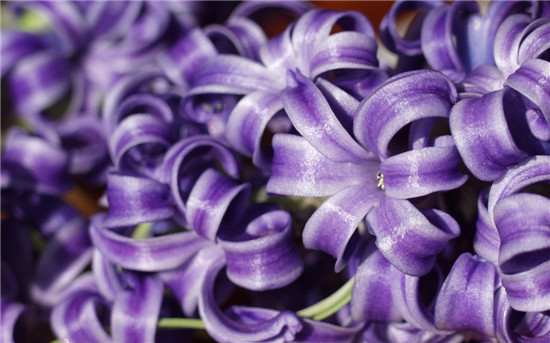
The water-colored hyacinth, also known as sea daffodil, western daffodil, five-colored daffodil and shiyangjin, is a perennial herbaceous bulbous plant. Its bulb is egg-shaped with a membranous outer skin, and the color of the skin membrane is positively correlated with the flower color. Before blooming, it looks like garlic. It originates from the Mediterranean coast and the Asia Minor region, and is currently the most fragrant variety among the flowering plants discovered by research. It prefers a sunny and relatively moist growing environment and requires well-drained, fertile sandy loam soil.
The water-colored hyacinth is a perennial herbaceous bulbous plant. Its bulb is egg-shaped with a membranous outer skin, and the color of the skin membrane is positively correlated with the flower color. Before blooming, it looks like garlic. It has 4-9 leaves, narrowly lanceolate, fleshy, with a groove on the surface, green and glossy. The flower stem is fleshy, 15-45 cm long, with a terminal raceme. 10-20 small flowers are densely arranged on the upper part, horizontal or drooping, funnel-shaped, with a tubular perianth that is four-lobed and recurved at the upper part. It comes in colors such as purple, rose red, pink, yellow, white and blue, and bears capsules. Its natural flowering period is March to April.
The water-colored hyacinth likes sunlight and is cold-tolerant. It is suitable for growing in a cool, moist environment and in loose, fertile sandy soil, and it dislikes waterlogging. It prefers a warm, moist winter and a cool, slightly dry summer, in a sunny or semi-shaded environment. It likes fertilizer and is suited to fertile, well-drained sandy loam soil. It can be planted in the ground, in pots or in water.
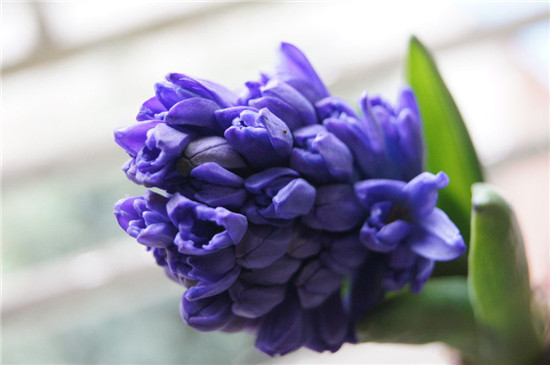
The flower language of the water-colored hyacinth:
The flower language of the water-colored hyacinth: may the one I love deeply be happy forever.
The water-colored hyacinth is actually the blue hyacinth. This is a problem caused by translation. For example, the flower language of the dark blue hyacinth that you see is "somewhat melancholy because of love," while the flower language of the water-colored hyacinth is "I hope the person I love can be happy," which shows that such love no longer belongs to oneself and likewise carries a meaning of melancholy. On closer thought, the meanings the two are trying to express are actually quite similar. In addition, some people also say that the flower language of the water-colored hyacinth includes "joy, affection, and deep tenderness."
Purple hyacinth: sadness, jealousy.
White hyacinth: love that one dares not reveal.
Red hyacinth: thank you.
Yellow hyacinth: I am very happy.
Dark blue hyacinth: somewhat melancholy because of love.
Light purple hyacinth: gentle temperament, romantic feelings.
Peach-pink hyacinth: passion, hoping to gain the other person's friendship.
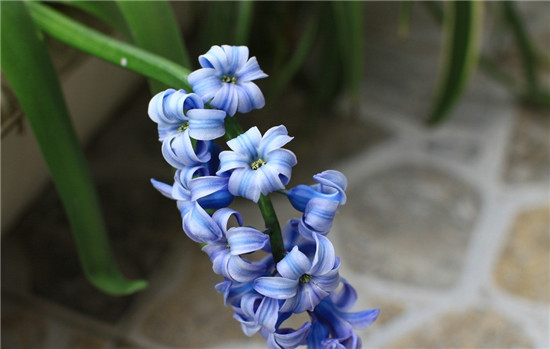
How to grow hyacinths in water
1. There should be a space of 1 cm to 2 cm between the water surface and the bottom of the bulb. Never let the water cover the bottom of the bulb.
2. The water temperature should not be high; below 15°C is better.
3. Place the bulb on the neck of the bottle. After roots develop, the water level can be lowered until the roots just touch the water surface. This allows the roots to fully absorb oxygen and promotes the growth of root hairs. After the roots develop, cover the growing container with black cloth to let the bulb develop further.
4. Do not place it in direct sunlight before the bulb sprouts.
5. When the sprout grows to 5 cm, place it in a dark place. After the roots have fully grown, place it in a warm place without direct sunlight, and add water frequently so that the water reaches the bulb.
6. When the leaves and flower buds grow, expose it to sunlight for one to two hours each day to make the leaves and flower stems sturdy. Turn it to a different direction every day so that it does not grow leaning to one side. No fertilization is needed, and in March or April of the following year it will bloom into a bright, fragrant hyacinth.
7. At a temperature kept between 17°C and 20°C in your home, you will enjoy the process of the buds growing and coloring. But do not place them directly near a heat source; in this way, the beautiful hyacinth flowers can remain in bloom longer.
8. When growing in clear water, change the water once a week. When growing with nutrient solution, change it according to how cloudy it becomes, and keep the water quality in the bottle clean.
The above is all the content I have summarized for you on the introduction to water-colored hyacinths and how to grow them. I hope this article can help everyone. Please also continue to follow us.